A weak monsoon can disrupt sowing and reduce crop yields, putting pressure on farm incomes and loan repayments. The article traces how rainfall deficits can also strain State finances as demand for drought relief rises.
UPSC relevance:
|
Prelims GS Paper I |
Geography, Agriculture and Economy · Indian monsoon, El Niño, kharif and rabi seasons, and disaster response and mitigation funds |
|
Mains GS Paper I |
Physical Geography · Monsoon variability, rainfall distribution and regional drought vulnerability |
|
Mains GS Paper II |
Polity and Governance · Finance Commission, fiscal federalism and Centre–State coordination in drought relief |
|
Mains GS Paper III |
Agriculture, Economy and Disaster Management · Rainfall shocks and crop output, farm incomes, rural credit, farm-loan waivers, drought preparedness and disaster financing |
From Rainfall Deficit to Reduced Sowing
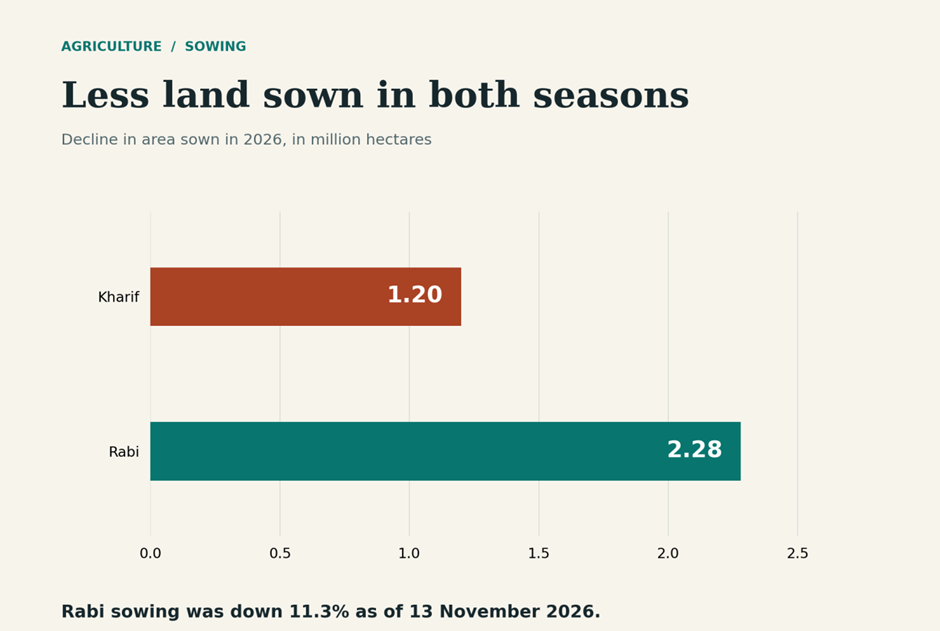
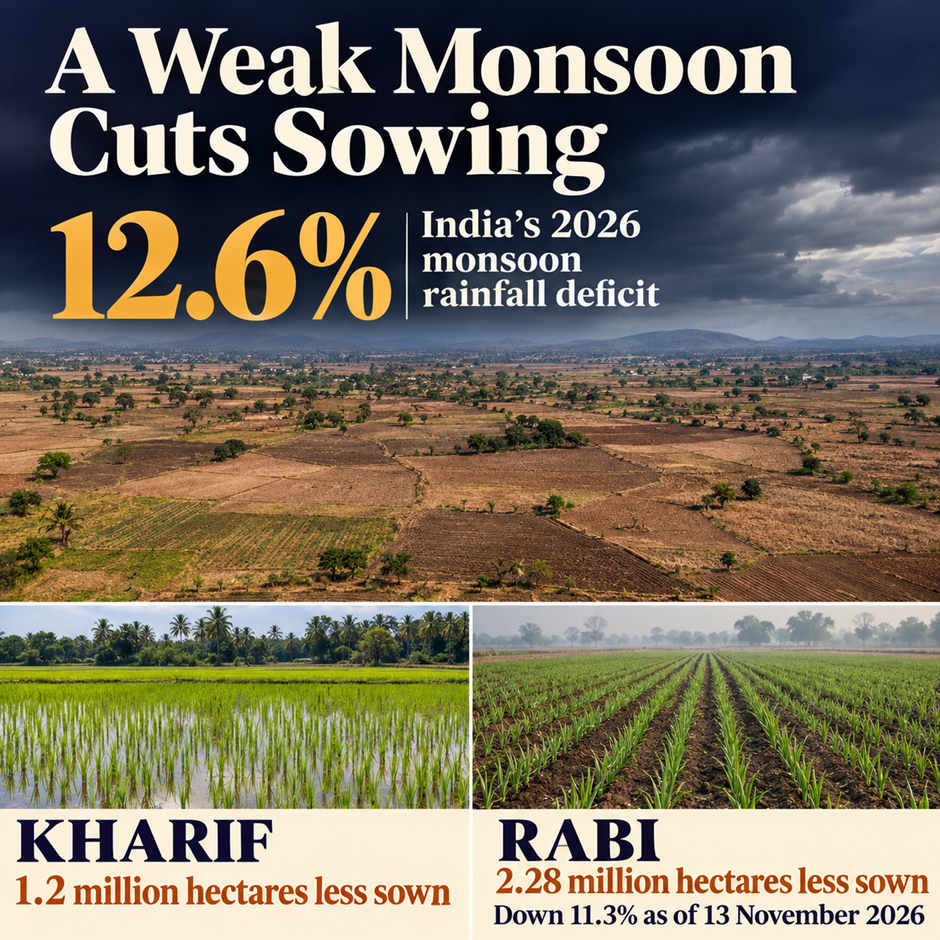
India recorded a 12.6% monsoon rainfall deficit. In 2026, the area sown under kharif crops declined by 1.2 million hectares, while the area sown under rabi crops was down 11.3% (2.28 million hectares) as of 13 November. Reduced sowing across both seasons could affect agricultural output, farm incomes and rural credit.
Where Is the Risk Concentrated?
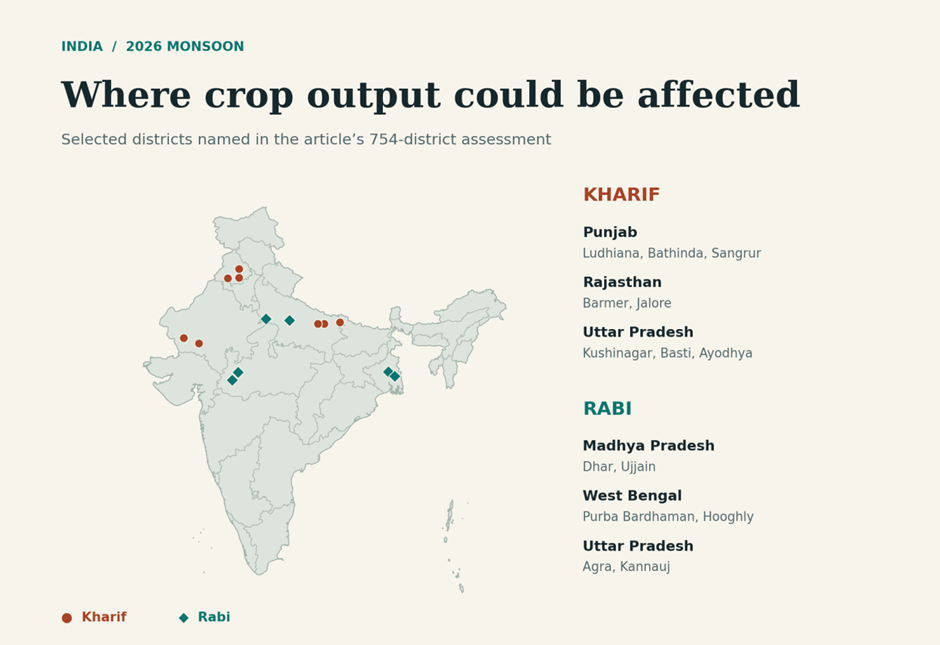
The impact of deficient rainfall varies by district and cropping season. An assessment of 754 districts combined 2026 rainfall deviations with district-level agricultural production data to identify areas where crop output could be affected.
|
Cropping season |
Districts where crop output could be affected |
|
Kharif |
Uttar Pradesh — Kushinagar, Basti and Ayodhya. Rajasthan — Barmer and Jalore. Punjab — Ludhiana, Bathinda and Sangrur. |
|
Rabi |
Madhya Pradesh — Dhar and Ujjain. West Bengal — Purba Bardhaman and Hooghly. Uttar Pradesh — Agra and Kannauj. |
The assessment also identified substantial exposure in Maharashtra, Gujarat, Telangana, Andhra Pradesh and Karnataka. The differences between kharif and rabi show why district-level, season-specific assessments matter for targeting agricultural support.
What Could the Rainfall Deficit Cost Agriculture?
Rainfall deficits concentrated in key agricultural districts could reduce crop output. A scenario-based assessment using district-level rainfall deviations estimates a potential combined loss of about 26 million tonnes across kharif and rabi crops. It also estimates that 13.5 million hectares of seasonal cropped area could be affected.
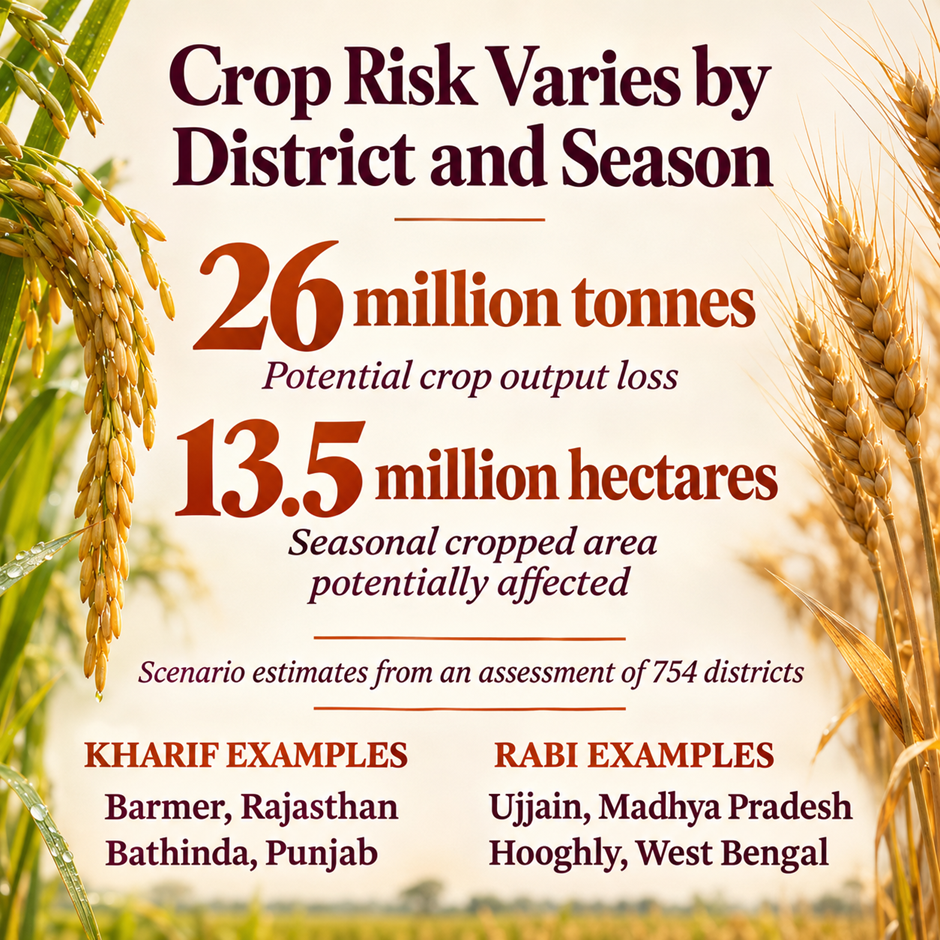
During the 2015–16 El Niño, 29.89 million hectares were reported as drought-affected, more than twice the area estimated to be at risk in the current assessment. The 1965–66 and 2002–03 episodes illustrate how severe production losses can be, with foodgrain output falling by 19% and 17.9%, respectively.
From Crop Losses to Rural Credit Stress
Rainfall deficits can reduce crop output and farm incomes, weakening farmers’ ability to repay existing loans. This can strain rural banks’ agricultural loan portfolios and make it harder for farmers to obtain fresh institutional credit for the next cropping season.
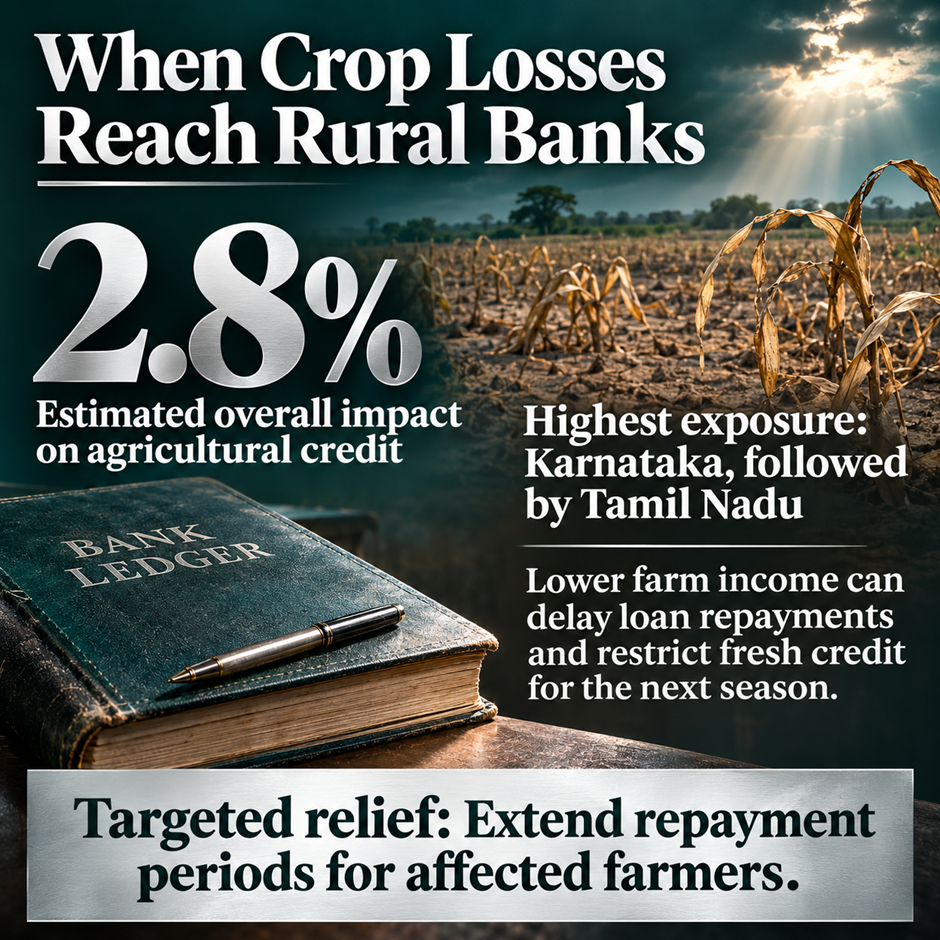
The district-level Climate–Credit Exposure Index combines rainfall stress with the relative importance of agricultural credit. It identifies the highest concentration of exposure in Karnataka, followed by Tamil Nadu. Exposure is also relatively high in Punjab, Telangana, Gujarat, Haryana and Maharashtra. The assessment estimates the overall impact on agricultural credit at 2.8%, with risks concentrated in areas where rainfall stress and agricultural lending overlap.
Can State Budgets Absorb the Shock?
Rainfall shocks place an additional fiscal burden on state governments by increasing the need for drought relief and mitigation. The 16th Finance Commission recommended a combined corpus of ₹2.04 lakh crore for the State Disaster Response Fund (SDRF) and the State Disaster Mitigation Fund (SDMF) for 2026–27 to 2030–31. Of this, ₹1.64 lakh crore is for response and relief, and ₹40,880 crore is for mitigation.
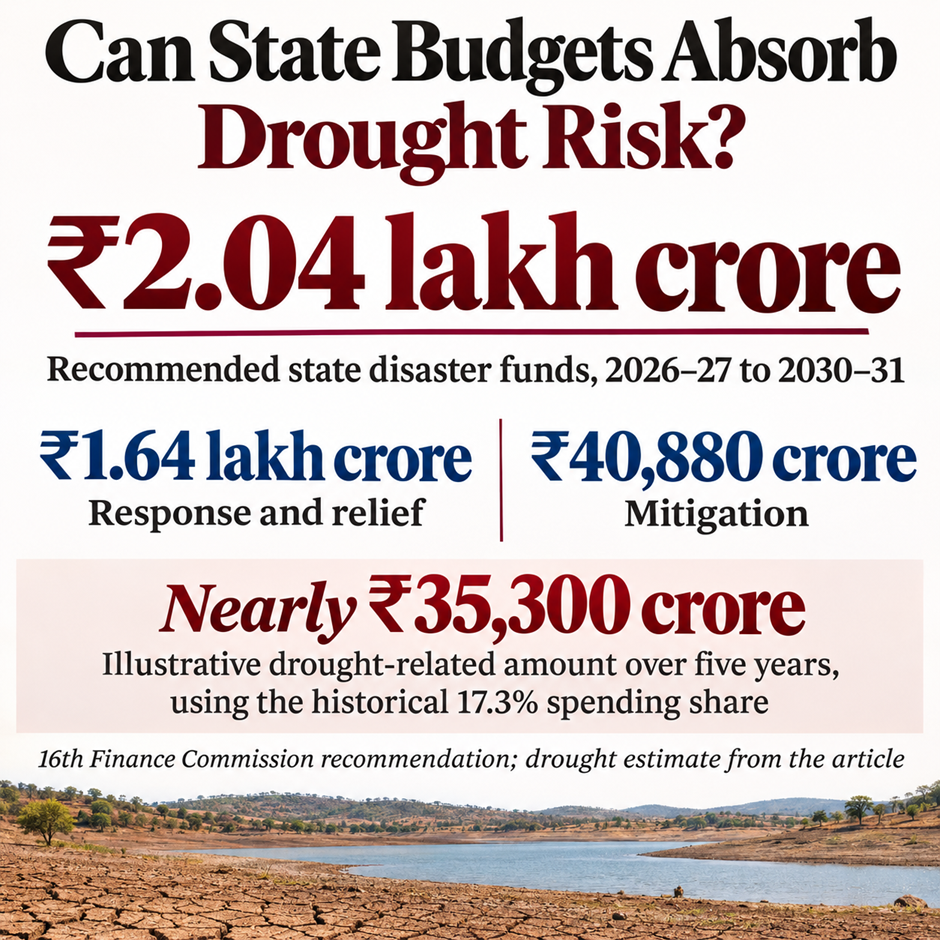
Drought accounted for 17.3% of state disaster-related expenditure between 2019–20 and 2023–24. Applying this historical share to the recommended corpus yields an illustrative estimate of nearly ₹35,300 crore over five years. This indicates the scale of resources that drought-related pressures could absorb and highlights the need to assess whether states have adequate fiscal capacity to manage rainfall shocks.
For Maharashtra, Rajasthan, Andhra Pradesh, Karnataka and Tamil Nadu, the assessment estimates a drought-related resource requirement of ₹13,776 crore over the Finance Commission’s award period. It also estimates that these five states would need an additional ₹32,775 crore to meet the projected fiscal burden.
The 2014–15 Drought and Centre–State Coordination
Past droughts illustrate the role of Centre–State coordination in disaster financing. During the 2014–15 drought, five states sought assistance from the National Disaster Response Fund (NDRF). The Centre approved ₹3,347 crore in combined drought relief for Haryana, Uttar Pradesh, Karnataka, Maharashtra and Andhra Pradesh. This experience highlights the need for states to strengthen drought preparedness and make adequate budgetary provisions for recurring rainfall shocks.
Targeted Farm Relief and Drought Preparedness
Farm-loan waivers can provide immediate relief to indebted farmers, but repeated blanket waivers can strain state finances. A more targeted approach is for banks to extend repayment periods for farmers affected by rainfall shocks. State governments could share part of the cost of this relief, easing repayment pressure on affected farmers.
States should also make adequate budgetary provisions for timely assessment of crop losses and drought mitigation. This would help them respond to agricultural distress while managing the fiscal burden of recurring rainfall shocks.
Map Economic Risks and Finance Resilience
India’s response to El Niño and rainfall variability should extend from measuring rainfall deficits to mapping economic risks and financing drought preparedness. District-level estimates show how rainfall shocks can reduce crop output, weaken farmers’ repayment capacity and increase pressure on state finances.
An integrated approach should combine district-level risk assessment, targeted disaster relief, continued access to agricultural credit and preventive investment. This can help states direct support to the most affected districts and reduce the burden of future rainfall shocks on farmers, rural economies and state budgets.
-