The article uses tea to trace how pesticide residues can pass from farms into food and where gaps in monitoring and enforcement can arise. It explains the difference between the legal residue limit in food and the amount considered acceptable to consum
UPSC relevance:
|
Mains — GS Paper II |
Governance — Statutory bodies, regulatory coordination and implementation of food safety standards |
|
Mains — GS Paper III |
Agriculture and Food Processing — Pesticide use, residue monitoring, food supply chains and agricultural export compliance |
Industry experts point to a gap between India’s food safety standards and the conditions under which farmers use pesticides. The challenge is to protect public health while setting residue limits that reflect crop-specific evidence, can be enforced on the ground and allow producers to meet domestic and export requirements.
Who regulates what?
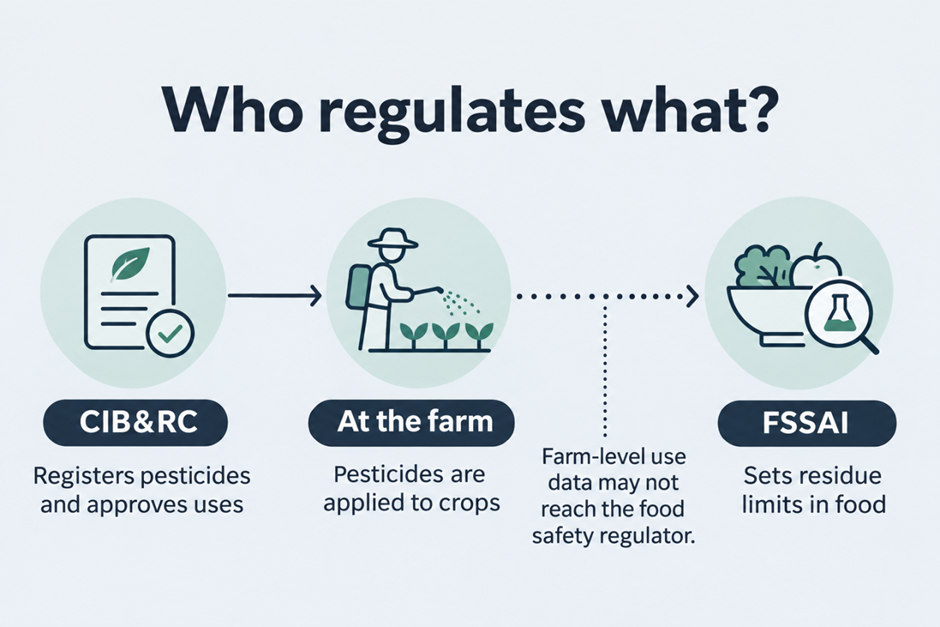
The Food Safety and Standards Authority of India (FSSAI) is a statutory body under the Ministry of Health and Family Welfare. It sets food safety standards and regulates food manufacture, storage, distribution, sale and import to protect public health.
The Ministry of Agriculture and Farmers Welfare oversees agricultural practices, while the Central Insecticides Board and Registration Committee (CIB&RC) oversees pesticide registration and approved uses. FSSAI sets food residue standards, but it lacks direct access to farm-level pesticide-use data and does not enforce pesticide rules at the point of application.
This division can leave FSSAI reliant on secondary data, international benchmarks and limited studies. Such evidence may fail to capture off-label use, where a pesticide is applied to a crop for which it is not approved, or cumulative dietary exposure through several foods. Coordination can connect farm-level pesticide use and residue data with food safety standards, sampling and enforcement across the supply chain.
The default limit dilemma
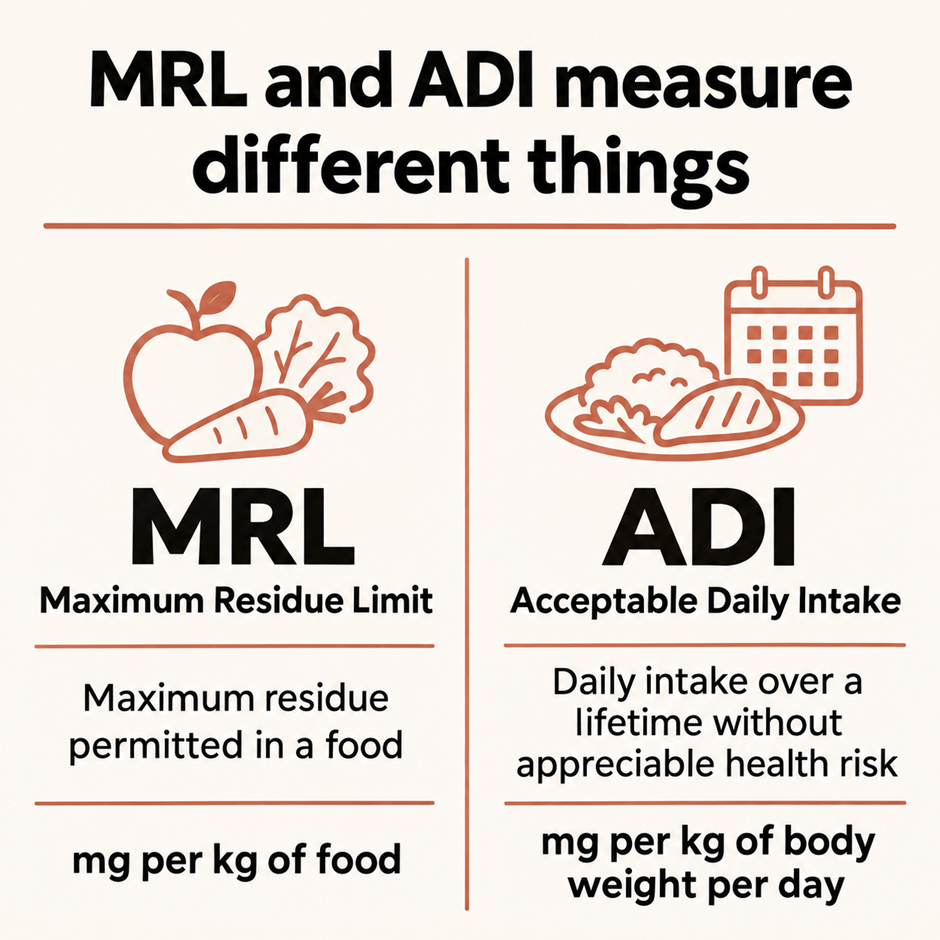
A Maximum Residue Limit (MRL) is the maximum pesticide residue permitted in a food, usually expressed in milligrams per kilogram (mg/kg). Acceptable Daily Intake (ADI) estimates the amount a person can consume daily over a lifetime without appreciable risk to health. An MRL applies to a particular food, while ADI helps assess exposure across the diet.
FSSAI has set specific MRLs for only some pesticide–crop combinations. Under the framework discussed in the article, a default tolerance limit of 0.01 mg/kg applies where a specific MRL is absent. Without crop-specific residue and risk data, a uniform default can create compliance difficulties, especially in tea and spices, where few pesticides are formally approved. Applying it to finished products can lead to the rejection of entire consignments.
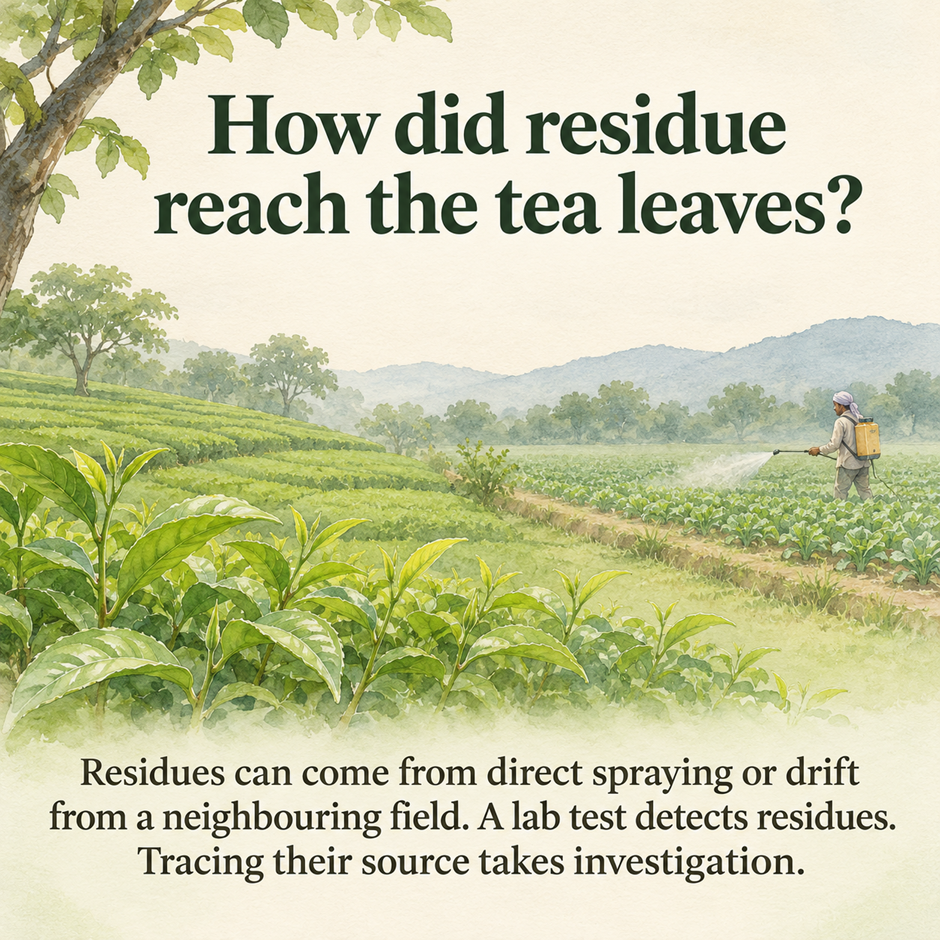
Residues can result from off-label use or unintended contamination, such as spray drift from neighbouring fields. Testing can detect residues, but identifying their source requires further investigation. At the same time, limited guidance and easy access to cheaper unapproved or banned chemicals can lead farmers to choose pesticides based on cost, availability and immediate effectiveness.
Tea illustrates the gap. The article reports that FSSAI banned 20 pesticides for tea and set default residue limits for six off-label pesticides. Yet some growers reportedly continue to rely on monocrotophos, which remains available online.
Domestic standards and export markets
India’s default MRLs can be stricter than corresponding limits abroad, where crop-specific limits are generally informed by field trials and risk assessments. Codex provides international benchmarks, while importing markets may prescribe their own limits. Indian exporters must therefore meet domestic standards as well as destination-specific requirements and test consignments accordingly before shipment.
-
Build crop-specific evidence. Use field trials, residue data and dietary risk assessments to set MRLs. Reflect CIB&RC decisions on approved pesticide uses and align with international standards where feasible.
-
Make compliance practical for farmers. Provide clear guidance on which pesticides are approved for each crop. Combine this guidance with residue testing and investigation of contamination sources.
-
Coordinate across institutions. FSSAI and the ministries responsible for Agriculture, Health, Food Processing, and Commerce and Industry should share farm-level and residue data and coordinate standard-setting, surveillance and enforcement.
Food safety improves when residue limits are grounded in crop-specific evidence and backed by clear guidance at the farm level. Linking pesticide regulation at the point of use with residue monitoring in food can protect consumers and make compliance more predictable for farmers and exporters.