India’s demographic transition brings new challenges of declining fertility, population ageing and changing workforce needs. Explore the shift towards family support, reproductive choice and policies suited to diverse regional realities.
UPSC syllabus relevance
-
GS Paper I: Population, demographic changes, women and society, migration.
-
GS Paper II: Government policies, health, welfare and vulnerable sections.
-
GS Paper III: Employment, human resources and inclusive growth.
Introduction
Population policy increasingly faces two different challenges: continued population growth in some regions and sustained low fertility with ageing in others.
Earlier, many governments emphasised smaller families to reduce pressure on resources and public services. Some countries and Indian states are now considering measures that encourage childbirth or help people achieve their desired family size.
This shift reflects changing demographic conditions. It does not mean that all regions require the same policy.
Essential Demographic Concepts
|
Concept |
Meaning |
|
Demography |
Study of population size, composition, distribution and change |
|
Total Fertility Rate—TFR |
Average number of children a woman would have if prevailing age-specific fertility rates remained unchanged |
|
Crude birth rate |
Annual live births per 1,000 people |
|
Replacement-level fertility |
Fertility needed for one generation to replace itself without migration; approximately 2.1 in low-mortality populations |
|
Population momentum |
Continued growth arising from a large population entering reproductive ages, even as fertility declines |
|
Population ageing |
An increase in the proportion of older people |
|
Dependency ratio |
Population in specified dependent age groups relative to the working-age population |
|
Demographic dividend |
Potential economic benefit from a relatively large working-age population, provided suitable education, health and employment opportunities exist |
Dependency ratios are age-based indicators: they do not imply that every working-age person is employed or every older person is economically dependent.
Malthusian and Neo-Malthusian Perspectives
In his 1798 essay, Thomas Robert Malthus argued that unchecked population could increase geometrically while food production increased arithmetically. He believed this imbalance would create pressure on resources.
He distinguished between:
-
Preventive checks: Measures reducing births, particularly delayed marriage and sexual restraint.
-
Positive checks: Factors increasing mortality, such as famine, disease and war.
These “positive checks” described population-limiting processes; they should not be interpreted as recommended government interventions.
Neo-Malthusianism extends concerns about population pressure to resource scarcity and environmental sustainability, often supporting contraception and family planning.
Malthusian arguments have been criticised for underestimating technological progress, agricultural productivity, voluntary fertility decline and unequal resource distribution.
Global Population Trends
According to the UN World Population Prospects 2024:
|
Indicator |
Estimate or projection |
|
Global population in 2024 |
8.2 billion |
|
Global TFR in 2024 |
2.25 children per woman |
|
Global TFR in 1990 |
3.31 children per woman |
|
Projected population peak |
Around 10.3 billion in the mid-2080s |
|
Projected population in 2100 |
Around 10.2 billion |
These projections depend on future fertility, mortality and migration patterns and are subject to uncertainty.
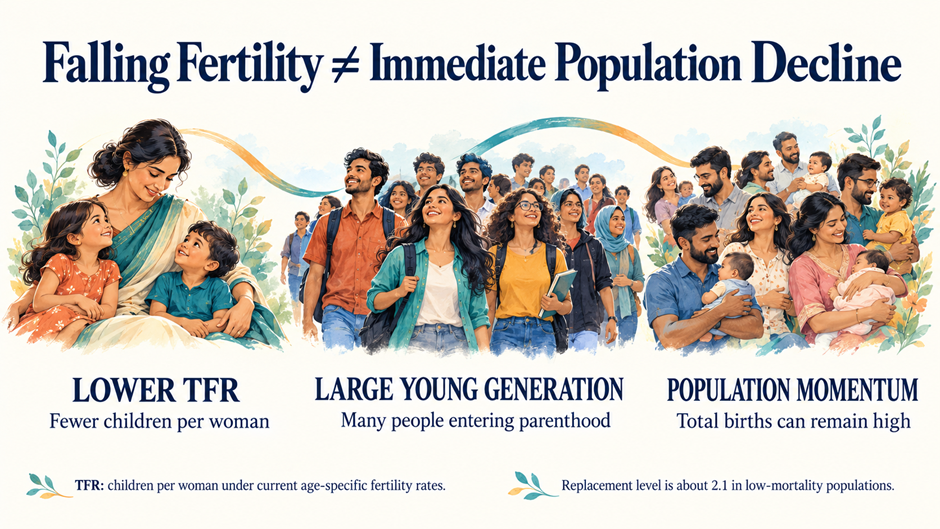
Why Population Can Grow Despite Falling Fertility
When a large generation reaches reproductive ages, births can remain numerous even if each woman has fewer children. This is population momentum.
Therefore, replacement-level fertility does not immediately produce a stable population. Conversely, below-replacement fertility does not automatically cause an immediate population decline.
Why Are Fertility Rates Falling?
Fertility decline is associated with several interconnected changes:
-
Improved child survival: Parents can have greater confidence that children will survive.
-
Women’s education and employment: Expanded opportunities influence marriage and childbearing decisions.
-
Access to contraception: Enables people to plan births.
-
Later marriage and parenthood: Can shorten the period available for childbearing.
-
Urbanisation: Changes housing conditions, livelihoods and family structures.
-
Rising costs: Housing, education and childcare can make larger families difficult to support.
-
Changing preferences: Desired family size and expectations of parenthood evolve.
The importance of each factor varies across regions and social groups.
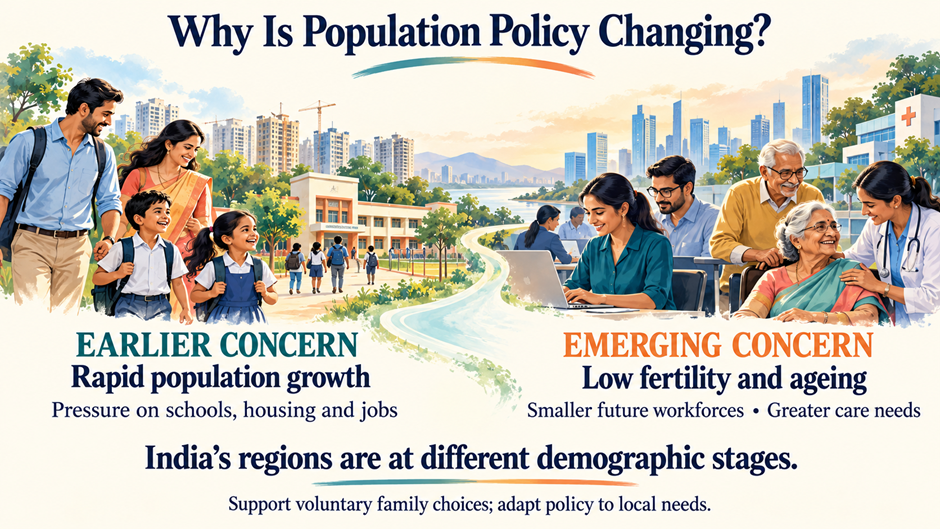
Why Are Population Policies Changing?
Sustained low fertility, combined with longer lives, changes population age structure.
|
Earlier policy concern |
Emerging concern in low-fertility societies |
|
Rapid increase in demand for schools, housing and jobs |
Smaller generations entering the workforce |
|
High child dependency |
Increasing old-age dependency |
|
Pressure to expand basic services |
Growing pension, healthcare and long-term care needs |
|
Encouraging smaller families |
Supporting desired childbearing and adapting to ageing |
However, falling fertility can initially reduce child dependency, creating a demographic-dividend opportunity. Total dependency does not necessarily rise immediately; its direction depends on the changing balance between children, working-age adults and older people.
Population Policies and Reproductive Rights
|
Approach |
Objective |
|
Anti-natalist policies |
Reduce births or population growth |
|
Pro-natalist policies |
Encourage births |
|
Rights-based family support |
Enable voluntary reproductive choices through services and supportive conditions |
Lessons from Coercive Policies
China’s one-child policy sought to restrict births. Romania’s Decree 770, by contrast, restricted abortion to increase births.
Their objectives differed, but both demonstrate the risks of coercive intervention in reproduction. Romania’s restrictions contributed to unsafe abortions and severe maternal-health consequences.
India’s Emergency-era coercive sterilisation experience similarly highlights the importance of informed consent and voluntary family planning.
Population policy must protect reproductive autonomy—the freedom to decide whether, when and how many children to have without coercion or discrimination.
Illustrative Responses in Indian States
India’s states occupy different demographic stages. Responses should therefore reflect local fertility, age structure, migration and development conditions.
|
State |
Illustrative response |
|
Andhra Pradesh |
Moves towards relaxing two-child restrictions; announced incentives of ₹30,000 for a third child and ₹40,000 for a fourth |
|
Sikkim |
Assistance of up to ₹3 lakh for eligible couples seeking infertility treatment, including IVF |
|
Tamil Nadu |
Announced extension of 365-day maternity leave for eligible women government employees having a third child |
Policy announcements, enacted legislation and operational benefits are distinct. Eligibility and implementation rules must be checked before treating a measure as universally available.
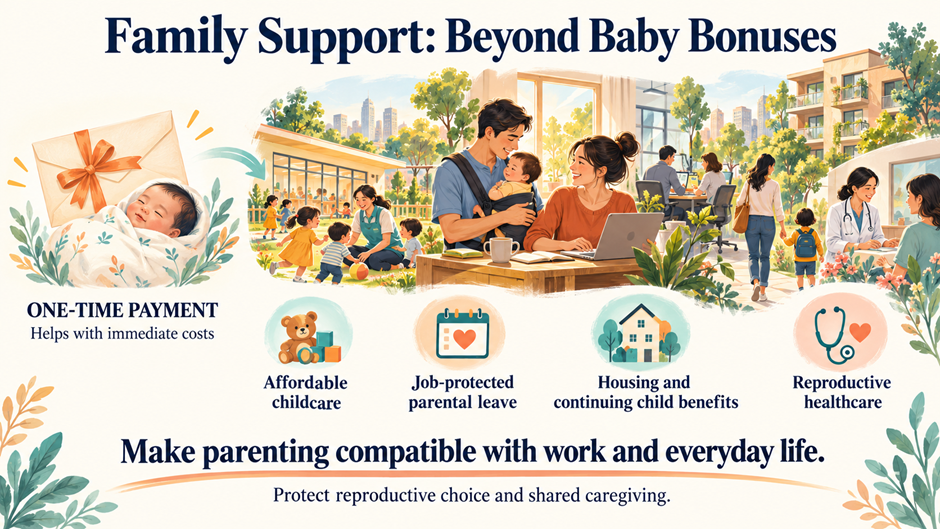
Why Baby Bonuses Alone Are Insufficient
A baby bonus is a payment linked to childbirth. It can help with immediate costs, but raising a child involves recurring expenses and long-term care responsibilities.
Cash benefits may influence the timing or number of births in some circumstances. They do not reliably restore fertility to replacement level when barriers such as insecure employment, unaffordable housing and inadequate childcare persist.
Evidence supports evaluating comprehensive family-support systems rather than relying on one-time payments alone.
Structural Support for Families
|
Measure |
Contribution |
|
Affordable, quality childcare |
Helps parents combine employment and caregiving |
|
Job-protected parental leave |
Provides care time while protecting employment |
|
Housing assistance |
Reduces a major household expense |
|
Continuing child benefits |
Supports families beyond childbirth |
|
Child tax credits |
Reduce eligible parents’ tax liability |
|
Reproductive healthcare |
Supports informed choices and access to treatment |
Tax-based benefits require careful design because households with little or no income-tax liability may otherwise receive limited support.
IVF: Individual Benefits and Demographic Limits
In-vitro fertilisation—IVF— involves fertilising an egg outside the body and transferring an embryo into the uterus.
Subsidies can improve access for people facing infertility. However, significant individual benefits do not automatically translate into a large national fertility increase.
Population-level effects depend on treatment coverage, accessibility, success rates and additional births. IVF assistance should also be assessed as a reproductive-health intervention.
Wider Implications for India
Women’s Employment
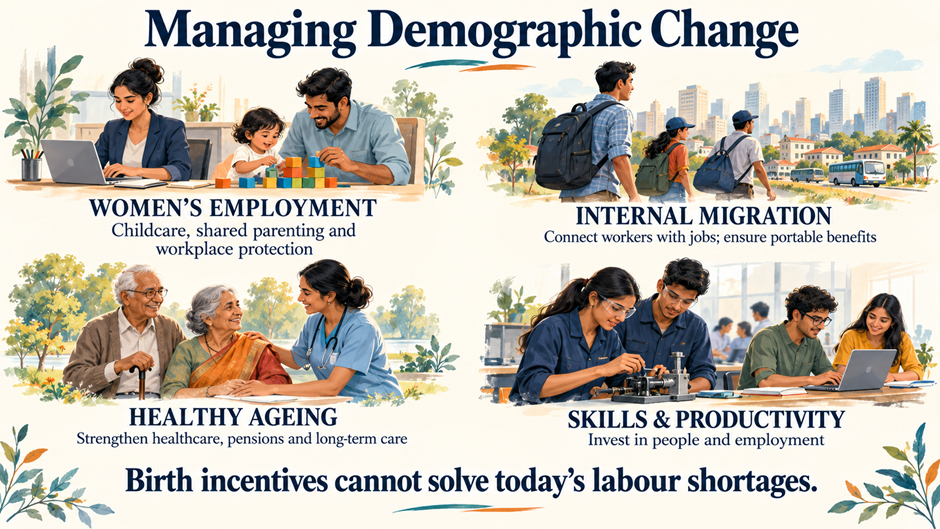
Encouraging childbirth without childcare, shared parenting and workplace protection can increase women’s unpaid work and interrupt careers.
Policies should promote fathers’ caregiving, prevent pregnancy-related discrimination and support women returning to employment.
Internal Migration
Migration can connect available workers with regions experiencing labour demand. Inclusive policies should provide portable welfare benefits, safe housing, workplace protection and access to education and healthcare.
Cultural and linguistic diversity requires effective integration; social conflict is not an inevitable consequence of migration.
Fiscal Sustainability
Recurring family benefits require dependable funding. States must balance them against education, infrastructure, healthcare, pensions and elder care.
Time Lag
Children born today enter the workforce only after many years. Birth incentives cannot resolve immediate labour shortages, making productivity, skills, migration and higher workforce participation equally relevant.
India’s demographic policy must address both the needs of a large young population and the emerging demands of ageing regions. Enabling voluntary family choices and investing in people are central to managing this transition.