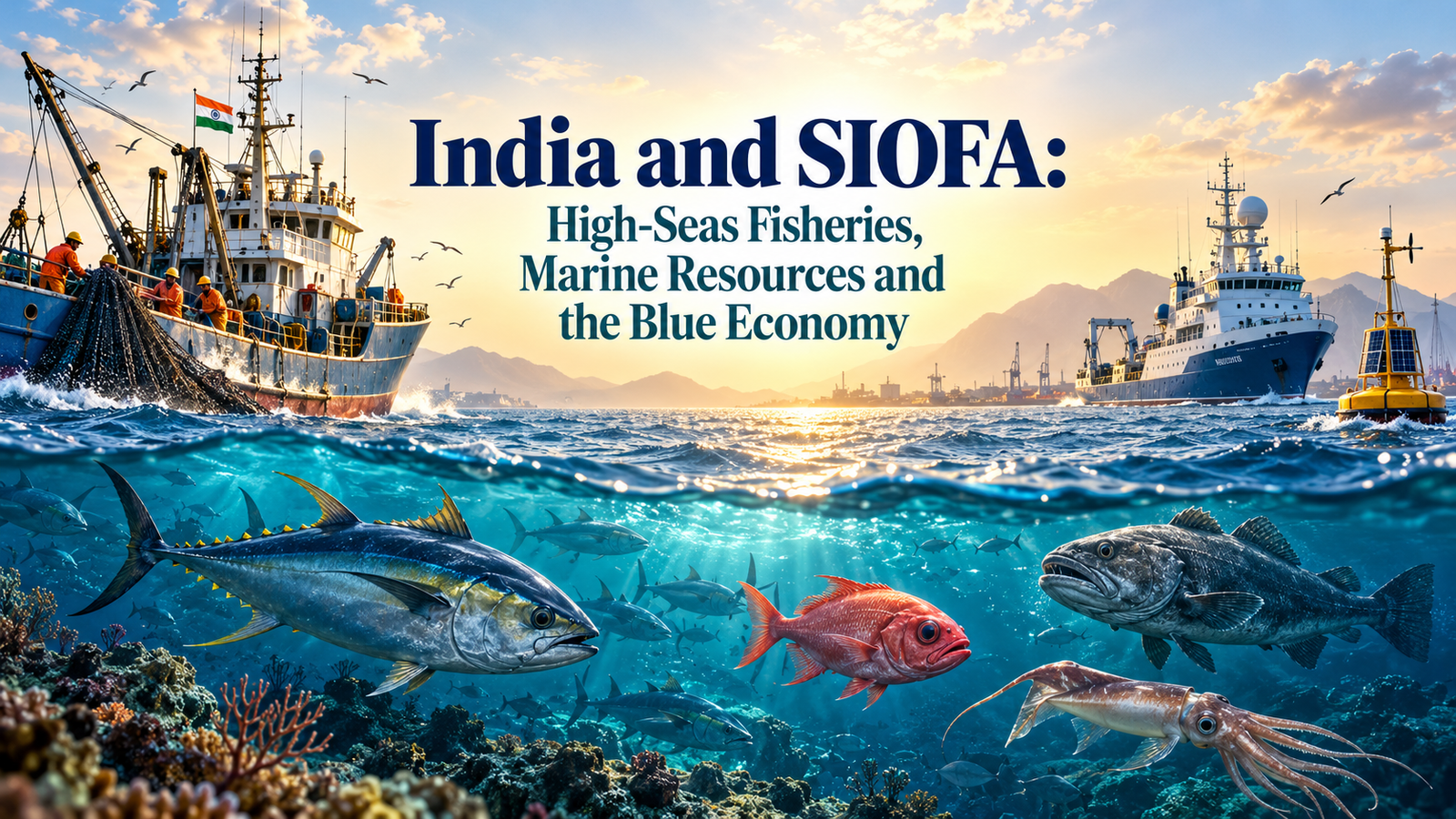
India’s engagement with SIOFA links high-seas fishing opportunities with sustainable marine resource management. Explore its significance for fisheries governance, ocean conservation and India’s Blue Economy.
UPSC syllabus relevance
-
GS Paper I: Ocean geography and distribution of natural resources.
-
GS Paper II: International institutions and agreements affecting India’s interests.
-
GS Paper III: Fisheries, food security, biodiversity conservation and the Blue Economy.
On 14 October 2026, the Central Government announced approval for India’s accession to the Southern Indian Ocean Fisheries Agreement (SIOFA).
India has participated as a Cooperating Non-Contracting Party (CNCP) since 2022. Accession would strengthen its participation in fisheries governance and create opportunities for authorised fishing in the agreement area. Government approval for accession should be distinguished from completion of the treaty’s formal accession process.
What Is SIOFA?
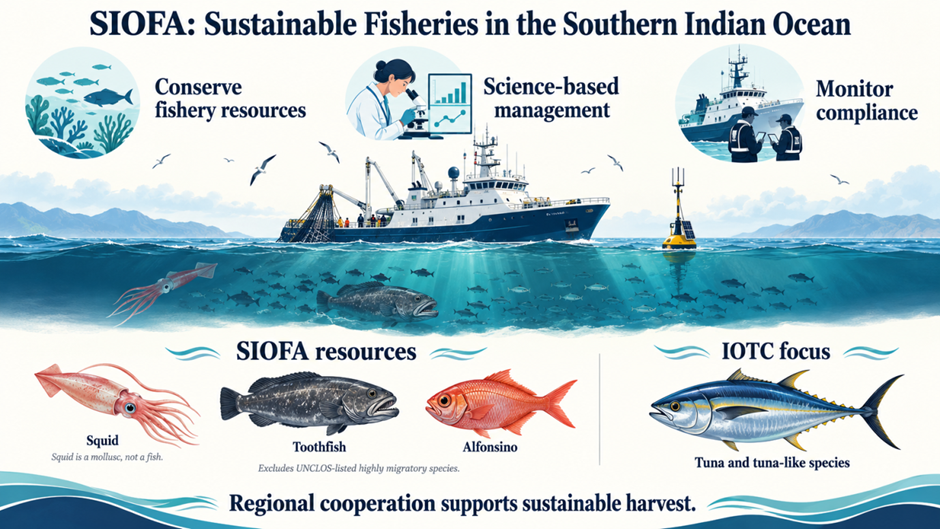
SIOFA is a regional agreement for the long-term conservation and sustainable use of fishery resources in its defined area of the southern Indian Ocean, principally beyond national fisheries jurisdiction.
Its coverage includes fish, molluscs, crustaceans and other specified resources. It excludes:
-
Highly migratory species listed in Annex I of UNCLOS.
-
Sedentary species subject to coastal-state jurisdiction under UNCLOS Article 77(4).
Consequently, describing SIOFA simply as an agreement for “non-migratory fish” does not fully explain its legal scope.
Important Resources
|
Resource |
Basic understanding |
|
Toothfish |
High-value fish associated with cold, deep waters |
|
Alfonsino |
Commercially important deep-water fish |
|
Squid |
A cephalopod mollusc; biologically, it is not a fish |
Fisheries resources are broader than fish: they can include commercially harvested molluscs and crustaceans.
Understanding Maritime Zones
The United Nations Convention on the Law of the Sea (UNCLOS) provides the principal international legal framework governing ocean activities.
A nautical mile equals 1.852 kilometres. Maritime distances are measured from legally established baselines, rather than simply from any point on the coastline.
|
Zone |
Extent |
Principal legal feature |
|
Territorial sea |
Up to 12 nautical miles from baselines |
Coastal-state sovereignty, subject to UNCLOS rules, including innocent passage |
|
Contiguous zone |
Up to 24 nautical miles from baselines |
Specified enforcement powers concerning customs, fiscal, immigration and sanitary laws |
|
Exclusive Economic Zone (EEZ) |
Up to 200 nautical miles from baselines |
Sovereign rights over resources and specified jurisdiction; not complete sovereignty |
|
High seas |
Waters outside EEZs, territorial seas, internal waters and archipelagic waters |
Freedoms exercised subject to international law |
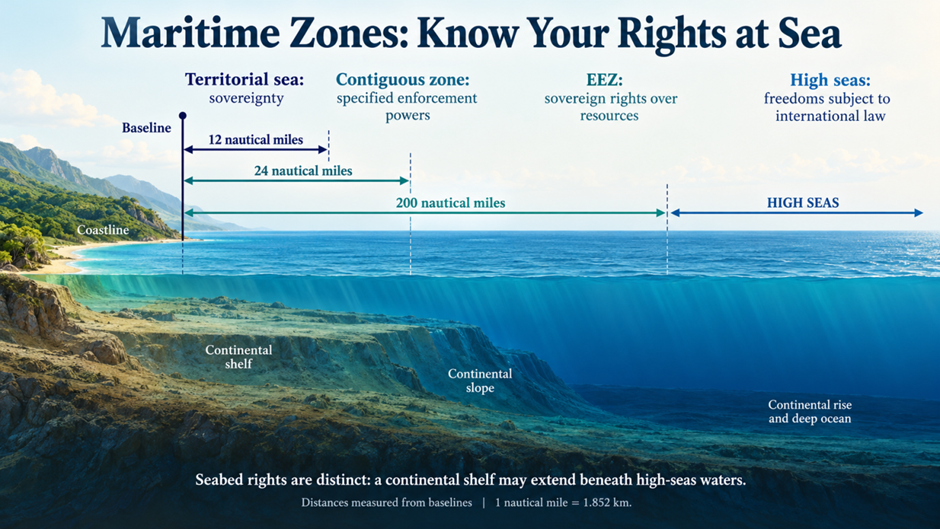
These distances are measured from the baseline: the EEZ does not extend another 200 nautical miles beyond the territorial sea.
High Seas Do Not Mean Unregulated Waters
High-seas freedoms include navigation and fishing, but states must fulfil conservation and cooperation obligations.
A vessel’s flag state—the country in which it is registered—has responsibilities concerning its activities and compliance. Fishing in another country’s EEZ requires the relevant coastal-state permission or access arrangement.
Water column and seabed are legally distinct: high-seas waters may overlie a coastal state’s continental shelf beyond 200 nautical miles.
Regional Fisheries Governance: SIOFA and IOTC
Regional Fisheries Management Organisations or Arrangements (RFMOs/RFMAs) enable states to cooperate on fish stocks that require management beyond a single country’s jurisdiction.
They can adopt conservation measures, coordinate scientific assessments and monitor compliance.
|
Aspect |
SIOFA |
Indian Ocean Tuna Commission— IOTC |
|
Principal focus |
Covered fishery resources within its southern Indian Ocean agreement area |
Tuna and tuna-like species within its area of competence |
|
Key distinction |
Excludes UNCLOS Annex I highly migratory species |
Addresses important highly migratory fisheries |
|
India’s engagement |
CNCP since 2022; accession approved by government in October 2026 |
Existing contracting party |
Date clarification: IOTC records India’s acceptance of its agreement on 13 March 1995. The agreement entered into force in 1996; these are different milestones.
Why Accession Matters for India
Fisheries Governance
Contracting-party status would allow fuller participation in decision-making, including the Scientific Committee and Compliance Committee.
Scientific Cooperation
Research programmes and stock assessments can help determine the condition of fish populations and inform sustainable harvesting. A stock assessment examines factors such as abundance, growth, reproduction and fishing pressure.
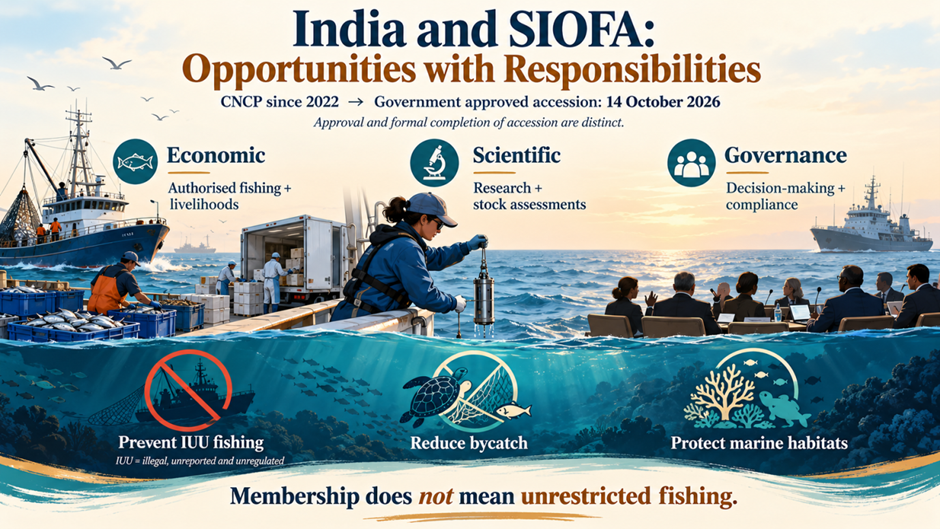
Economic Opportunities
Authorised fishing could support vessel operations, processing, cold chains, exports and employment. These opportunities remain subject to conservation measures and applicable authorisations.
Maritime Engagement
Participation would strengthen India’s role in southern Indian Ocean fisheries governance. It would also support involvement in the High Seas Boarding and Inspection (HSBI) Scheme, adopted under SIOFA and awaiting implementation according to the government announcement.
Membership does not confer unrestricted fishing rights or general authority to board any foreign vessel.
Illegal, Unreported and Unregulated Fishing
|
Component |
Meaning |
|
Illegal fishing |
Fishing that violates applicable laws or conservation measures |
|
Unreported fishing |
Catch or fishing activity that is not reported, or is misreported, contrary to requirements |
|
Unregulated fishing |
Fishing in circumstances that undermine applicable conservation responsibilities, including certain activities outside effective management arrangements |
IUU fishing can weaken stock assessments, threaten biodiversity, reduce legitimate fishers’ incomes and undermine sustainable management.
Relevant responses include vessel monitoring, accurate catch reporting, inspections and cooperation between flag states, coastal states and port states.
Blue Economy: Opportunities and Responsibilities
The Blue Economy involves sustainable use of ocean resources for economic growth, livelihoods and employment while maintaining marine ecosystem health.
It includes fisheries, aquaculture, shipping, coastal tourism, marine biotechnology and offshore renewable energy.
For India, expanding fisheries opportunities must be accompanied by:
-
Scientific catch management to prevent overexploitation.
-
Bycatch reduction: limiting unintended capture of non-target species.
-
Habitat protection, particularly vulnerable deep-sea ecosystems.
-
Vessel safety, trained crews and suitable infrastructure.
-
Traceability: documenting seafood origin and movement through supply chains.
-
Inclusive benefits for fishing communities and smaller enterprises.
Deep-sea fishing and high-seas fishing are different concepts: the former concerns depth or fishing grounds; the latter concerns legal jurisdiction.
Fish Diversity: Essential Static Linkages
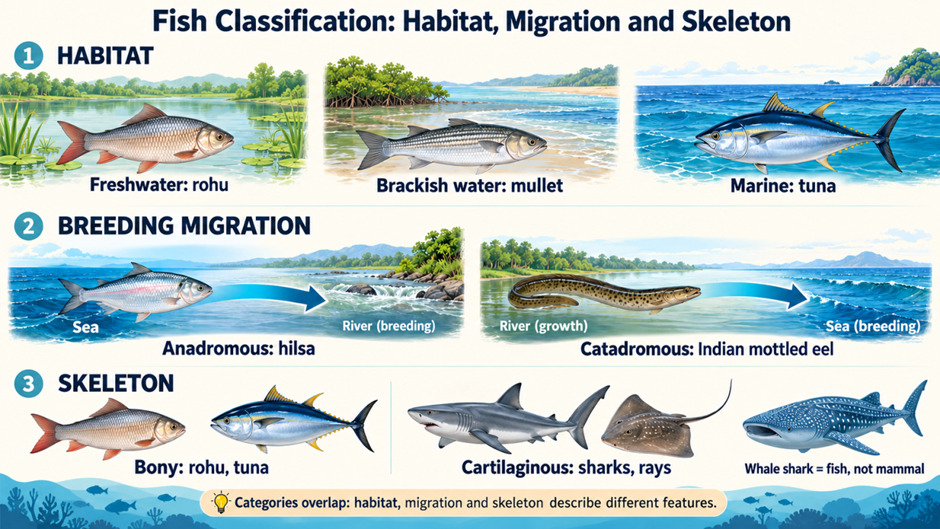
Fish can be classified by habitat, migration and skeletal structure. These classifications overlap: the same species can belong to more than one category.
A. Classification by Habitat
|
Category |
Habitat |
Examples |
|
Freshwater |
Rivers, lakes, ponds and reservoirs |
Rohu, catla, mrigal and freshwater catfishes |
|
Marine |
Seas and oceans |
Indian oil sardine, Indian mackerel, tuna and pomfret |
|
Brackish-water |
Waters where freshwater mixes with seawater |
Mullets, Asian seabass and many mudskippers |
Estuaries, lagoons and mangroves provide important feeding, breeding or nursery habitats. Some species tolerate a broad range of salinity and are not confined to one habitat category.
B. Classification by Migration
|
Type |
Breeding migration |
Example |
|
Anadromous |
Sea → freshwater |
Hilsa |
|
Catadromous |
Freshwater → sea |
Indian mottled eel |
Dams, altered river flows, pollution and habitat degradation can interrupt migration and reproduction.
C. Classification by Skeleton
|
Group |
Main feature |
Examples |
|
Bony fishes |
Skeleton primarily composed of bone |
Rohu, sardine and tuna |
|
Cartilaginous fishes |
Skeleton primarily composed of cartilage |
Sharks, rays and skates |
The whale shark (Rhincodon typus) is the largest living fish and a filter feeder. Despite its name, it is not a whale or mammal.
Types of Fishes in India
India has rich fish diversity because of its rivers, lakes, reservoirs, wetlands, coastal waters and surrounding seas. Fish are important for food security, employment, biodiversity, inland fisheries, aquaculture and the Blue Economy.
Major types of fish found in India
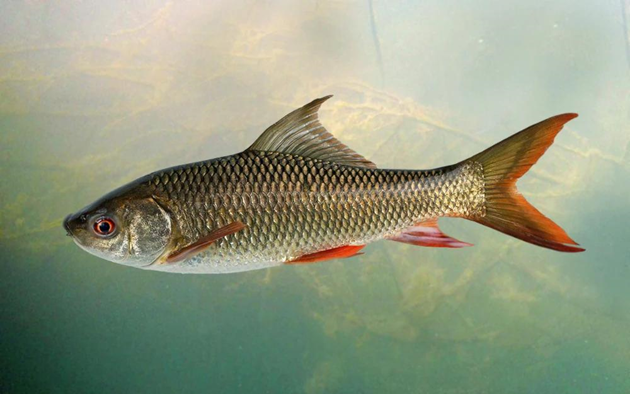
1. Freshwater fishes
Habitat: Rivers, lakes, ponds and reservoirs
Live mainly in inland freshwater ecosystems.
· Examples: Rohu (Labeo rohita), Catla (Catla catla), Mrigal (Cirrhinus mrigala), freshwater catfish.
· Importance: Inland fisheries, aquaculture and nutrition.
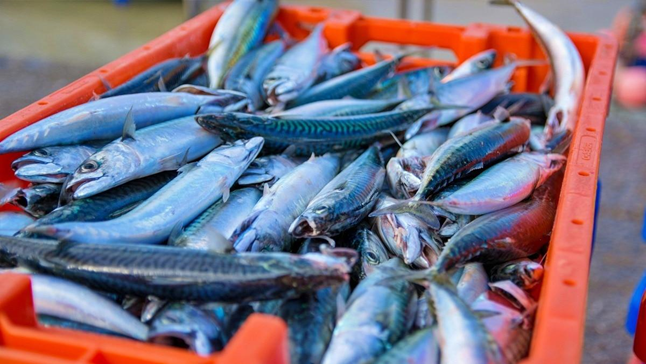
2. Marine fishes
Habitat: Arabian Sea, Bay of Bengal and Indian Ocean
Live in seawater and support India's marine fishing industry.
· Examples: Indian oil sardine (Sardinella longiceps), Indian mackerel (Rastrelliger kanagurta), tuna (Thunnus species), pomfret.
· Importance: Seafood exports, coastal livelihoods and marine food webs.
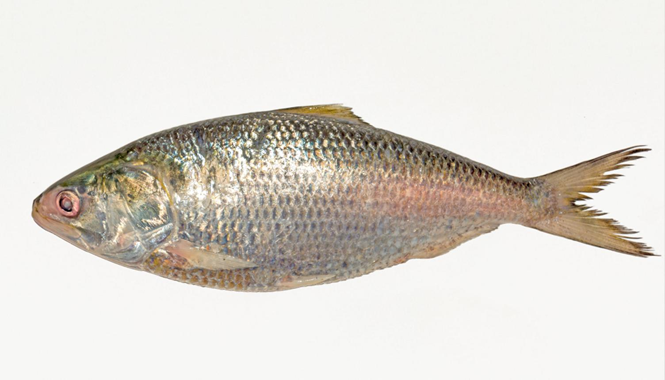
3. Anadromous fishes
Migration: Sea to freshwater for breeding
Spend much of their lives in the sea but migrate into freshwater to reproduce.
· Example: Hilsa (Tenualosa ilisha).
· Anadromous migration connects marine and river ecosystems.
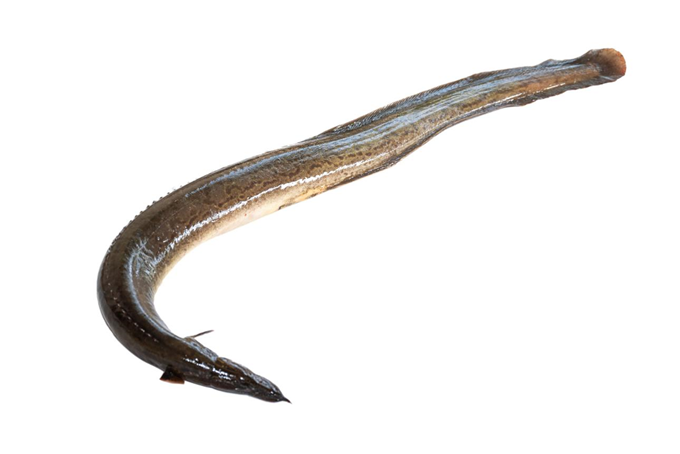
4. Catadromous fishes
Migration: Freshwater to sea for breeding
Live mainly in freshwater but migrate to the sea to reproduce.
· Example: Indian mottled eel (Anguilla bengalensis).
· Their life cycle depends on both freshwater and marine habitats.
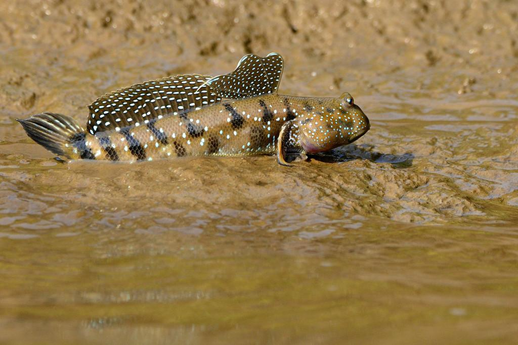
5. Brackish-water fishes
Habitat: Estuaries, lagoons and mangroves
Occur in water where freshwater mixes with seawater.
· Examples: Asian seabass (Lates calcarifer), mullets (Mugil and related genera), mudskippers.
· Importance: Estuarine ecosystems, mangrove food webs and aquaculture.
Selected Scientific Names
|
Species |
Scientific name |
|
Rohu |
Labeo rohita |
|
Hilsa |
Tenualosa ilisha |
|
Indian oil sardine |
Sardinella longiceps |
|
Indian mackerel |
Rastrelliger kanagurta |
|
Asian seabass |
Lates calcarifer |
|
Indian mottled eel |
Anguilla bengalensis |
|
Whale shark |
Rhincodon typus |
Fisheries and Sustainable Development
Fisheries contribute to nutrition, employment, exports and aquatic ecosystem functioning. Their long-term productivity depends on healthy habitats and sustainable harvesting.
India’s engagement with SIOFA connects international cooperation with domestic fisheries development. Its benefits will depend on scientific management, regulatory compliance, adequate infrastructure and equitable participation by fishing communities.