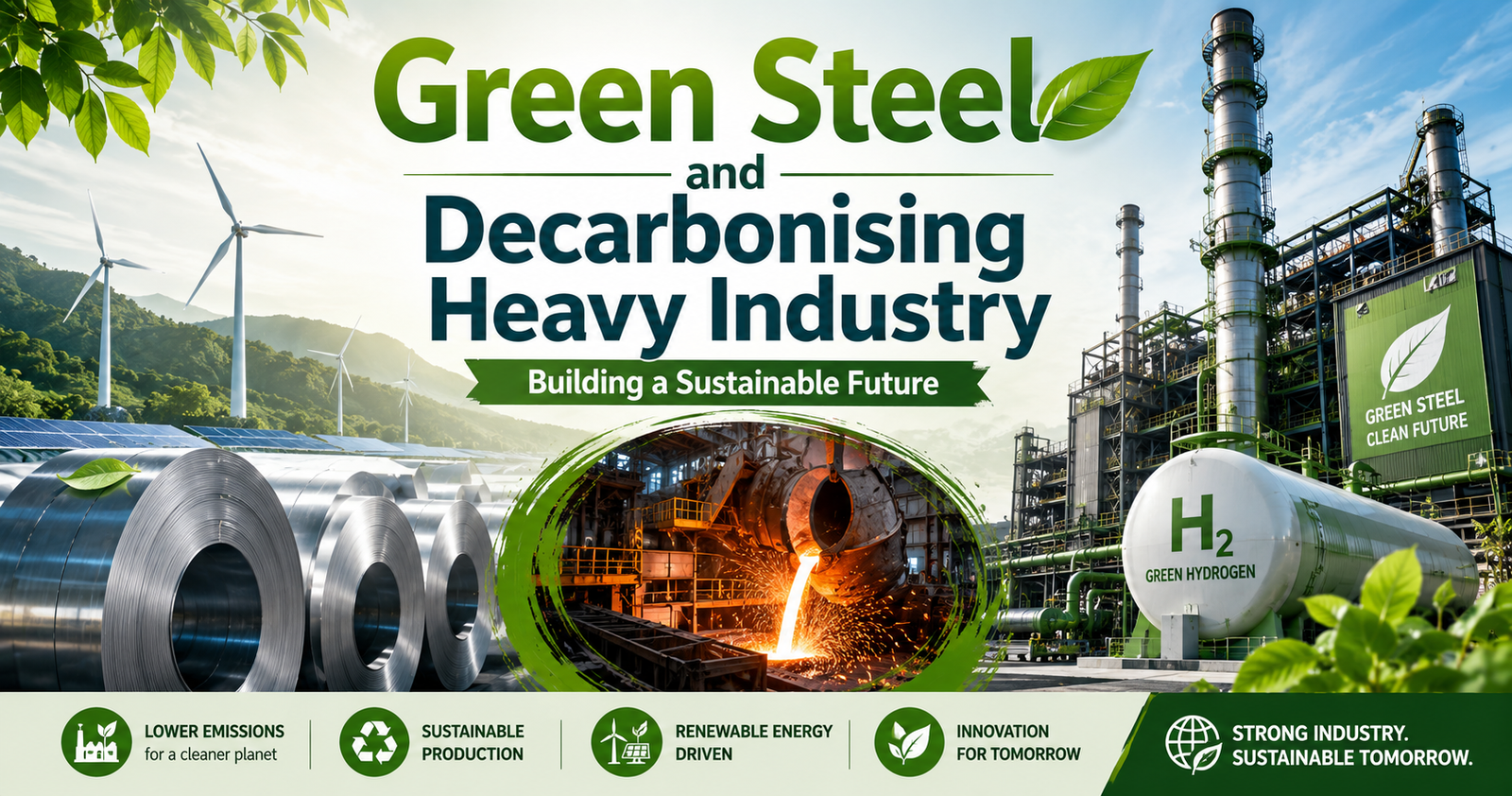
Understand Green Steel and decarbonising heavy industry, its importance for India, green hydrogen’s role, carbon border taxes, industrial transition challenges and sustainable manufacturing strategies from a UPSC perspective.
Syllabus Areas:GS III - Economy, Environment, Science and Technology |
India’s steel sector is increasingly facing pressure to reduce carbon emissions while simultaneously maintaining industrial competitiveness and export growth. The global transition toward low-carbon manufacturing, rising climate commitments and trade measures such as carbon taxes are forcing industries to adopt cleaner production technologies. As a result, green steel production and industrial decarbonisation have become major policy priorities.
Background
Steel is one of the most important industries in modern economies because it supports infrastructure development, construction, transport, manufacturing and defence production.
However, the steel sector is also among the largest contributors to greenhouse gas emissions because conventional steel manufacturing depends heavily on coal-based processes.
India is currently one of the world’s largest steel producers and therefore faces a dual challenge:
-
Expanding industrial growth to support development.
-
Reducing emissions to meet climate commitments.
This has brought greater attention toward green steel technologies and industrial decarbonisation strategies.
Why is Steel Production Environmentally Challenging?
Traditional steel production generates large emissions because iron ore is converted into steel using coal-intensive processes.
The major environmental concerns include:
a. High Carbon Emissions
-
Steel manufacturing contributes significantly to global carbon dioxide emissions.
-
Coal-based blast furnaces release large quantities of greenhouse gases.
b. Energy Intensity
-
Steel plants consume enormous quantities of electricity and thermal energy.
-
Energy-intensive industries increase pressure on fossil fuel consumption.
c. Air Pollution Concerns
-
Conventional steel plants emit particulate matter and industrial pollutants.
-
These emissions affect local environmental quality and public health.
Therefore, decarbonising steel production has become central to climate policy discussions.
What is Green Steel?
Green steel refers to steel produced through manufacturing methods that substantially reduce carbon emissions compared to traditional production processes.
The objective is not merely steel production, but producing steel with minimal environmental impact.
Green steel production generally relies on:
-
Renewable energy sources
-
Green hydrogen technologies
-
Energy-efficient manufacturing
-
Recycling and circular economy practices
The shift toward green steel represents a move from carbon-intensive growth toward sustainable industrialisation.
Role of Green Hydrogen in Green Steel Production
-
Green hydrogen is increasingly viewed as a transformative technology for decarbonising heavy industries.
-
Green hydrogen is produced through electrolysis using renewable energy sources rather than fossil fuels.
-
Its importance in steel production comes from the fact that hydrogen can replace coal during iron reduction processes.
Benefits of Green Hydrogen:
-
Reduces carbon emissions significantly.
-
Supports clean industrial production.
-
Enhances energy security by reducing fossil fuel dependence.
-
Contributes toward long-term net-zero goals.
Challenges:
-
Production costs remain high.
-
Infrastructure requirements are substantial.
-
Renewable energy availability remains uneven.
Therefore, scaling green hydrogen requires large investments and policy support.
Understanding Industrial Decarbonisation
Industrial decarbonisation refers to reducing carbon emissions generated by industrial activities while maintaining economic productivity.
It includes multiple strategies:
Technological Measures:
-
Cleaner production technologies.
-
Carbon capture technologies.
-
Electrification of industrial processes.
Operational Measures:
-
Improving energy efficiency.
-
Waste heat recovery systems.
-
Process optimisation.
Structural Measures:
-
Transition toward renewable energy.
-
Resource efficiency improvements.
-
Circular economy adoption.
Industrial decarbonisation is increasingly becoming necessary because climate goals cannot be achieved without reducing emissions from heavy industries.
Carbon Border Adjustment Mechanism (CBAM): Why It Matters
One of the major concerns for Indian industries is the emergence of carbon-based trade barriers.
CBAM is a mechanism through which importing countries impose carbon-related charges on goods produced with high emissions.
Why Countries Introduce CBAM:
-
Prevent carbon leakage.
-
Protect domestic industries following strict climate policies.
-
Encourage cleaner production globally.
Implications for India:
-
Carbon-intensive exports may become costlier.
-
Indian steel producers may lose competitiveness.
-
Export-oriented sectors could face additional compliance burdens.
Therefore, cleaner manufacturing is increasingly becoming an economic necessity rather than merely an environmental choice.
India’s Net-Zero Pathway and Steel Sector
India has announced long-term climate commitments that require emission reductions across sectors.
Heavy industries such as steel will play a critical role because:
-
Industrial emissions are substantial.
-
Demand for steel is expected to grow rapidly.
-
Infrastructure expansion requires large-scale production.
Thus, achieving climate goals while maintaining growth requires cleaner industrial transformation.
Major Challenges for India
a. Financial Challenges:
-
Green technologies require high initial investment.
-
Smaller firms may struggle with transition costs.
b. Technological Challenges:
-
Limited access to advanced technologies.
-
Dependence on imported equipment.
c. Infrastructure Challenges:
-
Renewable energy expansion requirements.
-
Hydrogen transport and storage limitations.
d. Competitiveness Concerns:
-
Transition costs may increase product prices.
-
International competition remains intense.
Way Forward
India’s green industrial transition requires coordinated action across policy, technology and finance.
Important measures include:
a. Policy Support:
-
Incentives for low-carbon manufacturing.
-
Carbon reduction roadmaps.
-
Green procurement policies.
b. Technological Support:
-
Scaling green hydrogen production.
-
Investing in industrial innovation.
-
Expanding research and development.
c. Economic Measures:
-
Climate finance mobilisation.
-
International technology partnerships.
-
Support for MSMEs during transition.
Green steel represents more than an industrial innovation; it reflects the broader transition toward sustainable economic growth. For India, balancing industrial expansion with climate commitments will determine long-term competitiveness in an increasingly carbon-conscious global economy.
Prelims Questions:Q1. With reference to Green Hydrogen, consider the following statements:
Which of the statements given above is/are correct? A) 1 only Answer: B) 1 and 2 only Explanation:
Q2. Consider the following statements regarding Carbon Border Adjustment Mechanism (CBAM):
Which of the statements given above is/are correct? A) 1 only Answer: B) 1 and 2 only Explanation:
Q3. Which of the following measures can contribute to industrial decarbonisation?
Select the correct answer using the code given below: A) 1 and 2 only Answer: B) 1, 2 and 3 only Explanation:
|