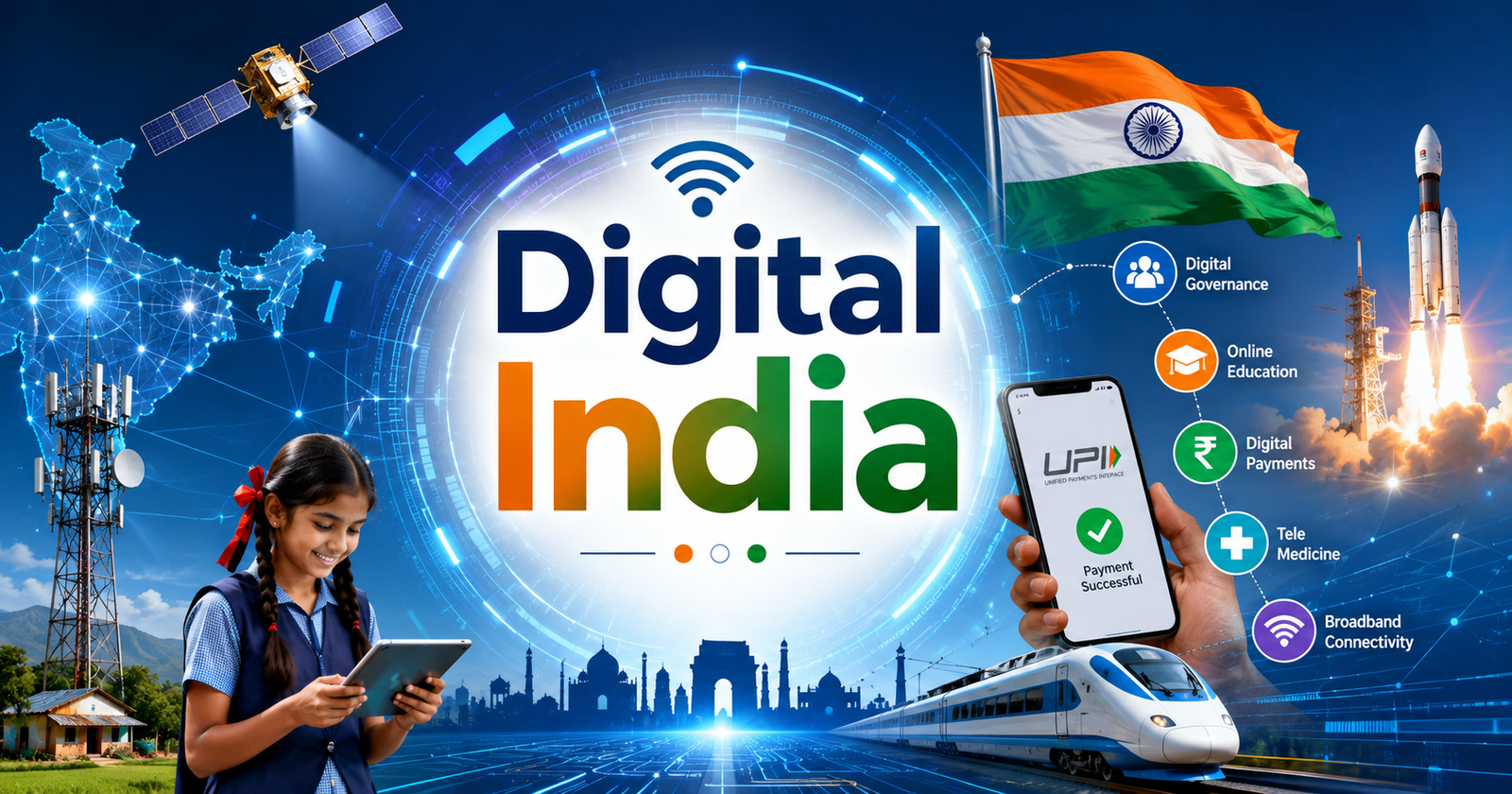
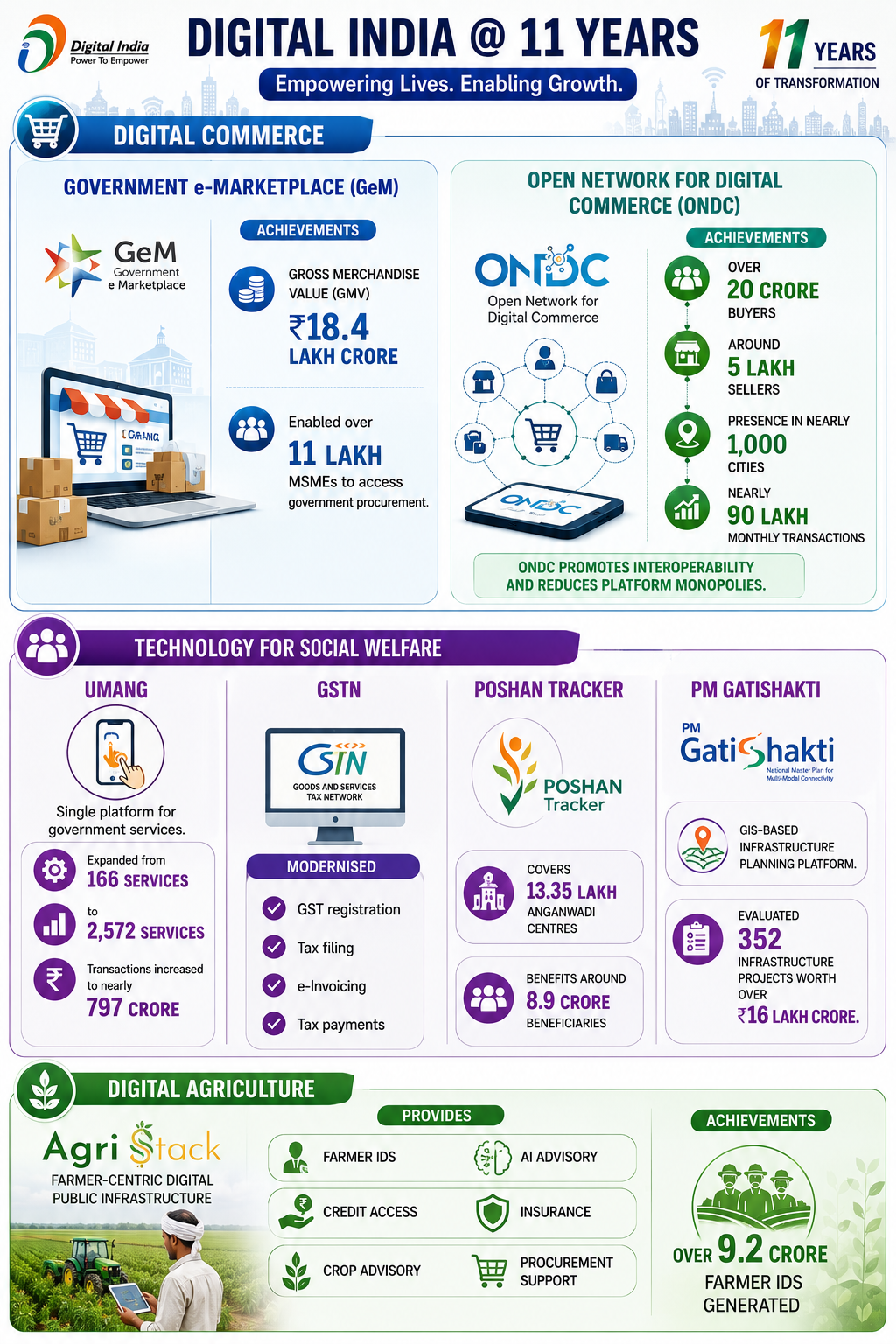
Explore how Digital India has transformed governance, digital payments, healthcare, education, agriculture, and public service delivery over 11 years, making India a global leader in Digital Public Infrastructure (DPI).
Syllabus Areas:
GS II - Governance
GS III - Economy, S&T
General Essay
Launched on 1 July 2015 by the Ministry of Electronics and Information Technology (MeitY), the Digital India Programme is the Government of India's flagship initiative aimed at transforming the country into a digitally empowered society and knowledge economy.
Over the past eleven years, Digital India has evolved from improving digital access and governance to driving India's next phase of technology-led growth through Artificial Intelligence (AI), semiconductor manufacturing, Digital Public Infrastructure (DPI), affordable digital connectivity, and innovation, supporting the vision of Viksit Bharat 2047.
Objectives of Digital India
The programme aims to:
-
Transform India into a digitally empowered society.
-
Provide governance and services electronically.
-
Improve transparency and accountability.
-
Bridge the urban-rural digital divide.
-
Promote digital inclusion.
-
Build robust Digital Public Infrastructure (DPI).
-
Encourage innovation and entrepreneurship.
-
Generate employment through digital technologies.
-
Strengthen India's global leadership in digital governance.
Major Achievements in 11 Years
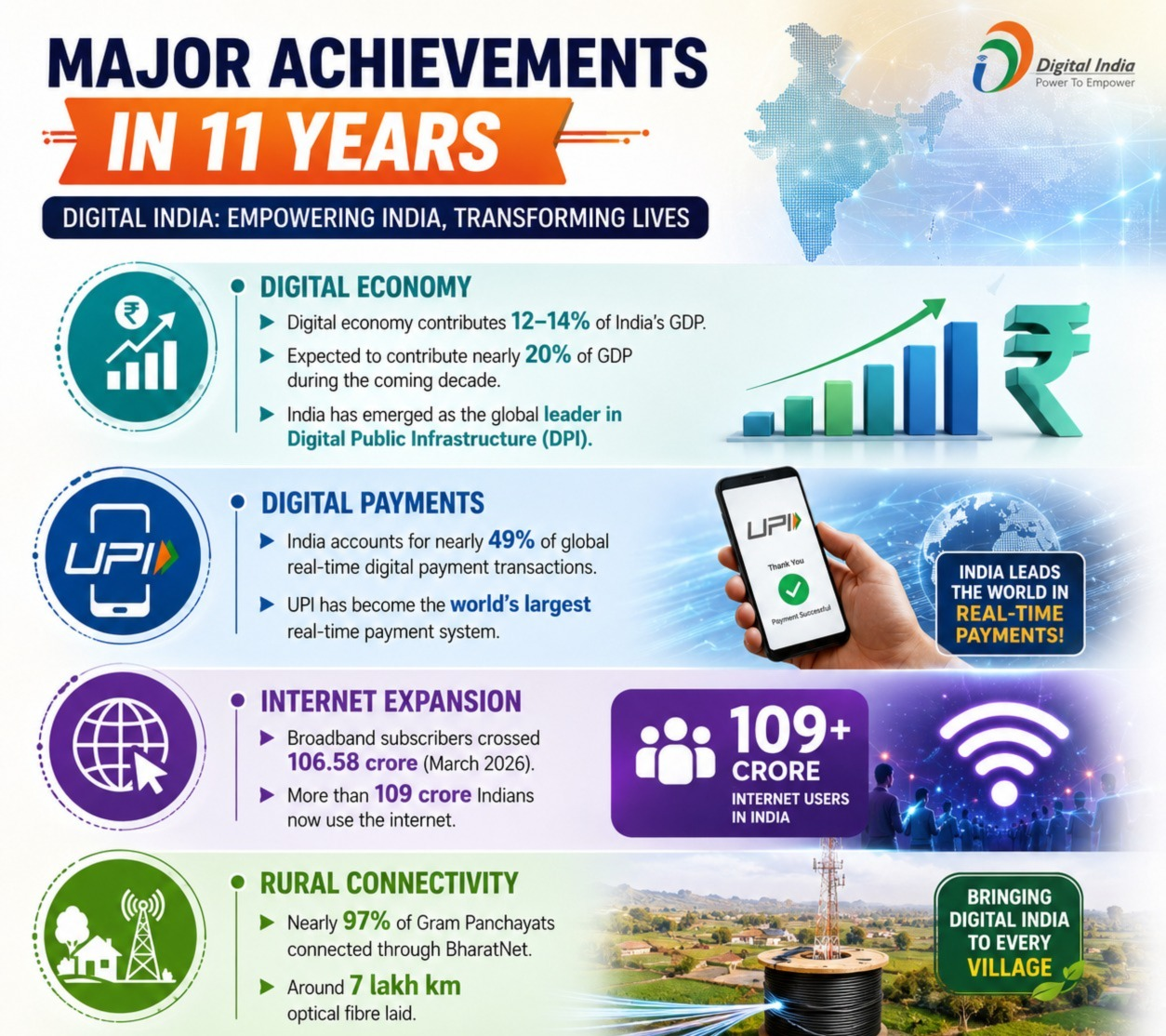
These achievements have significantly improved financial inclusion, e-governance, telemedicine, online education, and rural entrepreneurship.
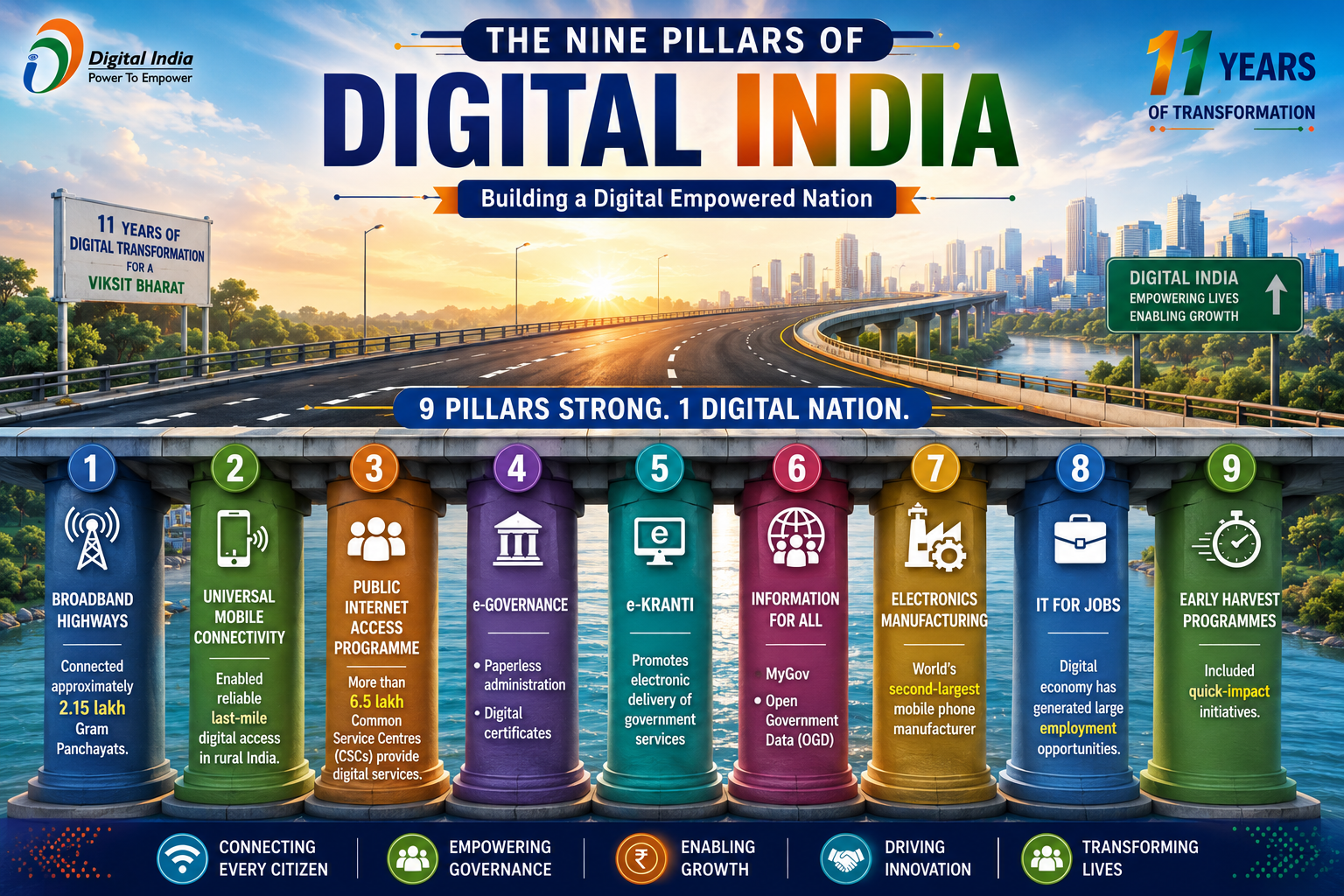
The Nine Pillars of Digital India
1. Broadband Highways
-
BharatNet expanded broadband connectivity to villages.
-
Connected approximately 2.15 lakh Gram Panchayats.
-
Improved rural governance, education, healthcare, and digital banking.
2. Universal Mobile Connectivity
-
Expanded broadband and mobile connectivity nationwide.
-
Enabled reliable last-mile digital access in rural India.
3. Public Internet Access Programme
-
More than 6.5 lakh Common Service Centres (CSCs) provide digital services.
-
Around 1.6 lakh Post Offices deliver digital citizen services.
-
Enhanced access to banking, governance, and welfare.
4. e-Governance
-
Focused on Paperless administration, Digital certificates, Online applications, Integrated public services
-
Major platforms include: DigiLocker, National Single Sign-On (NSSO)
-
These have significantly reduced paperwork and improved ease of living.
5. e-Kranti
-
Promotes electronic delivery of government services through eHospital, eSanjeevani, eCourts
-
It has made public service delivery faster, transparent, and citizen-centric.
6. Information for All
-
Digital platforms like MyGov, Open Government Data (OGD) promote transparency, citizen participation, and open governance.
7. Electronics Manufacturing
-
India has become World's second-largest mobile phone manufacturer
-
Electronics production increased from ₹1.9 lakh crore (2014-15) to nearly ₹12 lakh crore (2026).
8. IT for Jobs
Digital economy has generated large employment opportunities.
Highlights:
-
IT & ITeS industry revenue reached USD 283 billion.
-
More than 2,100 Global Capability Centres (GCCs) employ nearly 26 lakh professionals.
9. Early Harvest Programmes
-
Included quick-impact initiatives such as Biometric attendance, Secure government email, Public Wi-Fi, SMS weather alerts, eBooks
-
These demonstrated the immediate benefits of technology-enabled governance.
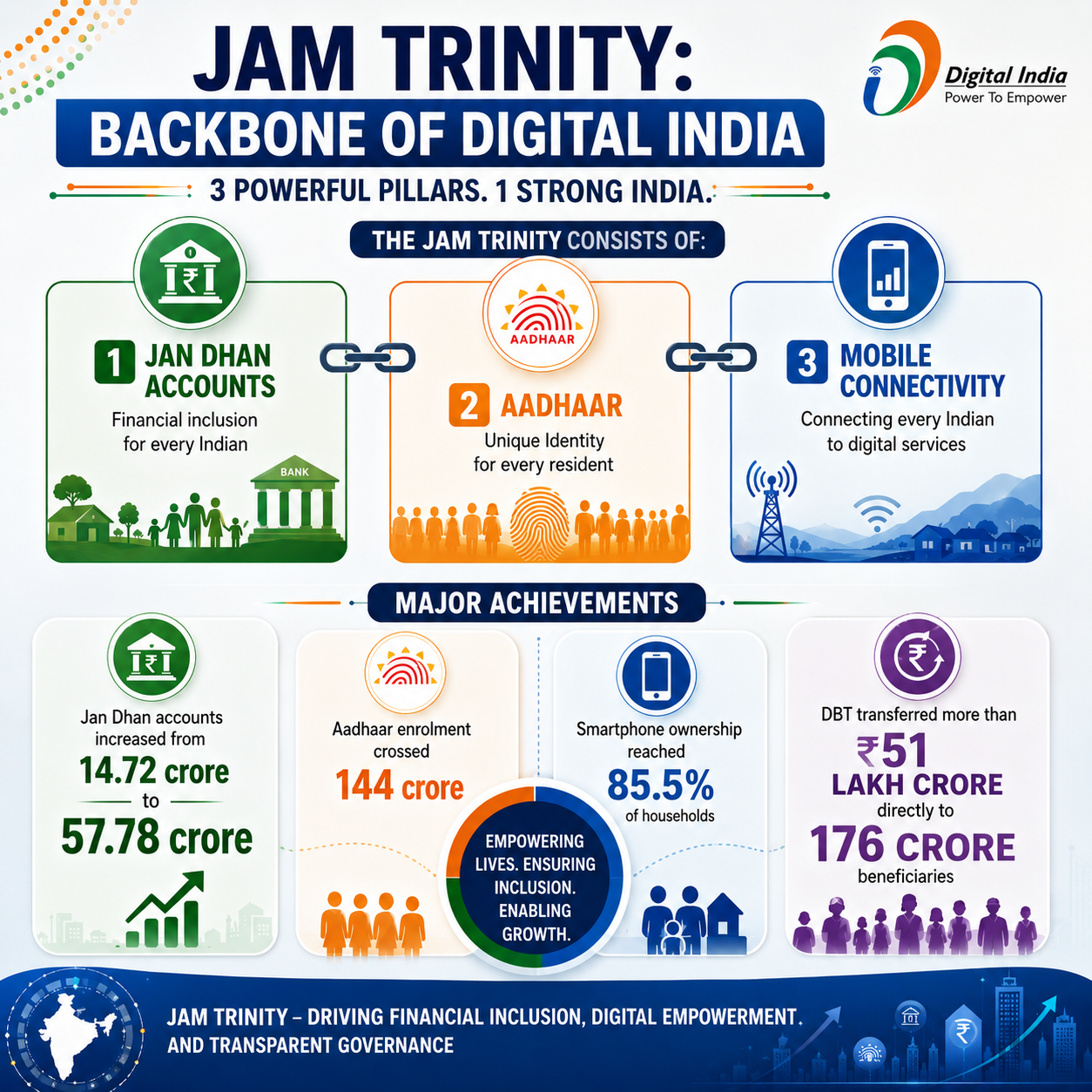
JAM Trinity:
JAM Trinity is a flagship initiative of the Government of India that integrates Jan Dhan Accounts, Aadhaar, and Mobile Connectivity to create an inclusive and transparent digital governance ecosystem. It forms the foundation of India's Digital Public Infrastructure (DPI) and has transformed the delivery of government services, financial inclusion, and welfare schemes.
Aadhaar: Foundation of Digital Identity
Key achievements:
-
Secure biometric identity system.
-
Enabled banking inclusion.
-
Simplified KYC.
-
Supports over 3,100 DBT schemes.
-
More than 98% of Public Distribution System (PDS) transactions authenticated through Aadhaar.
-
Aadhaar App crossed 3.1 crore downloads.
International Recognition:
Countries like Egypt, Nigeria, Indonesia, and Papua New Guinea are studying India's Aadhaar model.
DigiLocker
It is a digital document wallet enabling Secure storage, Instant verification, Paperless governance
Achievements:
-
70.69 crore users
-
More than 850 crore digital documents issued
Unified Payments Interface (UPI): Revolutionising India's Digital Payments
The Unified Payments Interface (UPI), developed by the National Payments Corporation of India (NPCI), has transformed India's digital payment ecosystem by enabling instant, secure, and interoperable fund transfers through smartphones.
Since its launch in 2016, UPI has evolved into the world's largest real-time digital payment platform, making cashless transactions simple, affordable, and accessible for millions of individuals, businesses, and government agencies. It has become a cornerstone of India's Digital Public Infrastructure (DPI) and a global model for digital financial inclusion.
-
UPI has expanded beyond India and is now operational in multiple countries.
-
It facilitates seamless cross-border payments and enhances convenience for Indian travellers, businesses, and tourists.
-
Countries including Singapore, UAE, France, Mauritius, Sri Lanka, Nepal, Bhutan, and Cambodia have adopted or integrated UPI-based payment systems.
Digital Health Revolution: Transforming Healthcare Through Digital India
The Digital India Programme has revolutionised India's healthcare ecosystem by integrating technology with public health services. Digital platforms have improved accessibility, affordability, transparency, efficiency, and quality of healthcare, especially for citizens living in rural and remote regions.
Major Digital Health Initiatives
1. Online Registration System (ORS)
-
The Online Registration System (ORS) is a national digital platform that enables citizens to book hospital appointments online in government hospitals.
-
Recorded more than 1.37 crore online appointments (as of 24 June 2026).
2. eHospital
-
The eHospital platform is a cloud-based Hospital Management Information System (HMIS) developed under the Digital India Programme.
-
It digitises hospital administration by integrating various hospital services into a single online platform.
-
Digitised hospital operations across numerous government healthcare institutions
3. eBloodBank
The eBloodBank system is a digital platform that connects blood banks across the country, ensuring efficient blood availability and management.
4. eSanjeevani
eSanjeevani is India's national telemedicine platform that enables patients to consult doctors remotely using digital technology.
It has become one of the world's largest telemedicine services.
5. CoWIN (COVID Vaccine Intelligence Network)
The CoWIN platform was developed to digitally manage India's COVID-19 vaccination programme and became one of the world's largest vaccination management systems.
What is DIKSHA?
DIKSHA (Digital Infrastructure for Knowledge Sharing) is India's flagship digital learning platform developed for school education. It is an open-source, curriculum-aligned digital platform that provides quality educational resources to students, teachers, and parents across the country.
-
Launched in 2017
-
Developed under the Ministry of Education
-
Implemented by NCERT in collaboration with CIET (Central Institute of Educational Technology)
-
A major component of the PM eVIDYA Initiative
-
Popularly known as "One Nation, One Digital Platform" for school education.
Major Features of DIKSHA
-
Curriculum-Aligned Content: Provides NCERT, State Board resources, videos, assessments, and teacher guides.
-
Energised Textbooks: QR-coded textbooks link to videos, animations, simulations, and digital resources.
-
Interactive Learning: Includes 2D/3D animations, AR, virtual labs, quizzes, and adaptive assessments.
-
Inclusive Education: Supports DAISY format, Text-to-Speech, ISL videos, and accessible learning content.
-
Personalized Learning: Offers practice questions, competency-based assessments, and adaptive learning.
-
Teacher Development: Provides NISHTHA training, TPD modules, certified courses, and teaching resources.
-
Federated Architecture: Enables states and boards to manage localized content.
-
Multilingual & Offline Support: Available in 135 languages with downloadable offline content for uninterrupted learning.
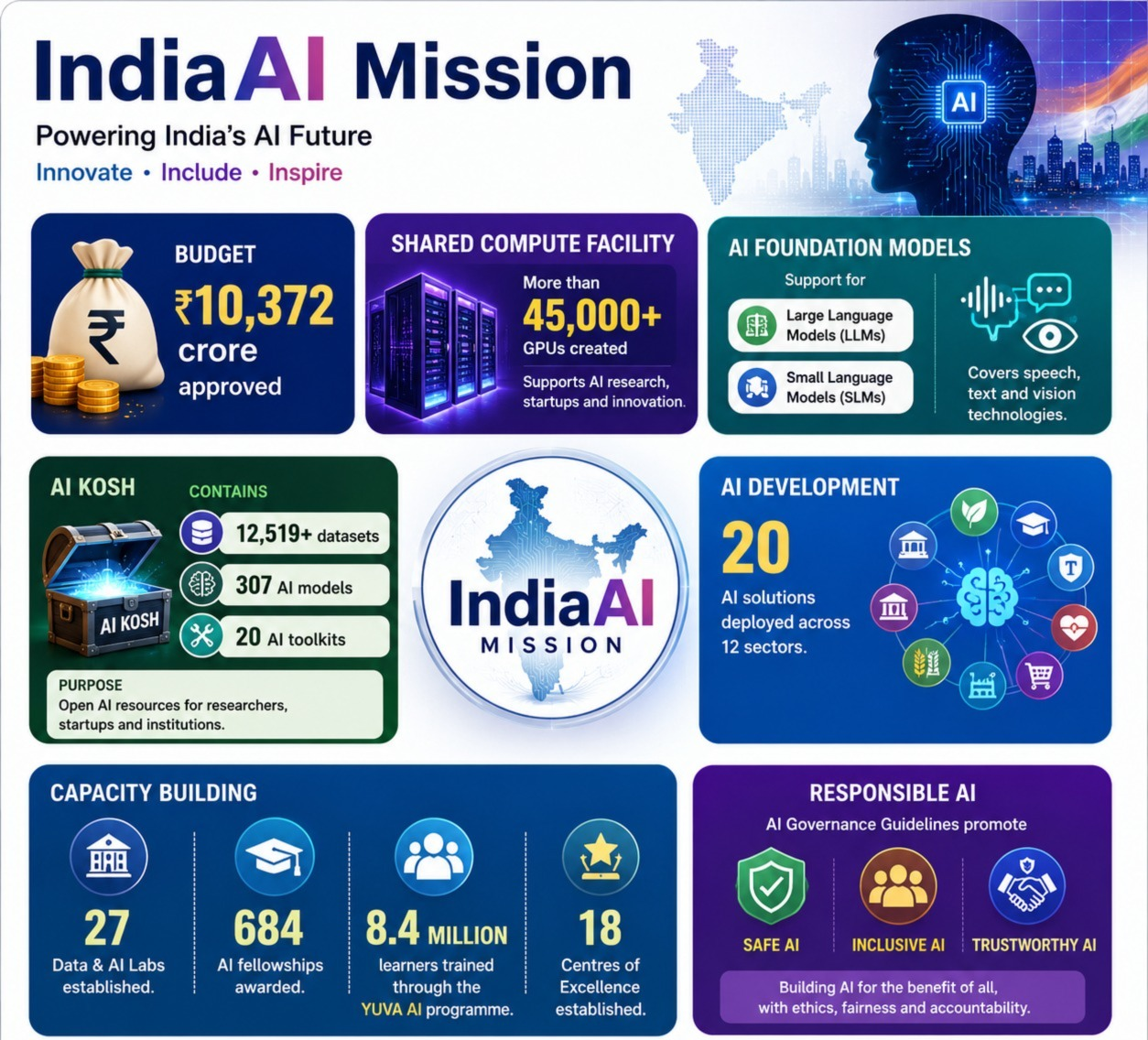
IndiaAI Mission: Building India's AI Ecosystem
The IndiaAI Mission, with an approved outlay of ₹10,372 crore, aims to create a world-class indigenous AI ecosystem.
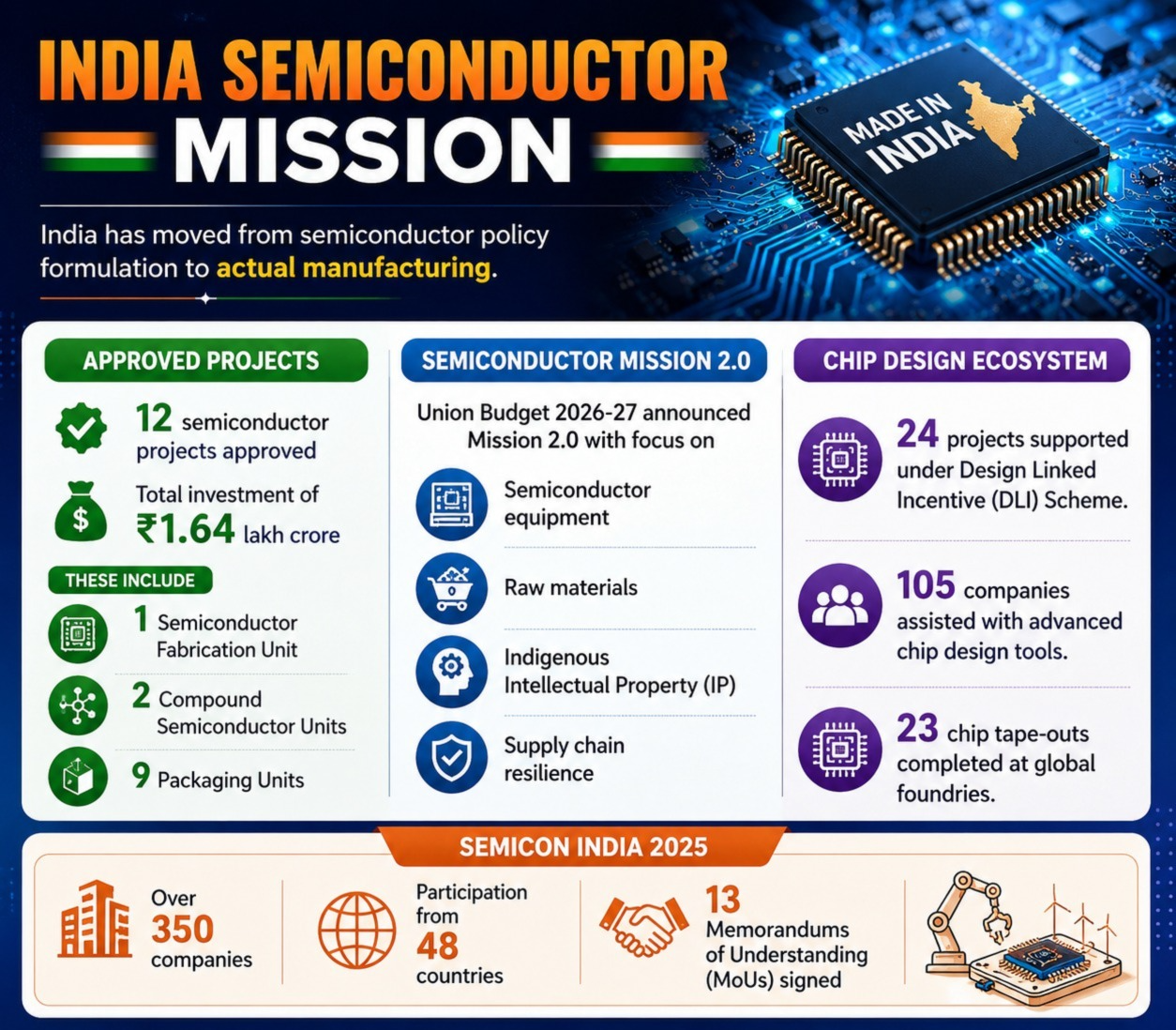
India's Global Digital Leadership
India is emerging as a global leader in Digital Public Infrastructure.
Key highlights:
-
Signed MoUs with 24 countries on India Stack and DPI.
-
UPI operational in several countries.
-
India Stack Global launched during G20 Presidency.
-
Indian digital platforms like Aadhaar, UPI, DigiLocker, CoWIN, GeM, DIKSHA, UMANG, and eSanjeevani are becoming global models.
Over the past 11 years, Digital India has transformed governance from paper-based administration to a technology-driven ecosystem powered by Digital Public Infrastructure. By integrating digital identity, payments, governance, healthcare, education, agriculture, commerce, and skilling, the programme has strengthened transparency, inclusion, and citizen empowerment. As India moves towards Viksit Bharat 2047, Digital India is expected to remain a key pillar of economic growth, innovation, and global digital leadership.
Prelims Questions:
1. Consider the following pairs:
Platform - Purpose
1. eSanjeevani - Telemedicine
2. UMANG - Government Services
3. AgriStack - Digital Agriculture
4. GeM - Government Procurement
How many pairs given above are correctly matched?
A. Only one
B. Only two
C. Only three
D. All four
Answer: D
2. With reference to Unified Payments Interface (UPI), consider the following statements:
-
UPI accounts for more than 80% of India's digital payments.
-
Nearly half of global real-time digital transactions are processed through UPI.
-
India's Digital Public Infrastructure has cooperation agreements with 23 countries.
Which of the statements given above is/are correct?
A. 1 only
B. 2 and 3 only
C. 1 and 3 only
D. 1, 2 and 3
Answer: D
Mains Question:
1. Discuss the role of Digital Public Infrastructure (DPI) in achieving the vision of Viksit Bharat 2047. What are the opportunities and challenges associated with India's digital transformation? (250 Words)
2. The next phase of national development will not be determined by the availability of natural resources, but by the nation's ability to create, own and responsibly deploy critical technologies. Discuss. (250 Words)
3. Good governance is no longer judged merely by the quality of policies but by the speed, accessibility and intelligence of public service delivery. Discuss. (150 words)