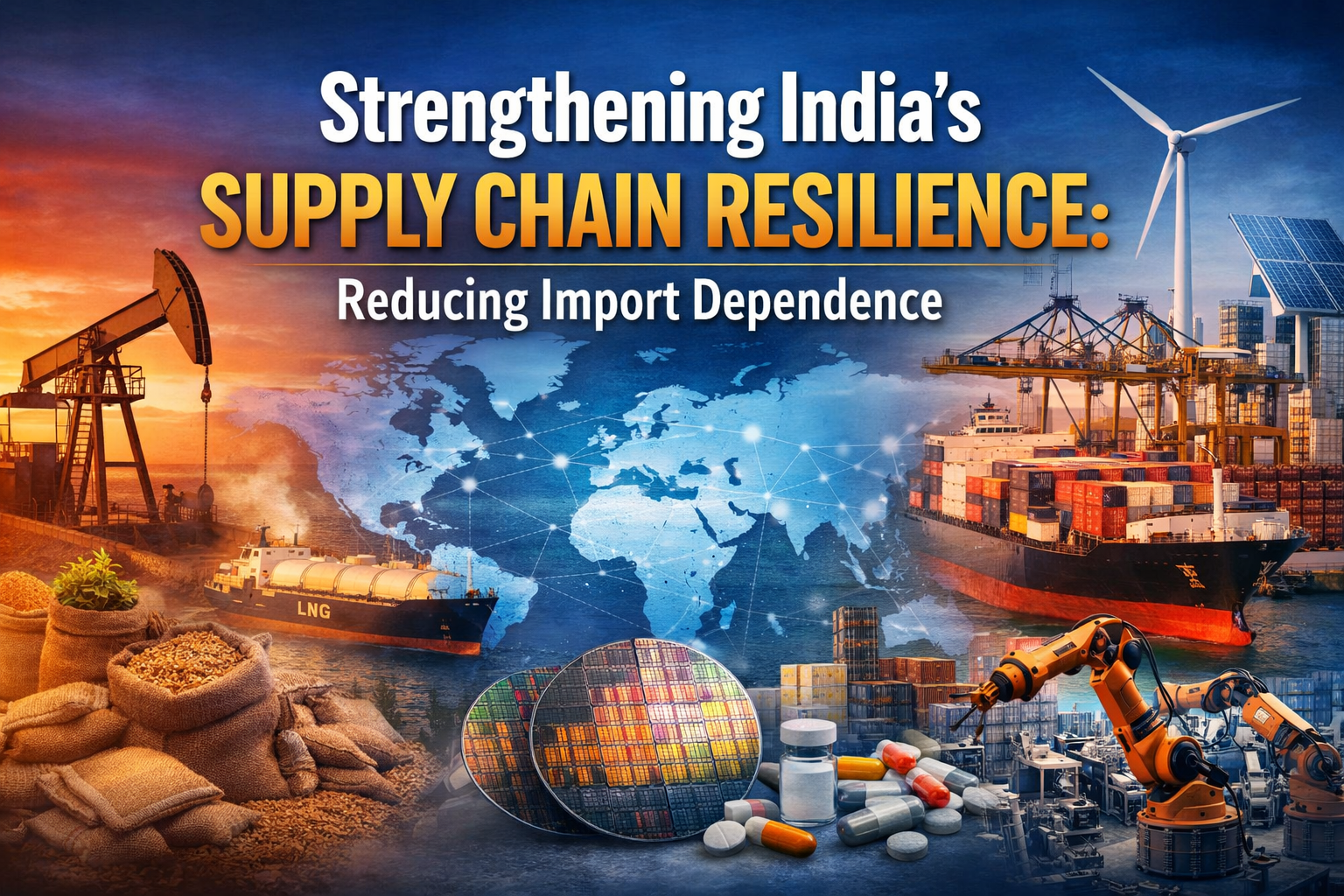
India’s supply chain vulnerabilities exposed by global disruptions highlight urgent need for import reduction, domestic manufacturing, energy security, and diversification to ensure economic resilience, stability, and sustainable long-term growth.
Syllabus Areas:GS II - International Relations GS III - Economy |
Why is it in the news?
-
Recent geopolitical tensions in West Asia have disrupted global supply chains.
-
This has exposed India’s heavy reliance on imports in critical sectors like energy, fertilizers, electronics, and pharmaceuticals.
-
The situation highlights the urgent need for India to build long-term economic resilience and reduce external vulnerabilities.
Introduction
-
India’s growth model is closely linked with global supply chains, enabling access to affordable inputs and technology.
-
However, this integration has also created systemic vulnerabilities, as disruptions in global markets directly affect domestic production and prices.
-
Therefore, the focus is shifting from efficiency-driven globalization to resilience-driven economic strategy.
Energy Security: The Core Structural Risk
-
India depends heavily on imports for energy, with about 85% of crude oil and over 50% of gas sourced externally.
-
This dependence makes the economy highly sensitive to geopolitical developments and price volatility.
-
Even a small increase in global oil prices has a multiplier effect:
-
It raises transportation and logistics costs.
-
It increases fertilizer prices, affecting agriculture.
-
It fuels inflation and reduces consumer purchasing power.
-
For instance, a $10 rise in crude oil prices can:
-
Significantly increase the import bill
-
Push inflation upward
-
Slow down GDP growth
-
To address this, India needs a balanced strategy:
-
Accelerating renewable energy expansion to reduce fossil fuel dependence
-
Investing in energy storage to ensure reliability
-
Promoting green hydrogen for long-term sustainability
-
Expanding domestic oil exploration for strategic security
-
Building petroleum reserves to handle short-term shocks
Energy security is not just an economic issue—it is a strategic necessity.
Food Security: An Overlooked Dependency
-
Despite being an agricultural powerhouse, India depends heavily on imports for edible oils, pulses, and fertilizers.
-
This creates a hidden vulnerability because:
-
Any global disruption directly affects food prices
-
It increases inflation, especially for poor households
-
It impacts rural incomes and agricultural stability
-
A key issue is the gap between domestic production and demand, especially in oilseeds and pulses.
-
Addressing this requires:
-
Strong procurement policies and price support for farmers
-
Encouraging crop diversification based on regional suitability
-
Creating buffer stocks to manage supply shocks
-
Reforming the fertilizer sector through:
-
Domestic production
-
Diversified import sources
-
Promotion of bio-fertilizers
Food security must be seen not just in terms of availability, but also stability and affordability.
Manufacturing Sector: The Hidden Weak Link
-
India’s imports account for a significant share of GDP, with a large portion consisting of raw materials and intermediate goods.
-
The structural issue is:
-
India is strong in final product manufacturing
-
But weak in upstream and intermediate production
-
This creates critical dependencies:
-
Pharmaceutical sector depends on imported APIs
-
Electronics sector relies on semiconductors and components
-
Industrial sector depends on imported machinery
-
These inputs are often non-substitutable, meaning:
-
If supply is disrupted, production cannot continue
-
This leads to economic losses and reduced competitiveness
-
Therefore, policy focus must shift from assembly to complete ecosystem development, including:
-
Intermediate goods manufacturing
-
Capital goods production
-
Technological capability building
Without strengthening the base, manufacturing growth remains fragile.
Critical Minerals: The Emerging Challenge
-
Modern industries depend on minerals like lithium, cobalt, copper, and rare earth elements.
-
These are essential for:
-
Electric vehicles
-
Renewable energy systems
-
Advanced electronics
-
However, their supply is highly concentrated globally, creating geopolitical risks.
-
For India, this means:
-
Potential disruption in future industries
-
Strategic vulnerability in energy transition
-
Solutions include:
-
Securing overseas mineral assets
-
Developing domestic mining capabilities
-
Promoting recycling and alternative technologies
Control over critical minerals will define future economic power.
Diversification: The Most Practical Solution
-
Reducing import dependence does not mean isolation; it means smart diversification.
-
At the domestic level:
-
Strengthening production of intermediates like APIs and semiconductors
-
Encouraging innovation and technology transfer
-
At the global level:
-
Expanding trade partnerships beyond traditional regions
-
Engaging with Africa and Latin America
-
At the technological level:
-
Adopting efficient production methods
-
Using alternative materials
-
Reducing input intensity
Diversification reduces risk without compromising growth.
Way Forward: Building a Resilient Ecosystem
-
Supply chain resilience requires a holistic approach:
-
Government → policy support and long-term vision
-
Industry → investment and innovation
-
Global partners → stable and diversified supply networks
-
It is not about short-term fixes, but about systemic transformation.
Conclusion:
-
India’s dependence on imports is a structural challenge that exposes it to global shocks.
-
The solution lies in building self-reliant yet globally integrated supply chains.
-
By focusing on:
-
Domestic capacity
-
Diversification
-
Technological advancement
India can transform vulnerability into strength and ensure sustainable, resilient economic growth in an uncertain world.
Prelims Questions1. With reference to India’s energy sector, consider the following statements:
Which of the statements given above is/are correct? Answer: (b) 2. Which of the following commodities contribute significantly to India’s import dependence?
Select the correct answer using the code below: Answer: (a) 3. Consider the following pairs:
Which of the pairs given above are correctly matched? Answer: (d) |
Mains Questions:1. Food security in India is increasingly linked with import dependence. Examine the statement and suggest reforms. 250 Words |