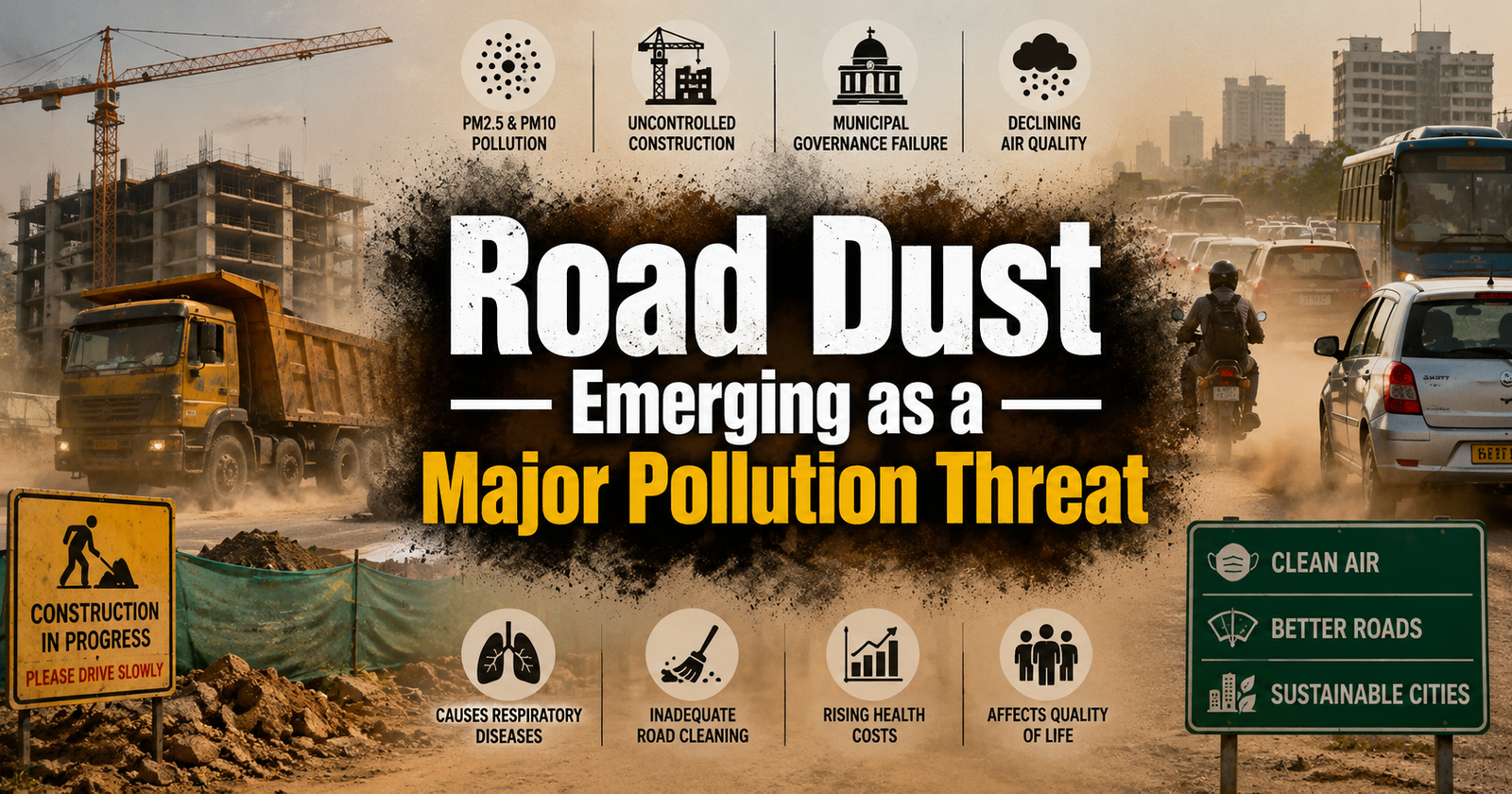
Road dust is emerging as a major contributor to urban air pollution, worsening PM2.5 and PM10 levels. Weak construction regulation, poor road maintenance, and governance gaps are intensifying public health and environmental challenges.
Syllabus Areas:GS III - Environment and Ecology |
Why is Road Dust Becoming a Major Concern?
Road dust has emerged as one of the largest contributors to urban air pollution, especially in rapidly growing cities. While industrial emissions and vehicle exhaust often receive more attention, dust generated from roads, construction activities, and poorly maintained public spaces significantly contributes to deteriorating air quality. Studies increasingly show that road dust is a major source of particulate matter pollution in Indian cities.
Understanding PM2.5 and PM10 Pollution
Particulate matter refers to extremely small particles suspended in the air that can enter the human body through breathing.
PM10 Pollution
PM10 includes particles with a diameter of less than 10 micrometers. Road dust contributes heavily to PM10 levels because loose soil, construction debris, and dust from damaged roads easily become airborne due to vehicle movement and wind.
PM2.5 Pollution
PM2.5 particles are much smaller and more dangerous because they can penetrate deep into the lungs and even enter the bloodstream. Road dust contributes indirectly to PM2.5 pollution when larger dust particles break down into finer particles through continuous movement and friction.
Health Impact
High concentrations of PM2.5 and PM10 can lead to respiratory diseases, asthma, cardiovascular disorders, lung damage, and increased health risks for children and elderly populations.
Major Sources of Road Dust Pollution
-
Construction Activities: Unregulated construction sites often leave exposed soil, sand, cement, and debris uncovered. Vehicle movement around these sites spreads fine particles into nearby residential and commercial areas.
-
Poor Road Infrastructure: Broken roads, potholes, and damaged surfaces generate large amounts of loose dust. Continuous traffic movement lifts these particles into the atmosphere.
-
Unpaved Roads and Shoulders: Many urban and peri-urban roads lack proper paving or maintenance. Unpaved shoulders act as constant dust generation zones.
-
Vehicular Movement: Heavy traffic continuously disturbs settled dust particles. Large vehicles such as trucks and buses contribute significantly due to stronger turbulence.
-
Improper Waste Management: Accumulation of construction debris, roadside waste, and uncovered dumping sites increases dust generation.
Urban Construction Regulation Challenges
-
Weak Enforcement of Rules: Although environmental regulations require construction sites to implement dust control measures, enforcement remains weak in many cities.
-
Lack of Dust Suppression Measures: Construction projects often fail to use water sprinklers, green covers, barricades, or debris management systems.
-
Poor Monitoring Systems: Municipal authorities frequently lack effective mechanisms to monitor compliance and penalize violators.
-
Rapid Urban Expansion: Fast-paced urbanization creates pressure for quicker construction, sometimes leading to environmental safeguards being ignored.
Municipal Governance Failures
-
Inadequate Street Cleaning: Many cities lack mechanized road sweeping systems and rely on manual cleaning methods that are insufficient for controlling dust.
-
Poor Coordination Between Agencies: Multiple agencies handle roads, construction approvals, sanitation, and traffic management, often leading to fragmented responses.
-
Insufficient Budget Allocation: Municipal bodies often face financial constraints, limiting investment in dust-control technologies and infrastructure maintenance.
-
Weak Accountability Systems: Lack of strict accountability mechanisms reduces pressure on agencies responsible for maintaining urban environmental standards.
Environmental and Economic Consequences
-
Declining Air Quality: Road dust significantly increases overall air pollution levels, making cities more vulnerable to prolonged poor air quality episodes.
-
Public Health Costs: Increasing pollution levels raise healthcare expenditure and reduce workforce productivity.
-
Reduced Urban Livability: Poor air quality negatively affects quality of life, tourism, and attractiveness for investment.
-
Climate and Ecosystem Effects: Dust particles influence local climatic conditions and can damage vegetation and urban ecosystems.
Measures for Effective Air Quality Management
-
Mechanized Road Cleaning: Cities should adopt mechanized vacuum sweepers and regular dust removal systems.
-
Dust Control at Construction Sites: Mandatory use of water spraying, green net coverings, barricades, and debris containment can reduce emissions.
-
Better Road Maintenance: Repairing damaged roads and paving road shoulders can significantly lower dust generation.
-
Data-Driven Monitoring: Real-time air quality monitoring systems should identify pollution hotspots and guide targeted interventions.
-
Strengthening Municipal Capacity: Municipal bodies need financial support, technical expertise, and stronger accountability frameworks.
-
Public Participation: Citizen reporting systems and awareness campaigns can help identify violations and improve compliance.
Road dust pollution represents an often overlooked but critical challenge for urban environmental governance. Addressing it requires coordinated action involving municipal authorities, construction agencies, urban planners, and citizens. Long-term improvements in air quality depend not only on controlling emissions from industries and vehicles but also on strengthening urban governance and infrastructure management.