Explore MoSPI 20th Statistics Day 2026, its theme, significance, key highlights, major publications, administrative data, and importance for UPSC Prelims and Mains preparation.
Syllabus Areas:
GS III - Economy
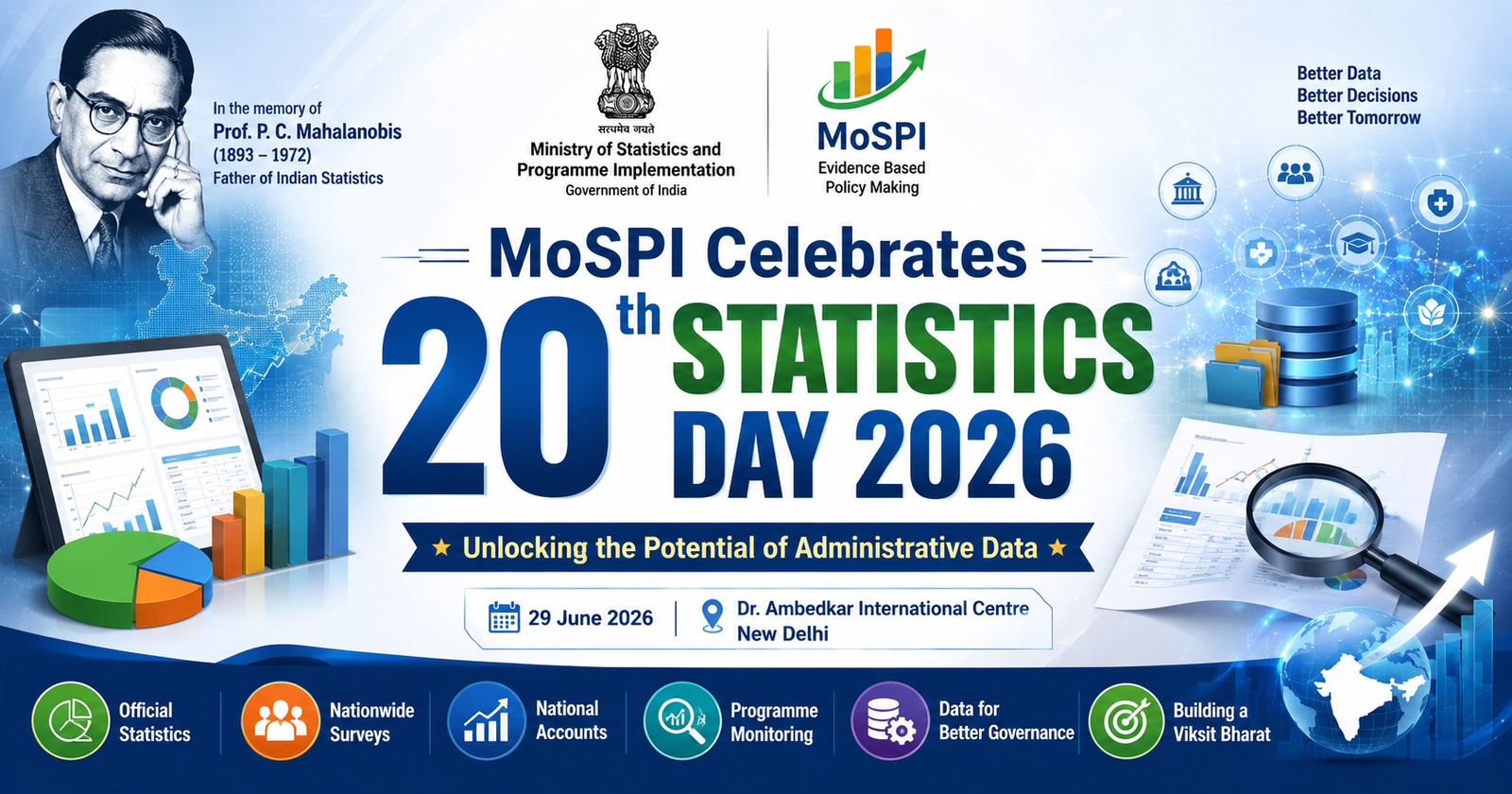
The Ministry of Statistics and Programme Implementation (MoSPI) celebrated the 20th Statistics Day on 29 June 2026 to commemorate the 133rd birth anniversary of Prof. Prasanta Chandra (P. C.) Mahalanobis, the architect of India's modern statistical system. The theme for this year's celebration was "Unlocking the Potential of Administrative Data", highlighting the growing role of administrative data in evidence-based governance.
What is Statistics Day?
-
Statistics Day is observed every year on 29 June, the birth anniversary of Prof. P. C. Mahalanobis.
-
The day recognizes his immense contribution to statistics, planning, and economic development in India.
-
It also promotes awareness about the importance of statistics in policymaking, governance, research, and national development.
Prasanta Chandra Mahalanobis (29 June 1893 – 28 June 1972):
He was one of India's greatest statisticians and planners. He is widely regarded as the Father of Modern Statistics in India. His contributions laid the foundation for India's statistical system, economic planning, and large-scale sample surveys.
Major Contributions
-
Founded the Indian Statistical Institute (ISI) in 1931
-
One of the world's premier institutions for statistics, mathematics, computer science, and quantitative economics.
-
Mahalanobis Distance
-
Developed the famous statistical measure called the Mahalanobis Distance, which is widely used in:
-
Machine Learning
-
Artificial Intelligence
-
Pattern Recognition
-
Data Classification
-
Multivariate Statistics
-
National Sample Survey (NSS)
-
Instrumental in establishing the National Sample Survey (NSS) in 1950.
-
Introduced scientific sample survey techniques in India.
-
Economic Planning
-
Played a leading role in preparing India's Second Five-Year Plan (1956–61).
-
Proposed the Mahalanobis Model, emphasizing rapid industrialization through investment in heavy industries and capital goods.
Why Administrative Data Matters
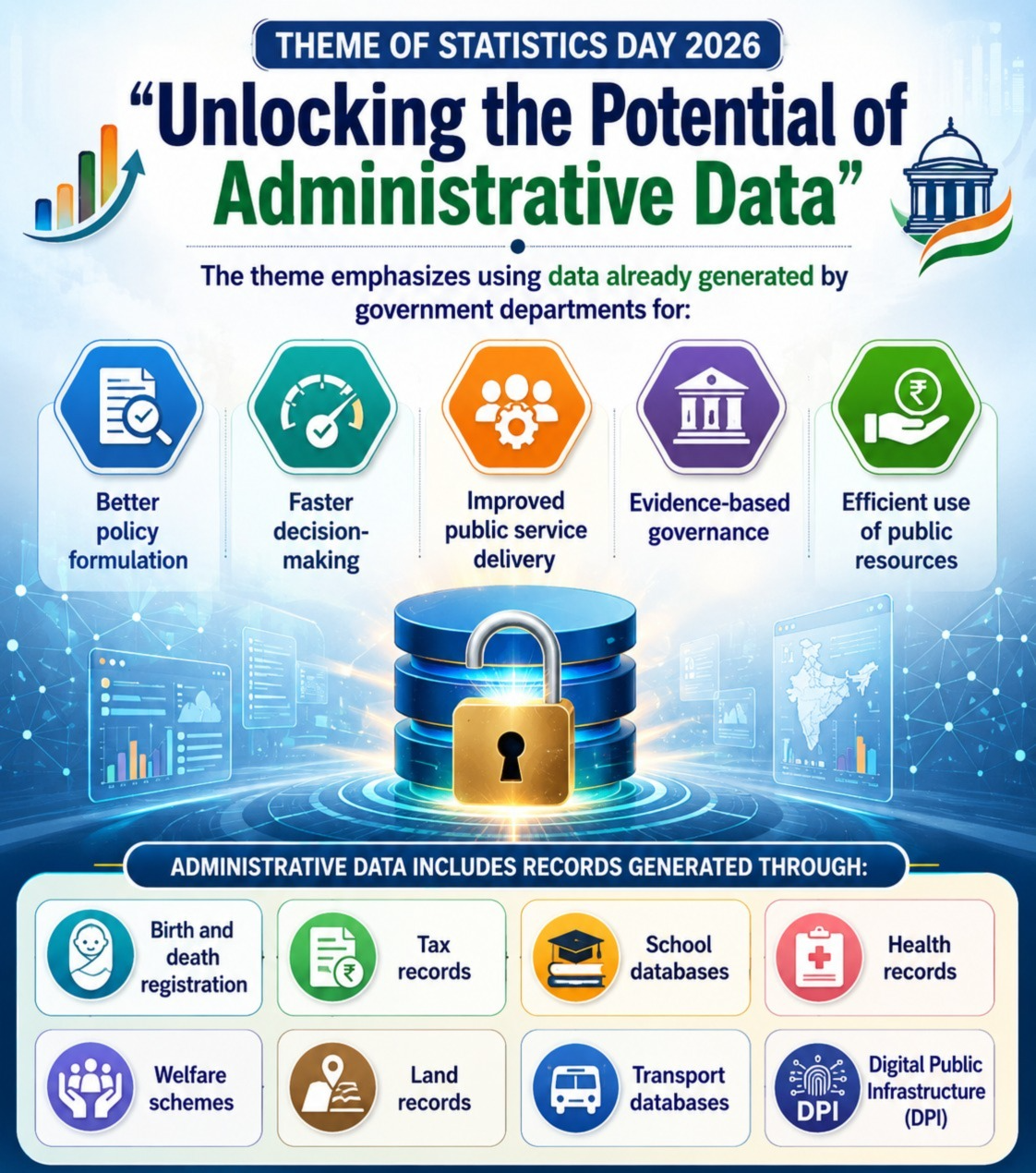
Administrative data plays a crucial role in strengthening evidence-based governance and improving public service delivery. Key benefits include:
-
Provides real-time information, enabling timely and informed policy decisions.
-
Reduces the cost and time involved in conducting large-scale surveys.
-
Improves data accuracy and reliability through continuously updated government records.
-
Enhances monitoring and evaluation of welfare schemes and public programmes.
-
Supports AI-driven policymaking by supplying large, structured datasets for advanced analytics.
-
Helps track India's progress towards Viksit Bharat 2047 through regular performance measurement.
-
Complements traditional surveys, offering more comprehensive and granular insights while maintaining statistical credibility.
Administrative data is intended to supplement—not replace—traditional statistical surveys, creating a stronger and more efficient national statistical system.
Major Publications Released
MoSPI released several important publications during the event:
1. Sustainable Development Goals – National Indicator Framework Progress Report 2026
Tracks India's progress towards achieving the SDGs.
2. Data Snapshot on SDGs – National Indicator Framework Progress Report 2026
Provides concise statistical indicators on SDG performance.
3. Sustainable Development Goals – National Indicator Framework 2026
Includes updated indicators along with metadata.
4. Labour Market Dynamics in Million-plus Cities
Analyzes employment trends in India's major urban centres.
5. Urban Unincorporated Enterprise Landscape
Provides insights into informal urban enterprises in million-plus cities.
6. Transforming Lives: India's Achievements under the People Dimension of the SDGs
Highlights India's progress in improving people's well-being under the SDGs.
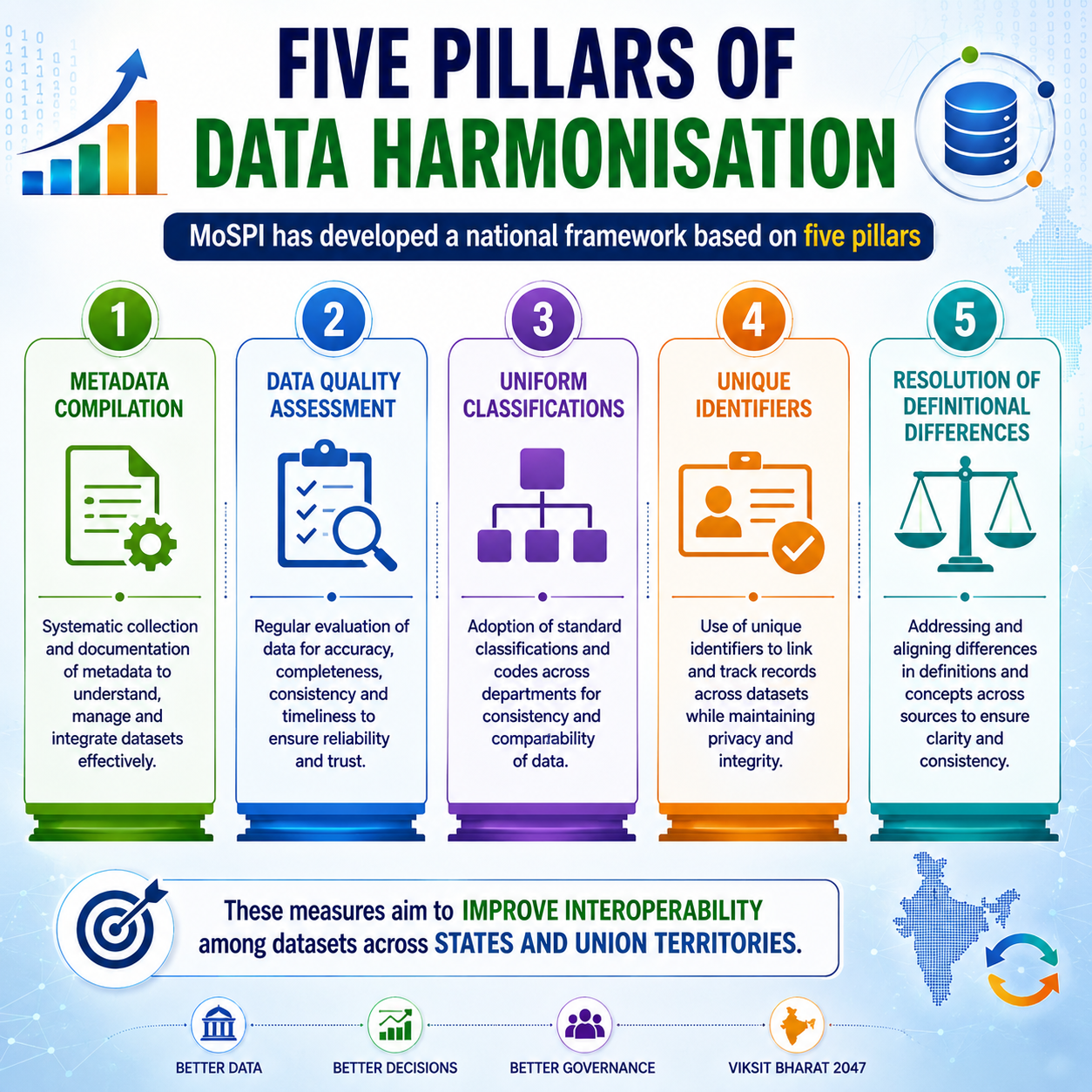
7. Handbook on Harmonisation of Datasets
Provides guidance for standardizing and integrating datasets across departments.
8. MoSPI Vision Document 2026–2031
Outlines the ministry's long-term roadmap for strengthening India's statistical system.
Ministry of Statistics and Programme Implementation (MoSPI)
MoSPI stands for the Ministry of Statistics and Programme Implementation. It is the nodal ministry of the Government of India responsible for collecting, compiling, analyzing, and disseminating official statistics, as well as monitoring the implementation of major government programmes and projects.
Objectives
-
Provide reliable and timely statistical data for policymaking.
-
Monitor the progress of major government schemes and infrastructure projects.
-
Improve evidence-based governance through quality statistics.
-
Coordinate statistical activities across Central and State Governments.
Major Responsibilities
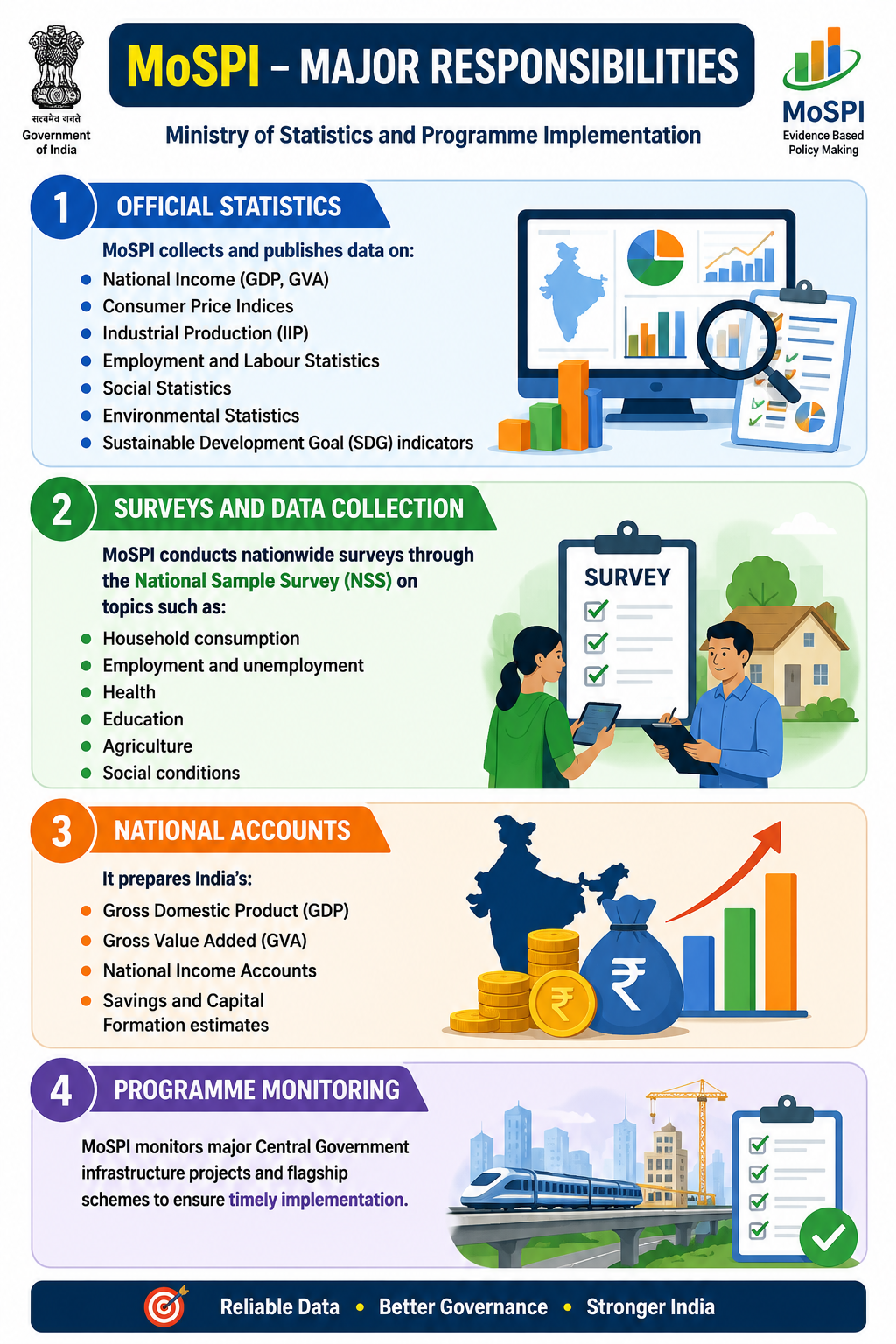
1. Official Statistics
-
MoSPI collects and publishes data on National Income (GDP, GVA), Consumer Price Indices, Industrial Production (IIP), Employment and Labour Statistics, Social Statistics, Environmental Statistics, Sustainable Development Goal (SDG) indicators
2. Surveys and Data Collection
-
MoSPI conducts nationwide surveys through the National Sample Survey (NSS) on topics such as Household consumption, Employment and unemployment, Health, Education, Agriculture, Social conditions
3. National Accounts
-
It prepares India's Gross Domestic Product (GDP), Gross Value Added (GVA), National Income Accounts, Savings and Capital Formation estimates
4. Programme Monitoring
-
MoSPI monitors major Central Government infrastructure projects and flagship schemes to ensure timely implementation.