
India updates its climate targets with ambitious NDC goals, focusing on renewable energy, emissions intensity reduction, and carbon sinks, while facing challenges in fossil fuel dependence, industrial growth, and implementation gaps.
Syllabus Areas:GS III - Environment |
India has recently updated its Nationally Determined Contributions (NDCs), setting more ambitious climate targets for 2035. This development comes at a crucial time when new data shows that India’s emissions growth has slowed significantly in 2025. The update is not just a routine revision but a signal of India’s evolving climate strategy in the context of global pressure, domestic development needs, and the accelerating clean energy transition.
Background: Understanding NDCs and the Global Climate Framework
Under the Paris Agreement (2015), all participating countries are required to submit Nationally Determined Contributions (NDCs). These are:
-
Voluntary climate action plans
-
Periodically updated to increase ambition
-
Focused on reducing greenhouse gas emissions and adapting to climate change
Unlike legally binding treaties, NDCs rely on political commitment, peer pressure, and global cooperation rather than strict enforcement.
India first submitted its NDC in 2015 and later updated it in 2022. The latest revision reflects a continuation of this incremental approach, aligning with global expectations while balancing domestic priorities.
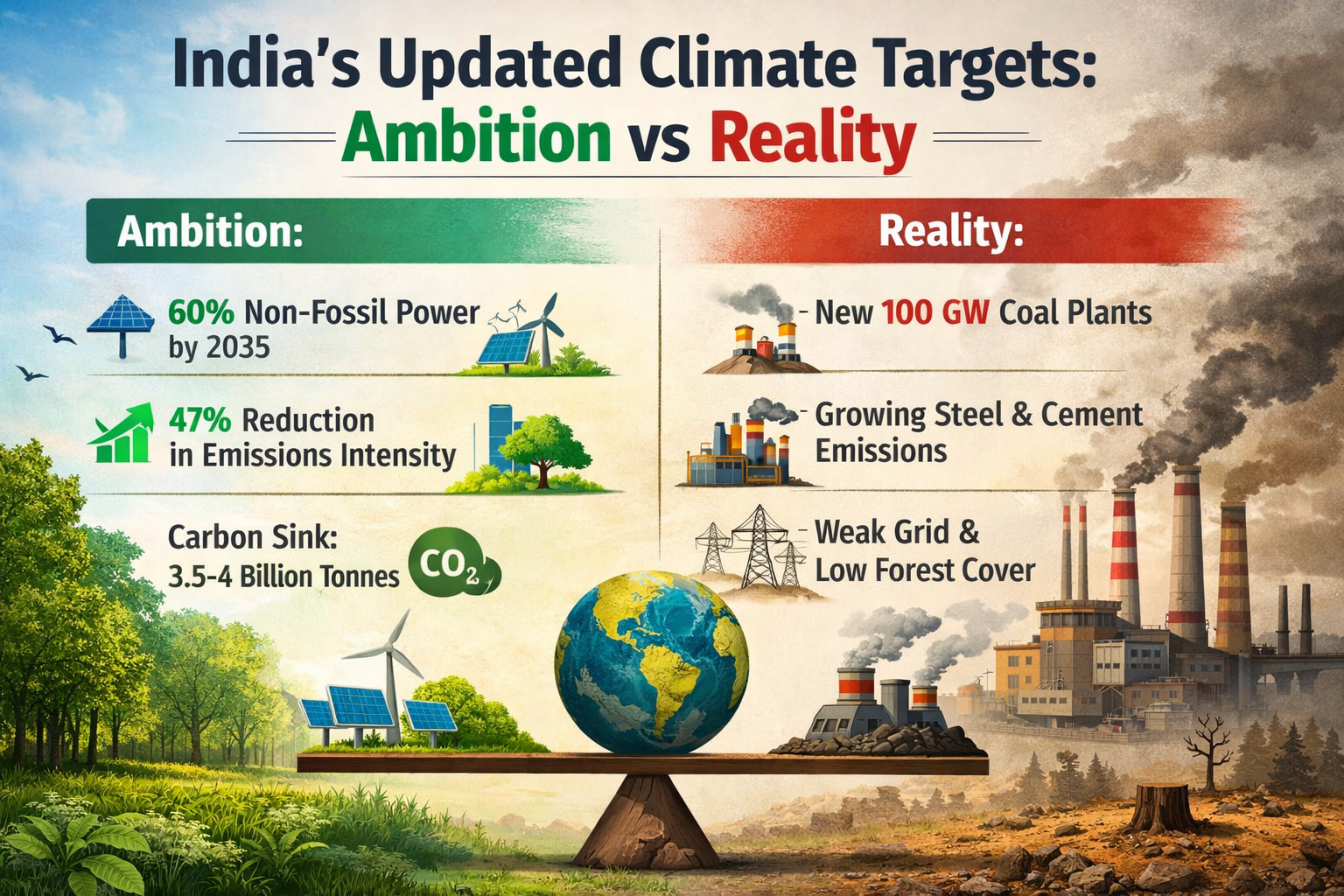
India’s Updated Climate Targets for 2035
The Union Cabinet has approved a new set of targets that significantly enhance India’s climate ambition:
1. Expansion of Non-Fossil Energy Capacity
-
Target: 60% of installed electricity capacity from non-fossil sources by 2035
-
Earlier target: 50% by 2030
This is a notable increase, especially since India has already achieved around 52% non-fossil capacity by early 2026, well ahead of its earlier deadline.
2. Reduction in Emissions Intensity
-
Target: 47% reduction in emissions intensity of GDP (from 2005 levels)
-
Earlier target: 45%
This reflects India’s continued reliance on efficiency improvements rather than absolute emission cuts.
3. Enhancement of Carbon Sink
-
Target: 3.5–4 billion tonnes of CO₂ equivalent through forests and tree cover
-
Earlier target: 2.5–3 billion tonnes
This places greater emphasis on afforestation and ecosystem-based mitigation strategies.
Closing the Global Gap
India’s updated NDC also addresses a diplomatic gap:
-
By the end of 2025, India and Argentina were the only G20 countries yet to submit a 2035 NDC
-
With this update, India aligns itself with global climate reporting expectations
This move strengthens India’s position in international climate negotiations.
Effectiveness of NDCs: A Global Reality Check
Despite repeated updates, the effectiveness of NDCs remains questionable.
Findings from Global Reports
-
UNEP Emissions Gap Report 2025 states that countries have missed targets repeatedly
-
Current commitments are insufficient to limit warming to 1.5°C
-
Global warming projections still range between 2.3°C and 2.5°C
-
Only about 14% of the required emissions reduction gap is being addressed
Key Structural Weaknesses
-
Lack of clear roadmaps for phasing out fossil fuels
-
Minimal focus on reducing fossil fuel subsidies
-
Heavy dependence of developing nations on international climate finance, which remains inadequate
Even after agreements like the COP28 UAE Consensus, countries have not committed to decisive actions such as reducing oil and gas production.
The Clean Energy Transition: Driven by Markets, Not Policies
Interestingly, the global shift toward clean energy is accelerating—but not primarily due to NDCs.
Key Trends
-
Record 814 GW of renewable capacity added globally in 2025
-
Renewables surpassed coal as the largest electricity source globally
Drivers of Change
-
Rapid decline in renewable energy costs
-
Industrial competition, especially China’s manufacturing dominance
Critical Insight
NDCs are increasingly acting as:
-
Documentation tools reflecting ongoing trends
rather than -
Policy instruments driving transformation
India’s Emissions Trends: Signs of a Turning Point
A recent analysis by CREA highlights a significant shift:
Key Observations (2025)
-
CO₂ emissions grew by only 0.7%, the slowest rate in over two decades (excluding COVID period)
-
Power sector emissions declined by 3.8%
Clean Energy Expansion
India added substantial capacity in 2025:
-
Solar: 47 GW
-
Wind: 6.3 GW
-
Hydro: 4 GW
-
Nuclear: 0.6 GW
This increase was sufficient to meet most of the rising electricity demand, reducing dependence on coal.
Possible Structural Shift
India may reach a critical inflection point by 2026, where:
-
Clean energy additions match or exceed demand growth
Sectoral Imbalance: The Hard-to-Abate Challenge
While the power sector shows progress, other sectors remain problematic:
-
Steel sector emissions increased by 8%
-
Cement sector emissions increased by 10%
These industries are:
-
Energy-intensive
-
Dependent on fossil fuels
-
Difficult to decarbonize quickly
This highlights the uneven nature of India’s climate transition.
Contradictions in India’s Development Path
Despite ambitious climate targets, India continues to invest in carbon-intensive sectors:
-
Planned addition of 100 GW coal-fired capacity
-
$1 trillion investment in petrochemicals by 2040
-
Expansion of coal-based steel production
The Core Contradiction
India is simultaneously:
-
Expanding clean energy and
-
Reinforcing fossil fuel infrastructure
This reflects a development-climate trade-off, common among emerging economies.
Implementation Challenges
1. Grid Infrastructure Constraints
-
Around 37 GW of renewable capacity remains stranded
-
Cause: inadequate transmission and grid readiness
2. Carbon Sink Limitations
What is a Carbon Sink?A carbon sink is any natural or artificial system that absorbs more carbon dioxide (CO₂) from the atmosphere than it releases, thereby helping to reduce global warming. |
-
Forest cover target: 33%
-
Current level: ~24%
Additionally, reliance on trees outside forests raises concerns about:
-
Measurement accuracy
-
Long-term sustainability
The Debate: Emissions Intensity vs Absolute Emissions
India uses emissions intensity (emissions per unit of GDP) as its primary metric.
Advantages
-
Reflects efficiency improvements
-
Accounts for developmental needs
-
Aligns with equity principles (low per capita emissions)
Concerns
-
Absolute emissions can still rise
-
May not align with global climate stabilization goals
This remains a contentious issue in international climate negotiations.
Beyond Targets to Transformation
India’s updated NDCs represent a significant step forward in ambition, particularly in renewable energy expansion and emissions efficiency. However, the broader picture reveals:
-
Strong progress in the power sector
-
Persistent challenges in heavy industries
-
Structural contradictions in policy direction
-
Implementation gaps in infrastructure and forest cover
At a global level, the NDC framework itself appears limited in driving transformative change.
Prelims Questions:1. Consider the following statements regarding Nationally Determined Contributions (NDCs):
Which of the statements given above is/are correct? Answer: B 2. Which of the following targets are part of India’s updated NDC (2035)?
Select the correct answer: Answer: A |
Mains Questions:1. Explain the concept of emissions intensity. How does India justify its use, and what are the limitations of this approach in global climate governance? 250 Words |
Also Read Related Topics Below,
2. Carbon Credit Scheme Targets
4. India’s Carbon Market & Carbon Sink
5. Reviving Agrobiodiversity for Nutrition & Climate Resilience