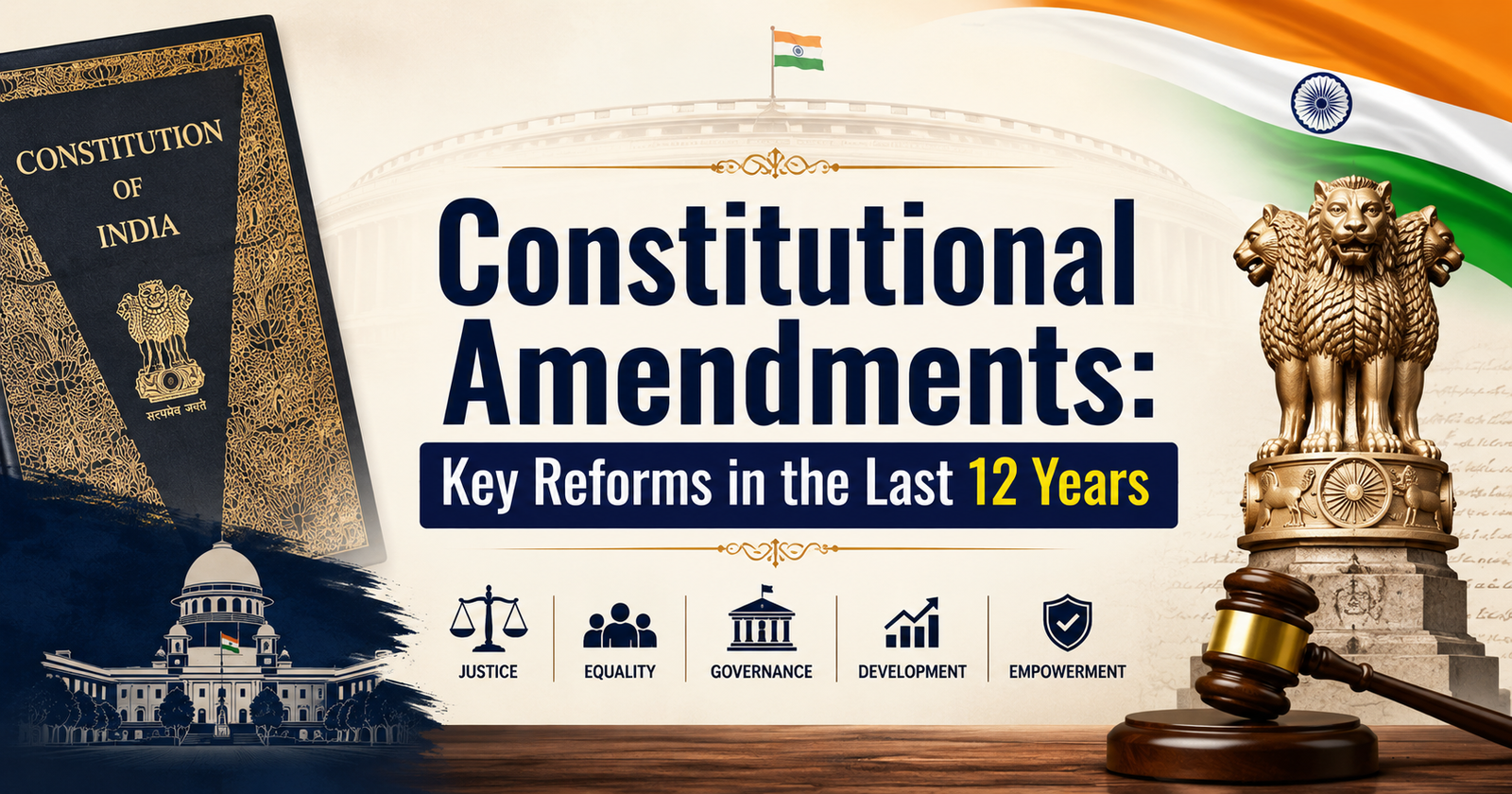
Explore the eight Constitutional Amendments enacted between 2014 and 2026, covering their objectives, key constitutional articles, major reforms, significance, and essential facts for UPSC Prelims and Mains.
Syllabus Areas:
GS II - Polity
The Ministry of Law and Justice informed Parliament that eight Constitutional Amendment Acts have been enacted during the last twelve years (2014–2026). The information was provided by the Union Minister of Law and Justice, Shri Arjun Ram Meghwal, in a written reply to the Lok Sabha.
A Constitutional Amendment is the formal process of modifying the Constitution under Article 368 to meet changing needs while preserving its Basic Structure.
Article 368: Article 368 empowers Parliament to amend the Constitution by a special majority and, in specified cases, with ratification by at least half the States.
1. 99th Constitutional Amendment Act, 2014
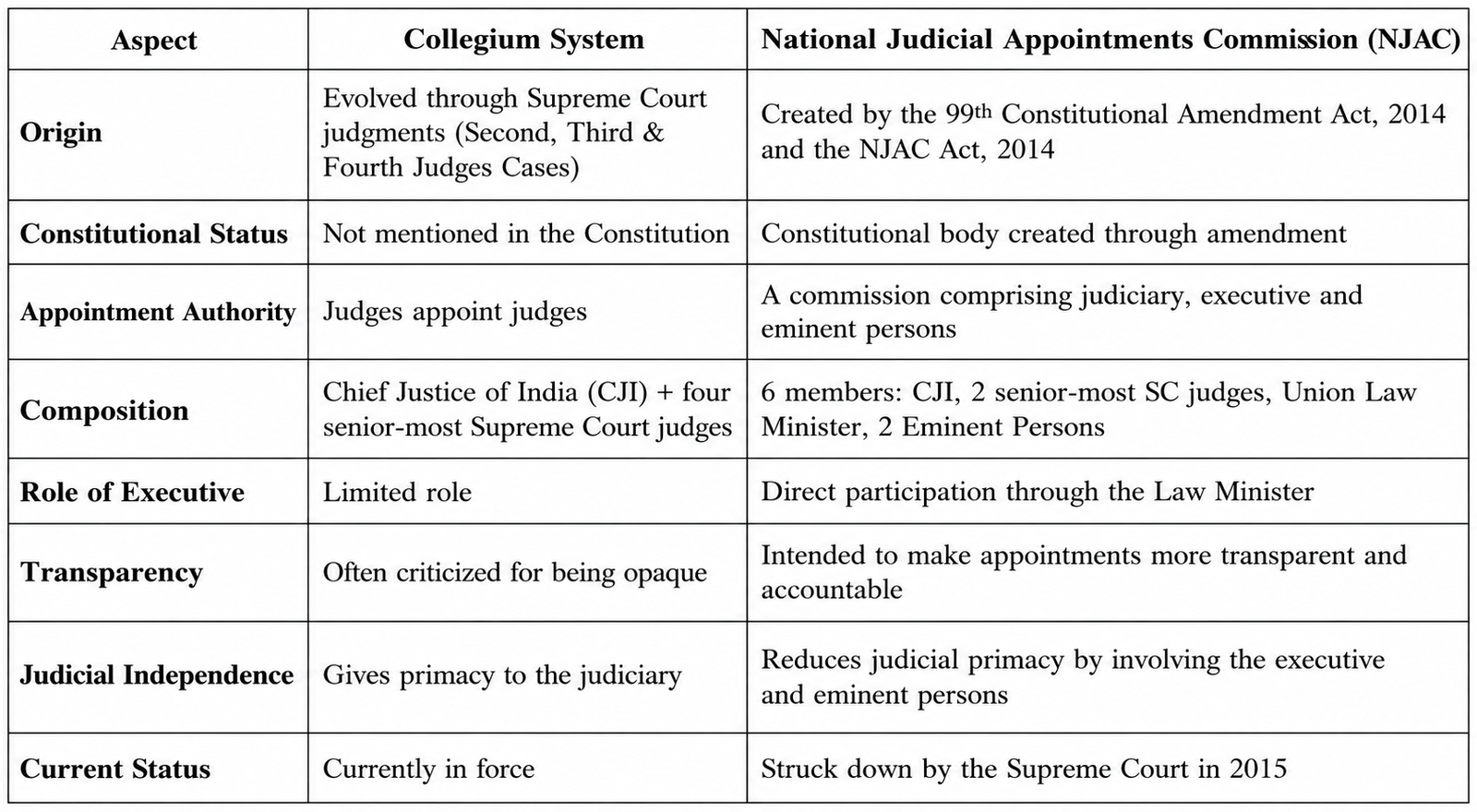
National Judicial Appointments Commission (NJAC)
Objective
-
To replace the Collegium System with the National Judicial Appointments Commission (NJAC) for appointing judges to:
-
Supreme Court
-
High Courts
Significance
-
Intended to make judicial appointments more transparent and accountable.
-
Reduced the exclusive role of the judiciary in appointing judges.
-
In 2015, the Supreme Court struck down the 99th Amendment as unconstitutional in the Fourth Judges Case.
-
The Court restored the Collegium System citing violation of the Basic Structure Doctrine (Judicial Independence).
2. 100th Constitutional Amendment Act, 2015
India–Bangladesh Land Boundary Agreement
The 1974 India–Bangladesh Land Boundary Agreement (LBA), also known as the Indira–Mujib Agreement, was signed on 16 May 1974 between:
-
India – Prime Minister Indira Gandhi
-
Bangladesh – Prime Minister Sheikh Mujibur Rahman
Objective
-
Its objective was to resolve the long-standing boundary disputes inherited from the partition of India in 1947.
Key Features
-
Exchange of enclaves.
-
Settlement of adverse possessions.
-
Final demarcation of international boundaries.
Importance
-
Resolved a long-pending border dispute.
-
Improved India–Bangladesh relations.
-
Enhanced border security and governance.
3. 101st Constitutional Amendment Act, 2016
Goods and Services Tax (GST)
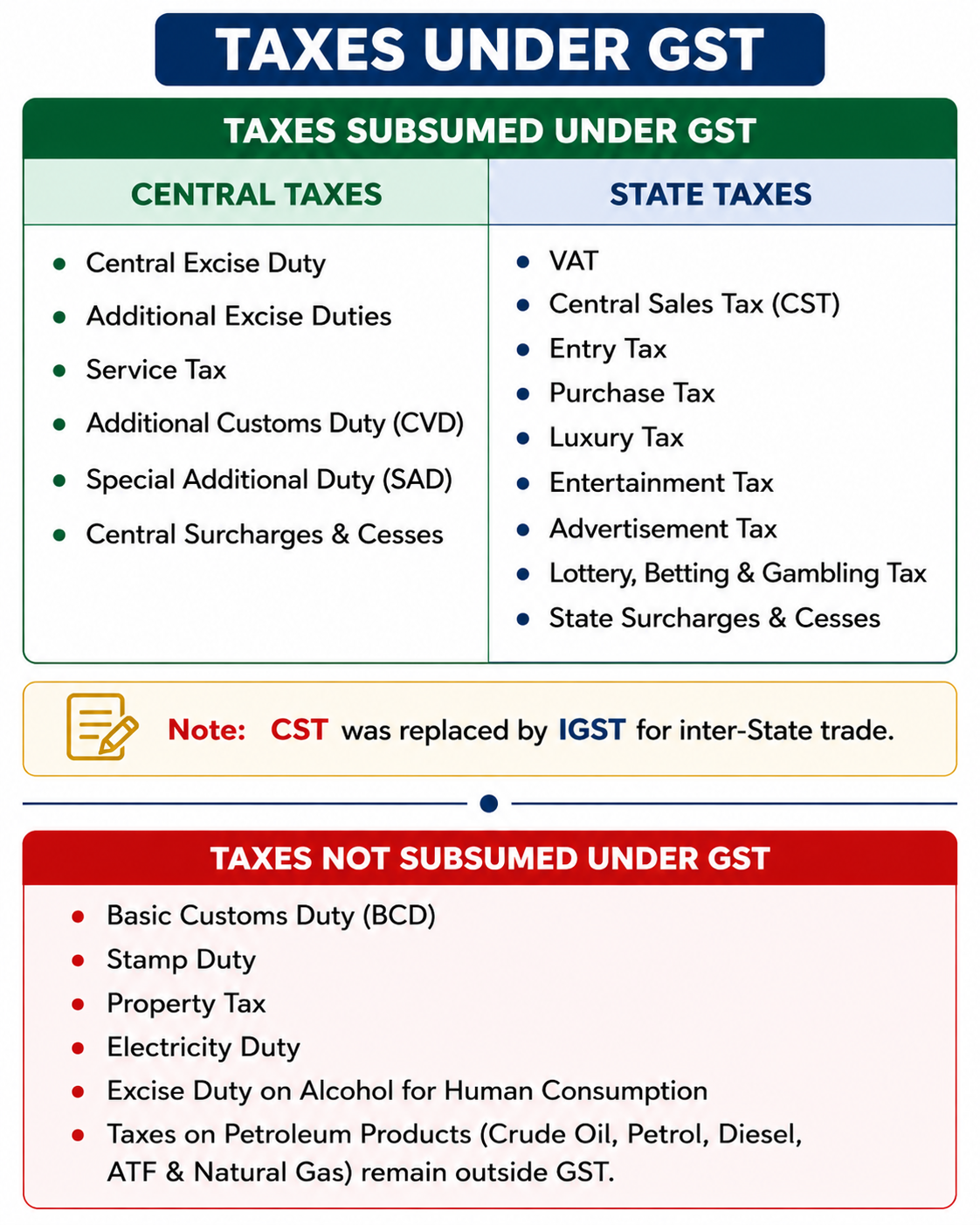
Goods and Services Tax (GST) is a destination-based indirect tax replacing multiple taxes, creating "One Nation, One Tax, One Market" across India.
Objective
-
Introduced the Goods and Services Tax (GST).
Major Changes
-
Created One Nation, One Tax.
-
Subsumed multiple indirect taxes.
-
Added:
-
Article 246A: Special Provision for GST - Empowers Parliament and State Legislatures to make laws on Goods and Services Tax (GST). Parliament has exclusive power to legislate on inter-State supply of goods and services.
-
Article 269A: Levy and Collection of GST on Inter-State Trade (≈30 words) - Provides that GST on inter-State supplies (IGST) shall be levied and collected by the Central Government and apportioned between the Centre and States as prescribed by Parliament.
-
Article 279A: GST Council - Establishes the GST Council, chaired by the Union Finance Minister, to recommend GST rates, exemptions, threshold limits, model laws, and policies, ensuring cooperative fiscal federalism.
GST Council
-
The GST Council is a constitutional body constituted by the President of India.
Composition of the GST Council:
-
Union Finance Minister – Chairperson
-
Union Minister of State (Finance/Revenue) – Member
-
Finance Minister (or Taxation Minister) of each State – Member
-
Vice-Chairperson - Chosen by the State representatives from among themselves.
-
Recommends GST rates, exemptions and policies.
Importance
-
Biggest indirect tax reform in independent India.
4. 102nd Constitutional Amendment Act, 2018
Constitutional Status to NCBC
Objective
-
Granted constitutional status to the National Commission for Backward Classes (NCBC).
Articles Added
-
Article 338B: National Commission for Backward Classes (NCBC) - Provides constitutional status to the National Commission for Backward Classes (NCBC), empowering it to investigate safeguards, inquire into complaints, advise governments, and monitor the welfare of Socially and Educationally Backward Classes (SEBCs).
-
Article 342A: Socially and Educationally Backward Classes (SEBCs) - Empowers the President to notify the Central List of Socially and Educationally Backward Classes (SEBCs). After the 105th Constitutional Amendment (2021), States can also maintain their own State OBC Lists.
Functions
-
Safeguards interests of OBCs.
-
Advises government on welfare measures.
-
Investigates complaints.
Importance
-
Strengthened constitutional protection for Other Backward Classes.
5. 103rd Constitutional Amendment Act, 2019
Reservation for Economically Weaker Sections (EWS): Upheld by the Supreme Court in Janhit Abhiyan v. Union of India (2022).
Objective
-
Introduced 10% reservation for Economically Weaker Sections.
Coverage
-
Government jobs.
-
Educational institutions.
Articles Added
-
Article 15(6): Empowers the State to provide 10% reservation for Economically Weaker Sections (EWS) in educational institutions, including private unaided institutions.
-
Article 16(6): Empowers the State to provide 10% reservation for Economically Weaker Sections (EWS) in appointments and posts under government employment.
Significance
-
First reservation based solely on economic criteria.
6. 104th Constitutional Amendment Act, 2019
Extension of Reservation for SCs and STs
Objective
-
Extended reservation of seats for Scheduled Castes, Scheduled Tribes in Lok Sabha, State Legislative Assemblies
Validity
-
Extended till 25 January 2030.
Another Important Change
-
Ended reservation of seats for the Anglo-Indian community through nomination.
7. 105th Constitutional Amendment Act, 2021
Restoration of States' Power to Identify OBCs
Objective
-
Restored the powers of State Governments to prepare and maintain their own State OBC Lists.
Reason
-
Passed after the Supreme Court's Maratha Reservation Judgment (2021).
Articles Amended
-
Article 338B: Provides constitutional status to the National Commission for Backward Classes (NCBC) to investigate safeguards, inquire into complaints, monitor welfare, and advise governments on SEBCs.
-
Article 342A: Empowers the President to notify the Central List of Socially and Educationally Backward Classes (SEBCs). States may maintain separate State OBC Lists after the 105th Amendment
-
Article 366: Defines important constitutional terms. The 105th Constitutional Amendment inserted Article 366(26C), defining Socially and Educationally Backward Classes (SEBCs) for constitutional purposes.
Importance
-
Re-established federal balance regarding OBC identification.
8. 106th Constitutional Amendment Act, 2023
Women's Reservation (Nari Shakti Vandan Adhiniyam)
Objective
-
Reserve 33% seats for women in Lok Sabha, State Legislative Assemblies
Key Features
-
Reservation effective after:
-
Next Census
-
Delimitation exercise
-
Valid for 15 years, with possible extension by Parliament.
Importance
-
Historic step towards women's political empowerment.