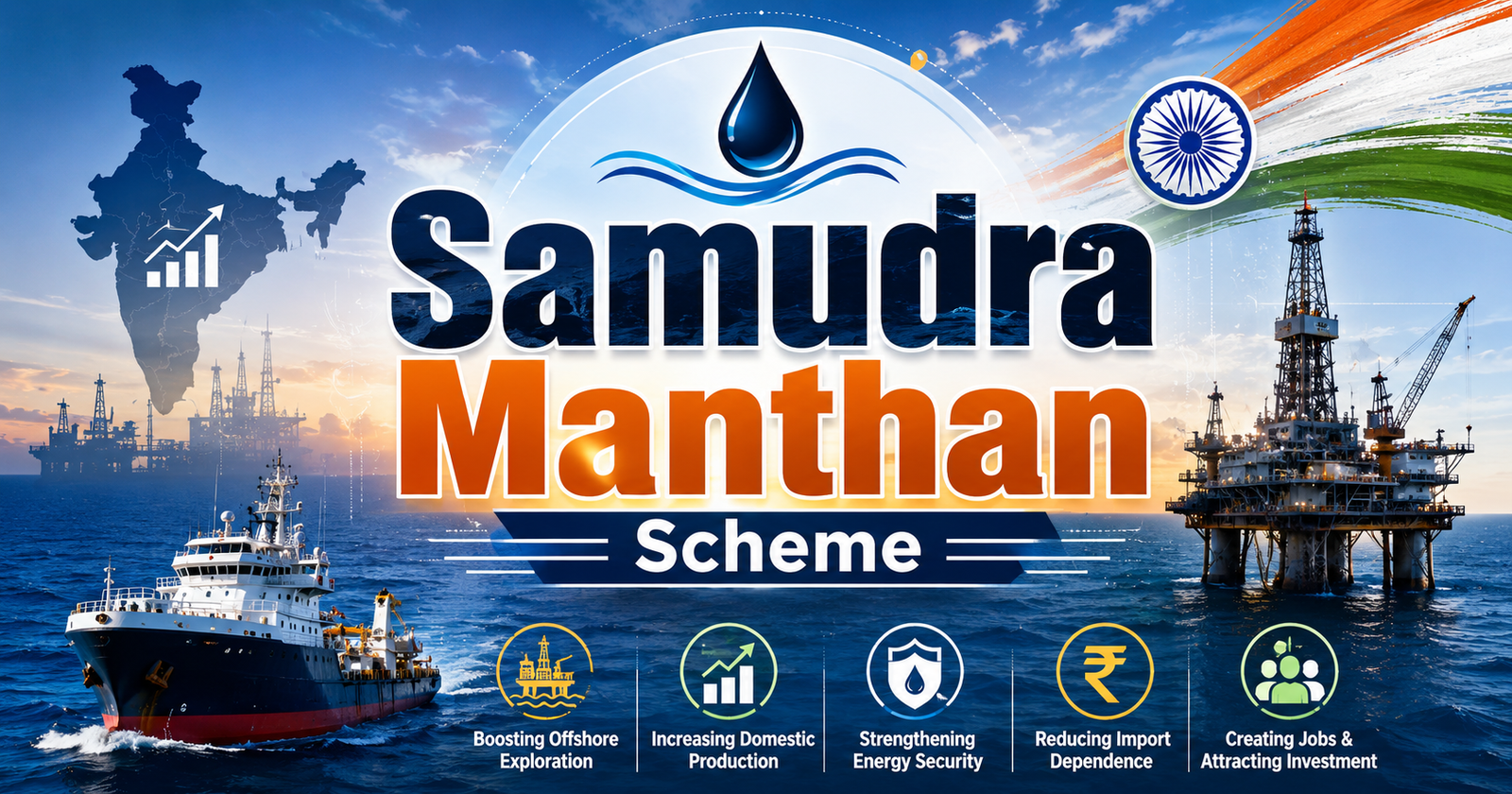
The ₹84,000-crore Samudra Manthan Scheme aims to boost offshore oil and gas exploration, strengthen energy security, reduce import dependence, attract investment, and enhance domestic production.
Syllabus Areas:
GS III - Economy and Environment
The Union Cabinet has approved the ₹84,000-crore Samudra Manthan Scheme, a five-year offshore oil and gas exploration programme aimed at revitalizing India's domestic hydrocarbon production. The initiative seeks to reduce India's heavy dependence on crude oil imports, enhance energy security, promote indigenous technology, and attract private as well as foreign investments into the exploration and production (E&P) sector.
What are Hydrocarbons?
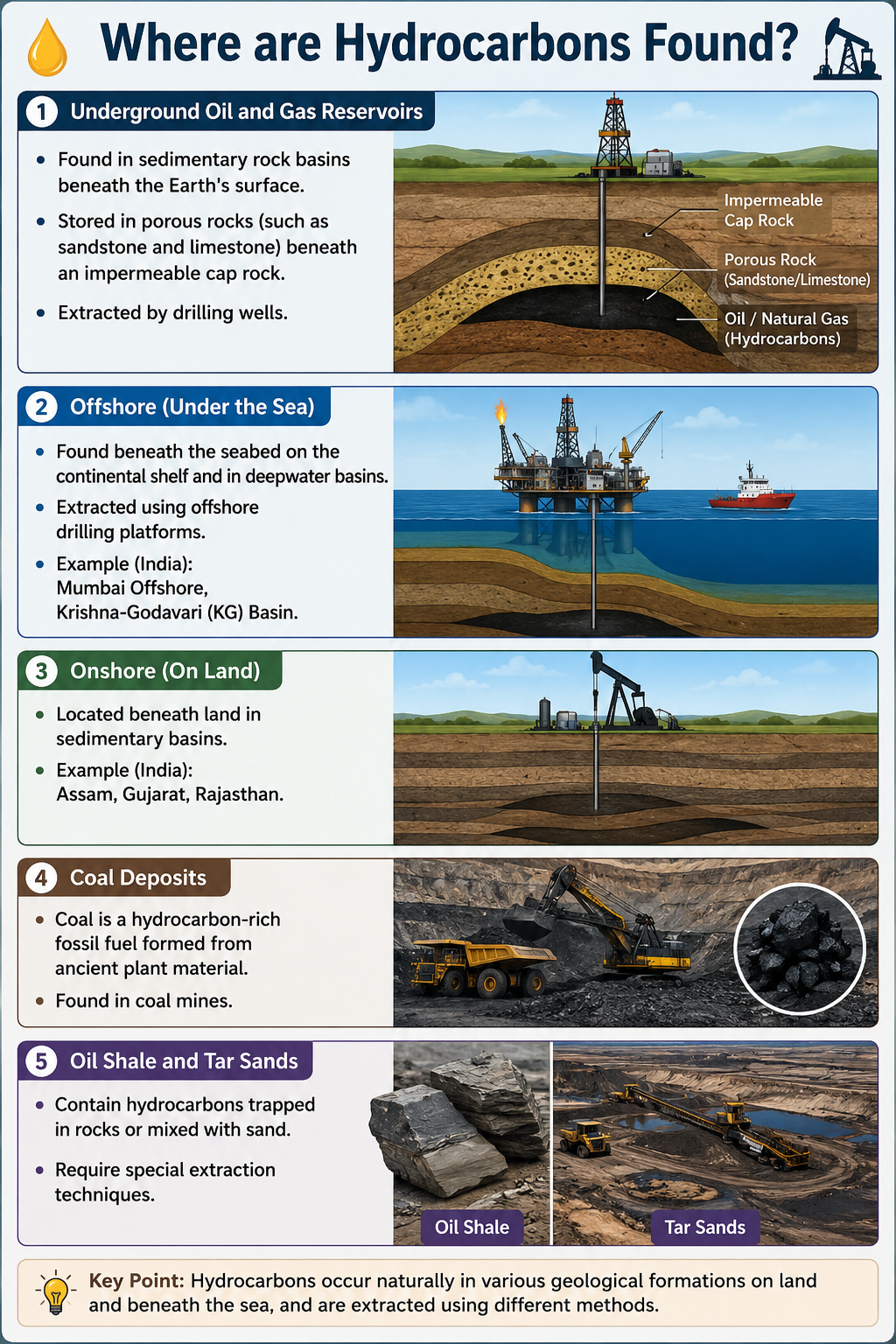
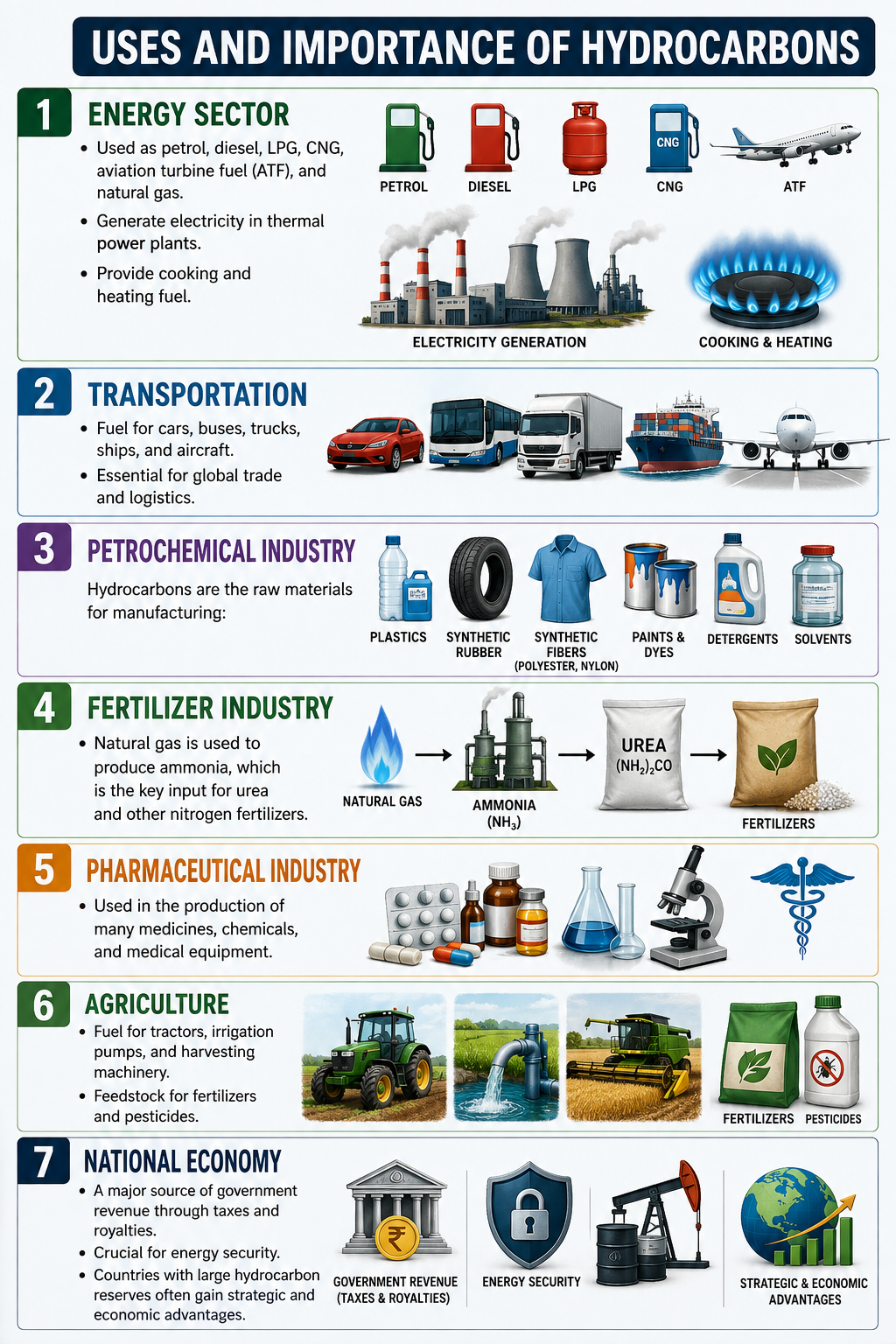
Hydrocarbons are organic compounds made up of only two elements: carbon (C) and hydrogen (H). They are the main components of fossil fuels such as natural gas, petroleum, and coal.
How are hydrocarbons formed?
-
Formed from the remains of ancient plants, algae, and marine organisms.
-
Buried under layers of sediment for millions of years.
-
Heat and pressure convert this organic matter into crude oil, natural gas, and coal.
Why is India Launching the Scheme?
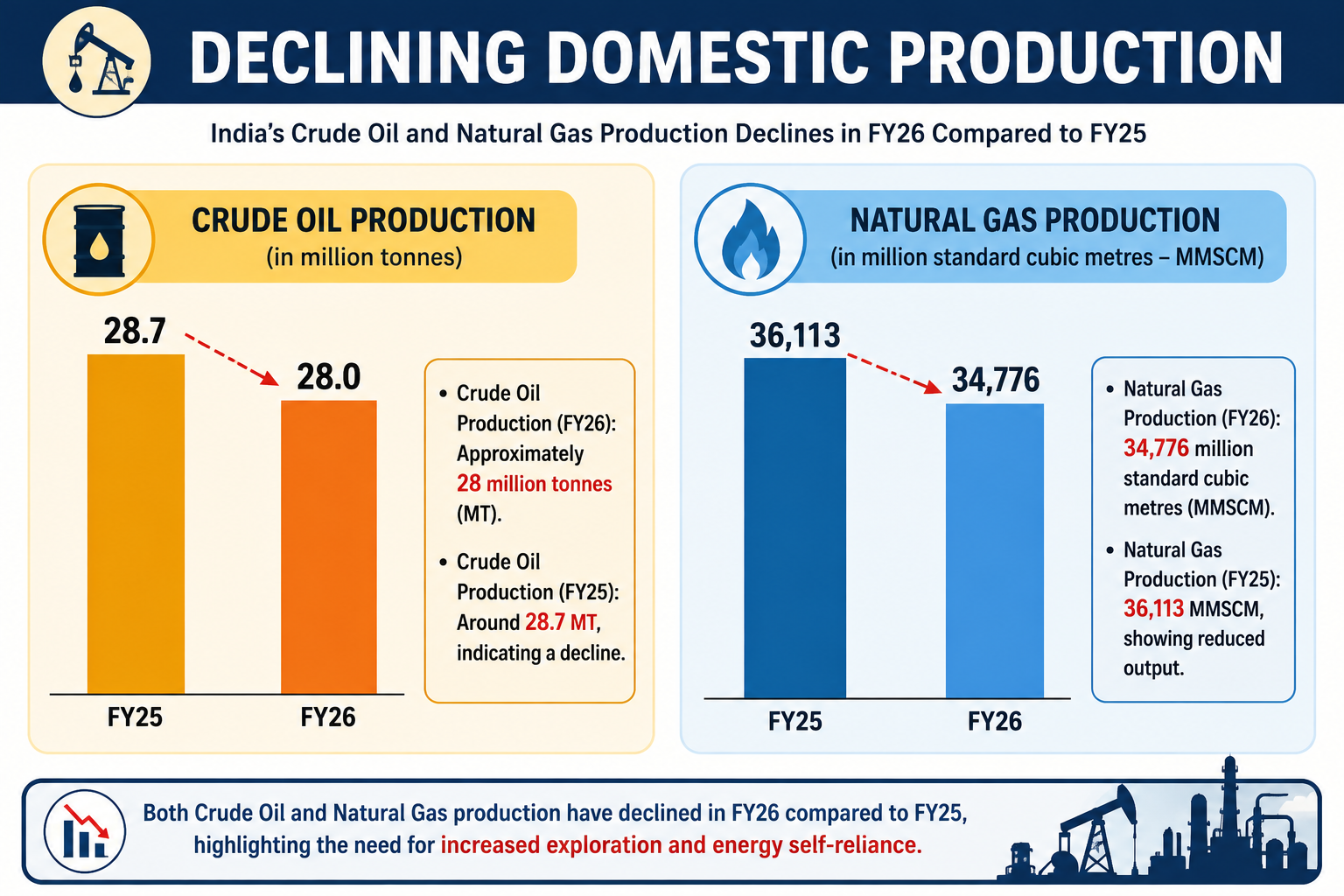
India's domestic crude oil and natural gas production has remained largely stagnant over the past few years, while energy demand has continued to increase.
Rising Import Dependence
-
India imports nearly 90% of its crude oil requirements.
-
Around 50% of the country's natural gas consumption is also met through imports in the form of Liquefied Natural Gas (LNG).
Economic Significance
-
Additional domestic production has the potential to reduce India's crude oil import bill by nearly ₹1 trillion annually.
-
India's petroleum consumption reached a record 241.6 million tonnes (MT) in FY26, reflecting growing energy demand.
What is Deepwater Exploration?
Deepwater exploration refers to the process of locating and drilling oil and gas reservoirs in offshore areas where the water depth generally exceeds 200 metres, often extending into ultra-deepwater regions beyond 1,500 metres.
Challenges
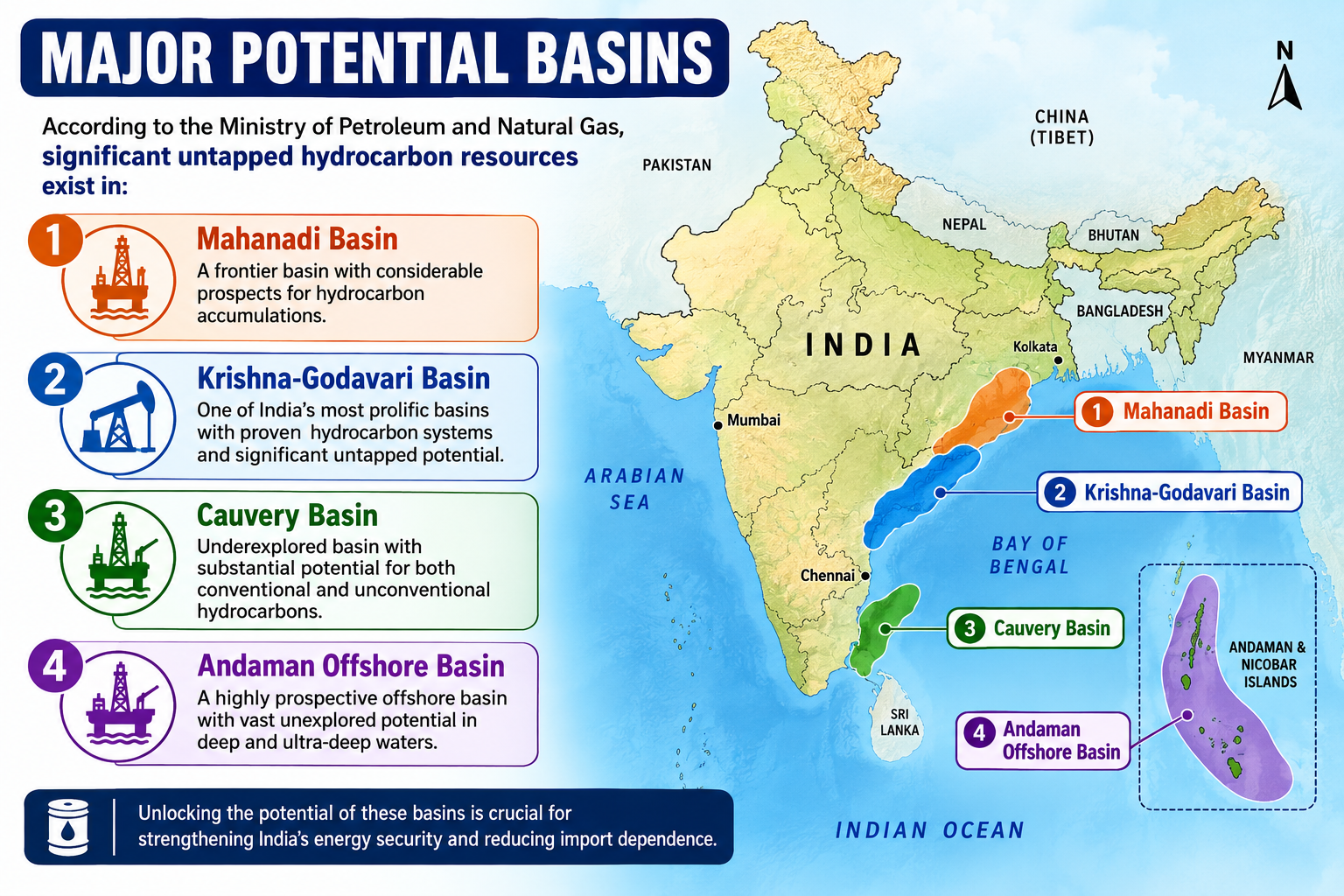
Deepwater exploration is highly capital-intensive and technologically demanding.
-
Requires advanced drilling technologies.
-
Exploration involves high geological risks.
-
A single exploratory well may cost between US$125 million and US$150 million.
-
Existing offshore oil and gas fields experience an annual production decline of 6–7%, making fresh exploration essential.
Objectives of the ₹84,000-Crore Scheme
The scheme aims to significantly expand India's domestic oil and gas production capacity.
Production Targets
-
Increase domestic oil and gas production from approximately 62 million tonnes of oil equivalent (MTOE) to 80 MTOE annually.
-
Expand India's hydrocarbon resource base from 1.6 billion tonnes of oil equivalent (BTOE) to 2.2 BTOE.
Strategic Importance
The programme assumes greater significance amid:
-
Global energy supply disruptions.
-
Geopolitical uncertainties, particularly arising from conflicts in West Asia.
-
India's long-term goal of strengthening energy security and reducing import dependence.
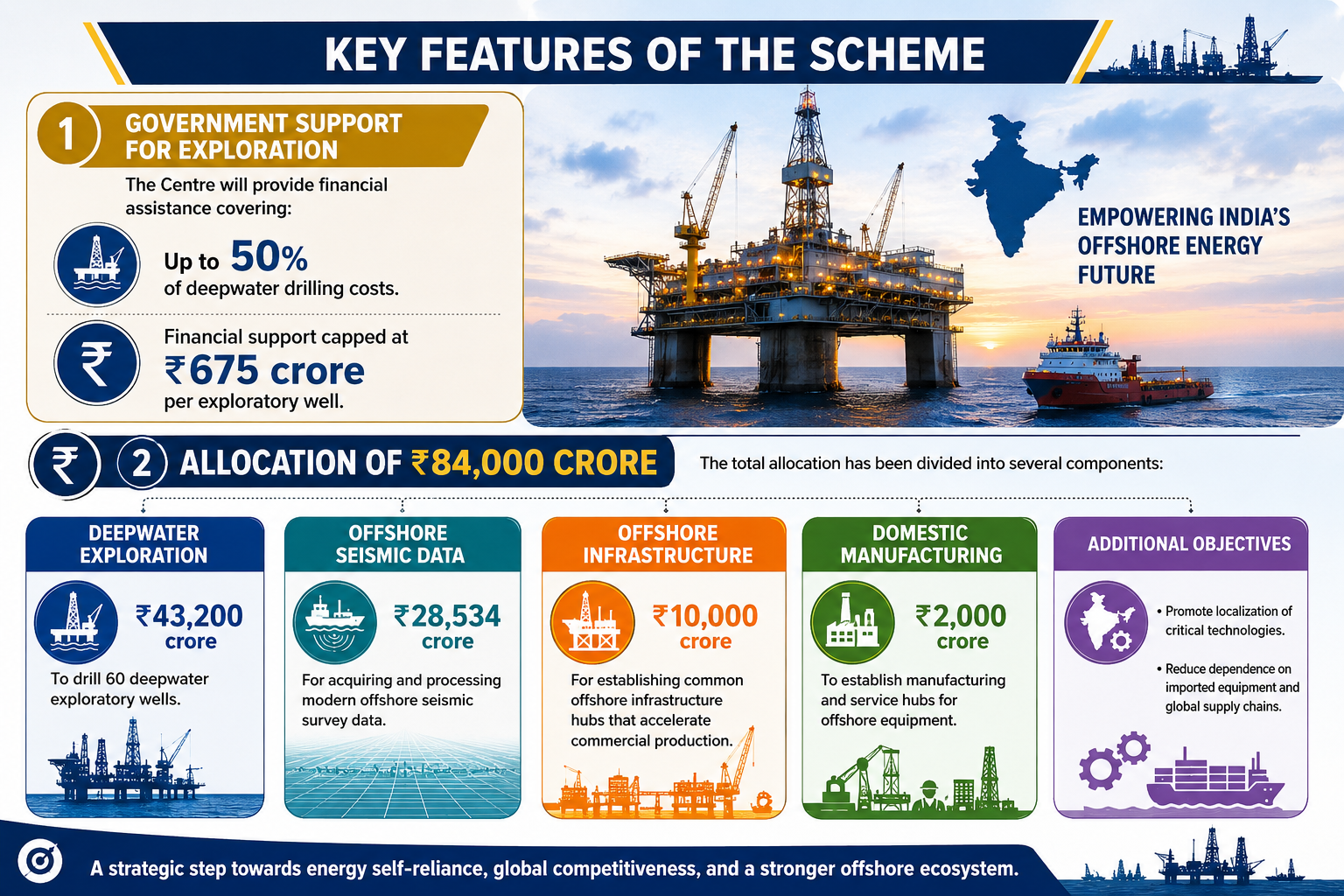
Expected Impact on India's Exploration Sector:
-
Improved Geological Understanding: Better seismic surveys and geological mapping reduce exploration uncertainty.
-
Lower Financial Risk: Government support reduces the cost and risk of deepwater drilling.
-
Enhanced Commercial Viability: Shared offshore infrastructure lowers costs and speeds up production.
-
Increased Investment: Attracts domestic E&P companies, global energy firms, and FDI.
-
Energy Security: Boosts domestic oil and gas production, reducing import dependence.
Significance for India
The Samudra Manthan Scheme is expected to:
-
Strengthen India's energy security.
-
Reduce dependence on imported crude oil and LNG.
-
Boost domestic hydrocarbon production.
-
Promote advanced offshore exploration technologies.
-
Develop indigenous offshore manufacturing capabilities.
-
Generate employment in the oil and gas sector.
-
Improve India's balance of payments by reducing the oil import bill.
-
Enhance resilience against global energy price volatility and geopolitical disruptions.
The ₹84,000-crore Samudra Manthan Scheme marks a major step towards strengthening India's energy security by boosting offshore exploration, reducing import dependence, attracting investment, and supporting long-term economic growth and self-reliance.