Firecracker regulation highlights the balance between religious freedom, public health and the right to clean air. Proportionate restrictions, effective enforcement and responsible citizenship can make celebrations safer and less polluting.
UPSC relevance:
GS II — Fundamental Rights, Judiciary and Governance;
GS III — Environmental Pollution.
Context
The Supreme Court permitted conditional use of certified green firecrackers during Deepavali in Delhi-NCR, highlighting the need to reconcile religious celebrations with public health and environmental protection.
Constitutional Framework
|
Provision |
Significance |
|
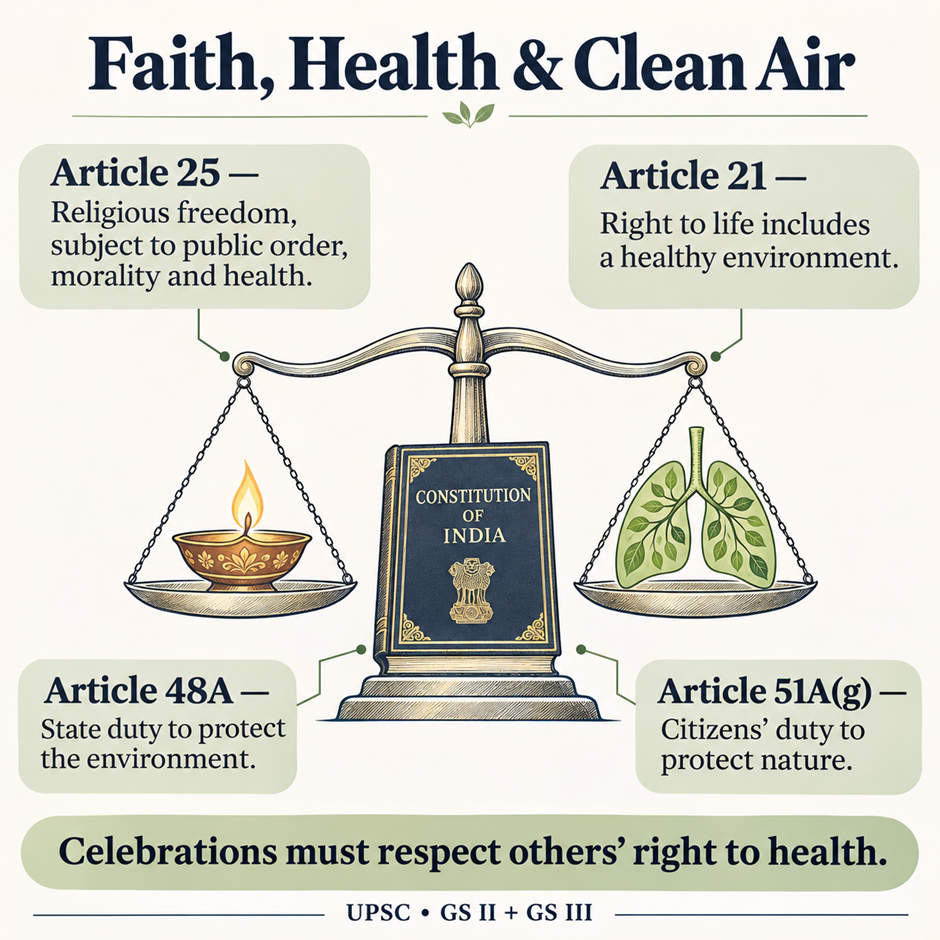
Article 21 |
The right to life includes a healthy, safe and pollution-free environment. |
|
Article 25(1) |
Religious freedom is subject to public order, morality, health and other fundamental rights. |
|
Article 48A |
Directs the State to protect and improve the environment and safeguard forests and wildlife. |
|
Article 51A(g) |
Makes environmental protection a fundamental duty of citizens. |
Religious Practice and Constitutional Limits
A practice associated with religion does not automatically become an essential religious practice. Courts examine its integral relationship with religious beliefs and observances. Religious association alone does not provide immunity from constitutional restrictions protecting public health.
Deepavali carries religious, social and emotional significance. However, pollution that threatens life and health undermines the welfare associated with its celebration.
Environmental and Health Impacts
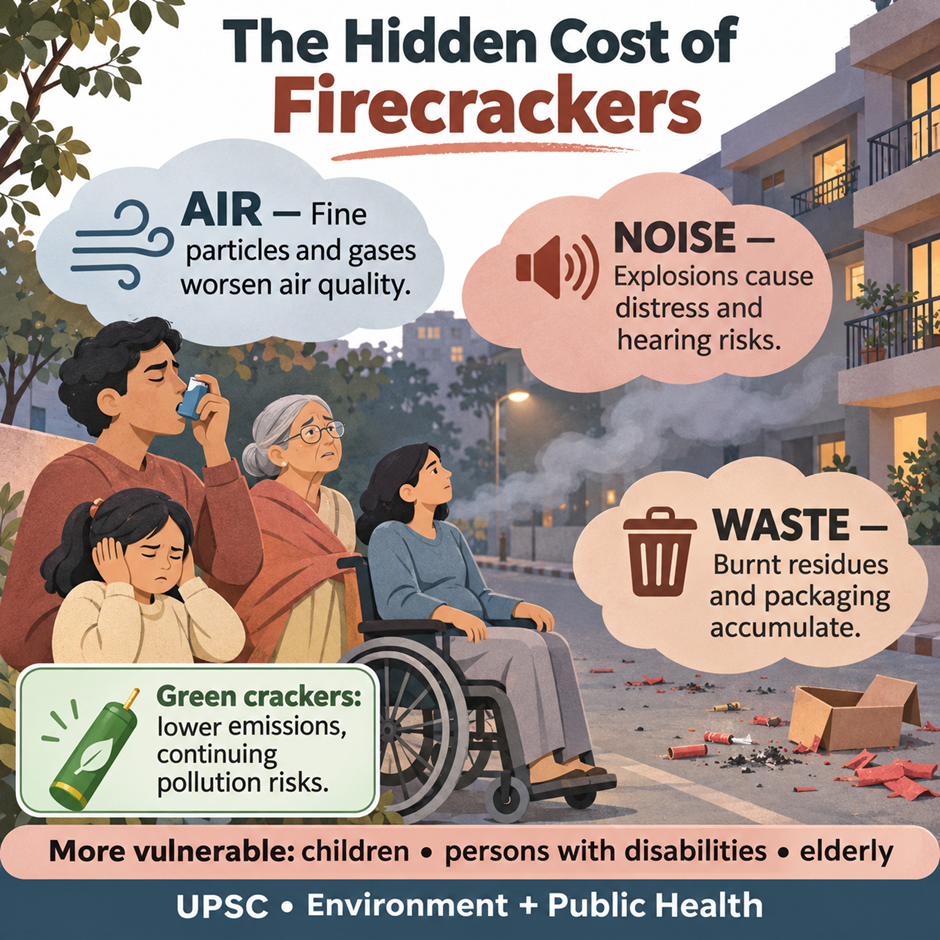
Firecrackers contribute to:
-
Air pollution: Release of particulate matter, gases and metal-containing particles.
-
Health risks: Aggravation of respiratory and cardiovascular conditions.
-
Noise pollution: Hearing risks, distress and disturbance to people and animals.
-
Solid waste: Accumulation of burnt residues and discarded packaging.
Children, persons with disabilities and the elderly face greater vulnerability.
Green Crackers: Reduced Emissions, Continuing Risks
Green crackers use modified formulations developed through CSIR-NEERI’s research to reduce emissions compared with conventional crackers. Their use still produces pollution and noise, requiring certification, safety standards, monitoring and responsible consumption.
Conditional Regulation: Key Directions
|
Area |
Directions reported in the order |
|
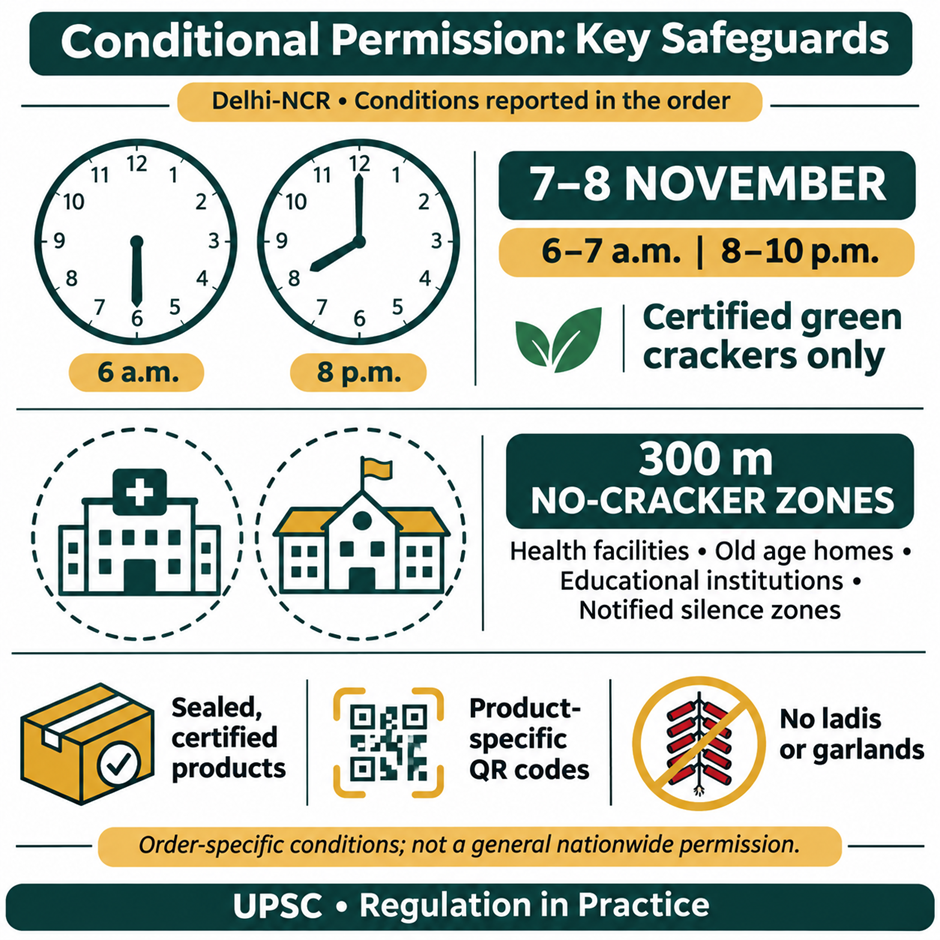
Permitted use |
Certified green crackers on November 7–8, from 6–7 a.m. and 8–10 p.m. |
|
No-cracker zones |
Within 300 metres of specified health facilities, old age homes, educational institutions and notified silence zones. |
|
Manufacturing |
Only certified manufacturers permitted to produce green crackers during November 2–6. |
|
Packaging |
Sealed boxes without mixing conventional or unauthorised crackers. |
|
Traceability |
Product-specific QR codes required for sale. |
|
Prohibited products |
Series crackers (‘ladis’) and garlands. |
|
Trader licences |
Temporary restoration of cancelled licences during November 4–6. |
|
Accountability |
Manufacturers and traders required to furnish a security deposit fixed by authorities. |
Why Bans May Fail
Weak enforcement can limit the effectiveness of even a complete ban. Major challenges include illegal supply, inadequate inspections, poor inter-agency coordination, difficulty identifying violations and limited public cooperation.
Effective pollution control therefore requires regulatory capacity, credible penalties, public awareness and accessible alternatives.
Principles for Environmental Regulation
1. Precautionary principle
Preventive action should address serious environmental risks even where scientific certainty is incomplete.
2. Polluter-pays principle
Those responsible for pollution should bear pollution-control and remediation costs. A security deposit supports compliance but does not automatically amount to compensation.
3. Proportionality
Restrictions should pursue a legitimate objective, be suitable and necessary, and balance competing rights. Time limits, location restrictions and emission standards can enable regulated celebrations while protecting health.
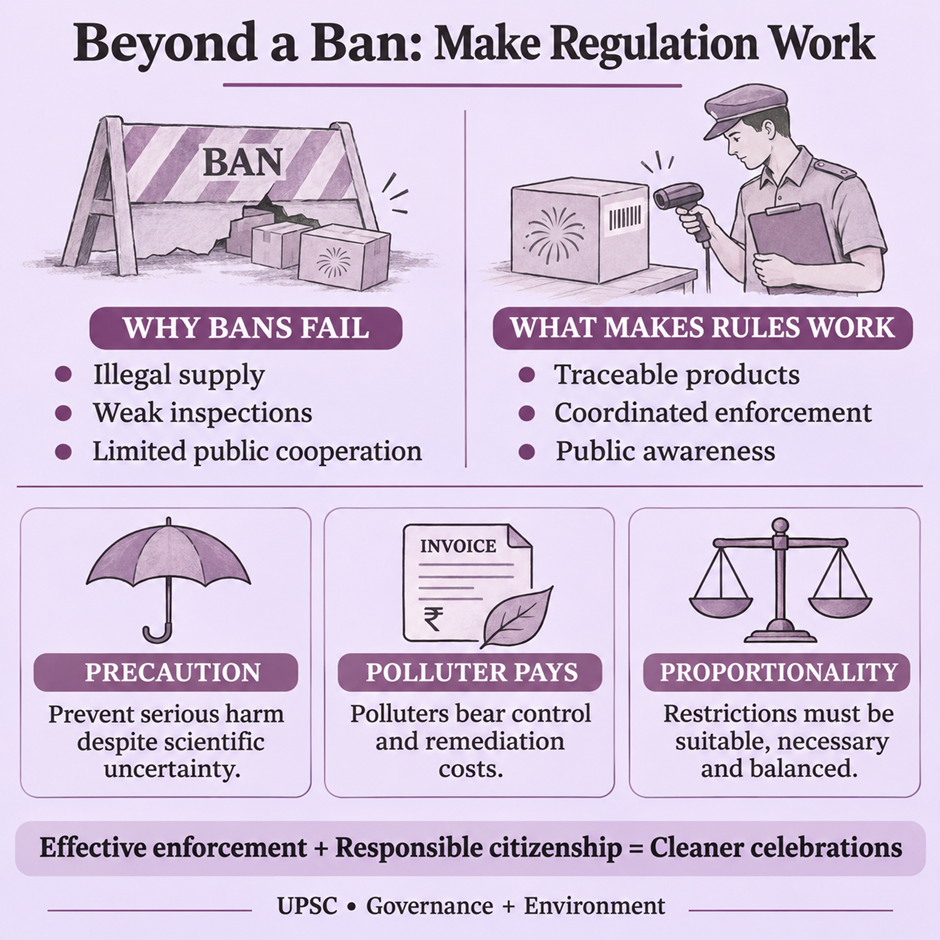
Religious freedom and environmental protection can coexist through proportionate regulation, effective enforcement and responsible citizenship. Constitutional governance must preserve lawful celebrations while safeguarding everyone’s right to health and clean air.
Mains question:
Evaluate the effectiveness of conditional regulation compared with blanket bans in controlling firecracker pollution. (250 words)
Also read Today's article on:
Celebrations and Clean Air: Balancing Rights