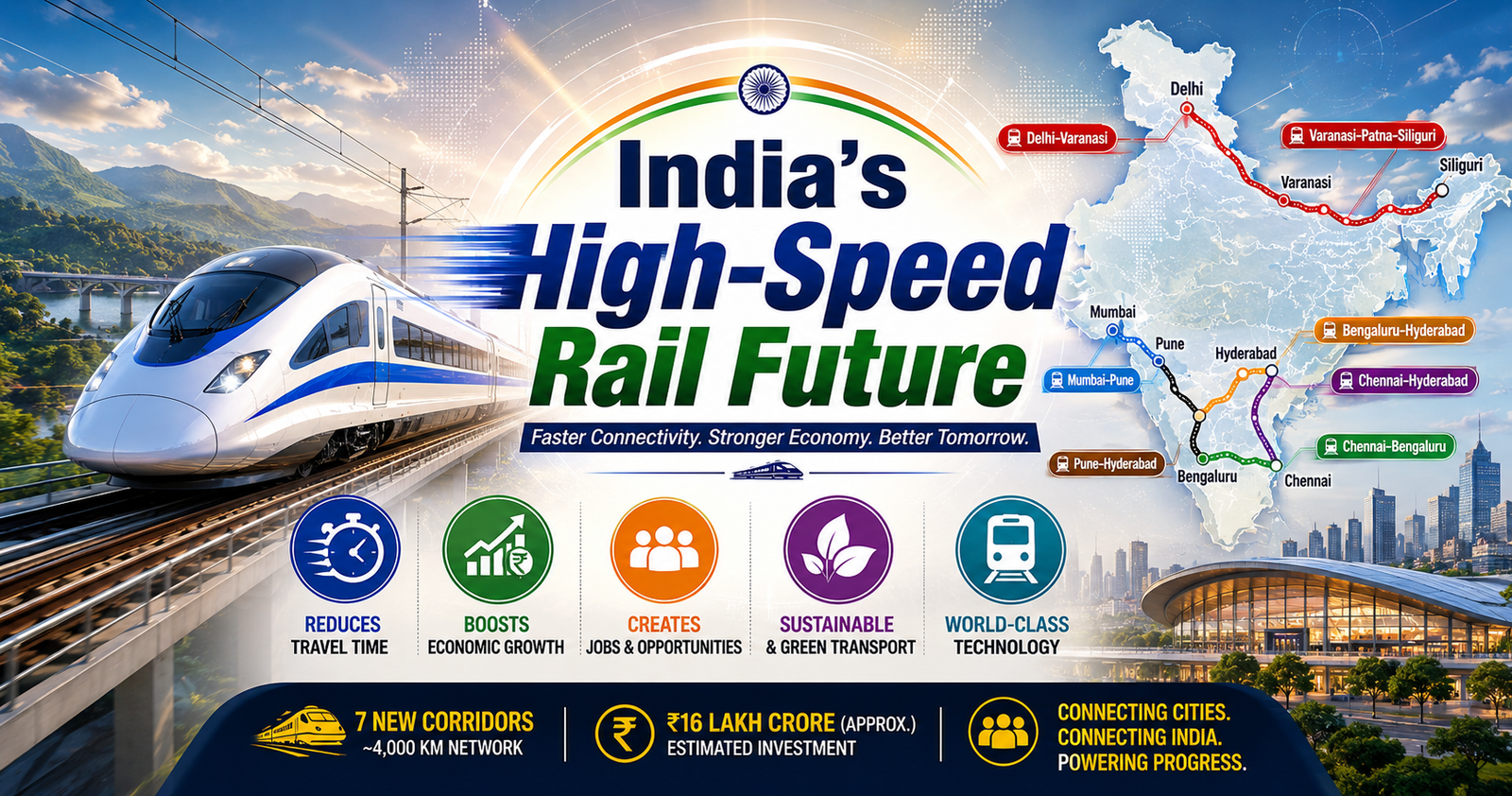
High-Speed Rail vision: the Mumbai–Ahmedabad Bullet Train project, Japanese Shinkansen technology, seven proposed corridors, indigenous manufacturing, and how high-speed rail will transform connectivity, infrastructure, and economic growth.
Syllabus Areas:
GS III - Economy, S&T
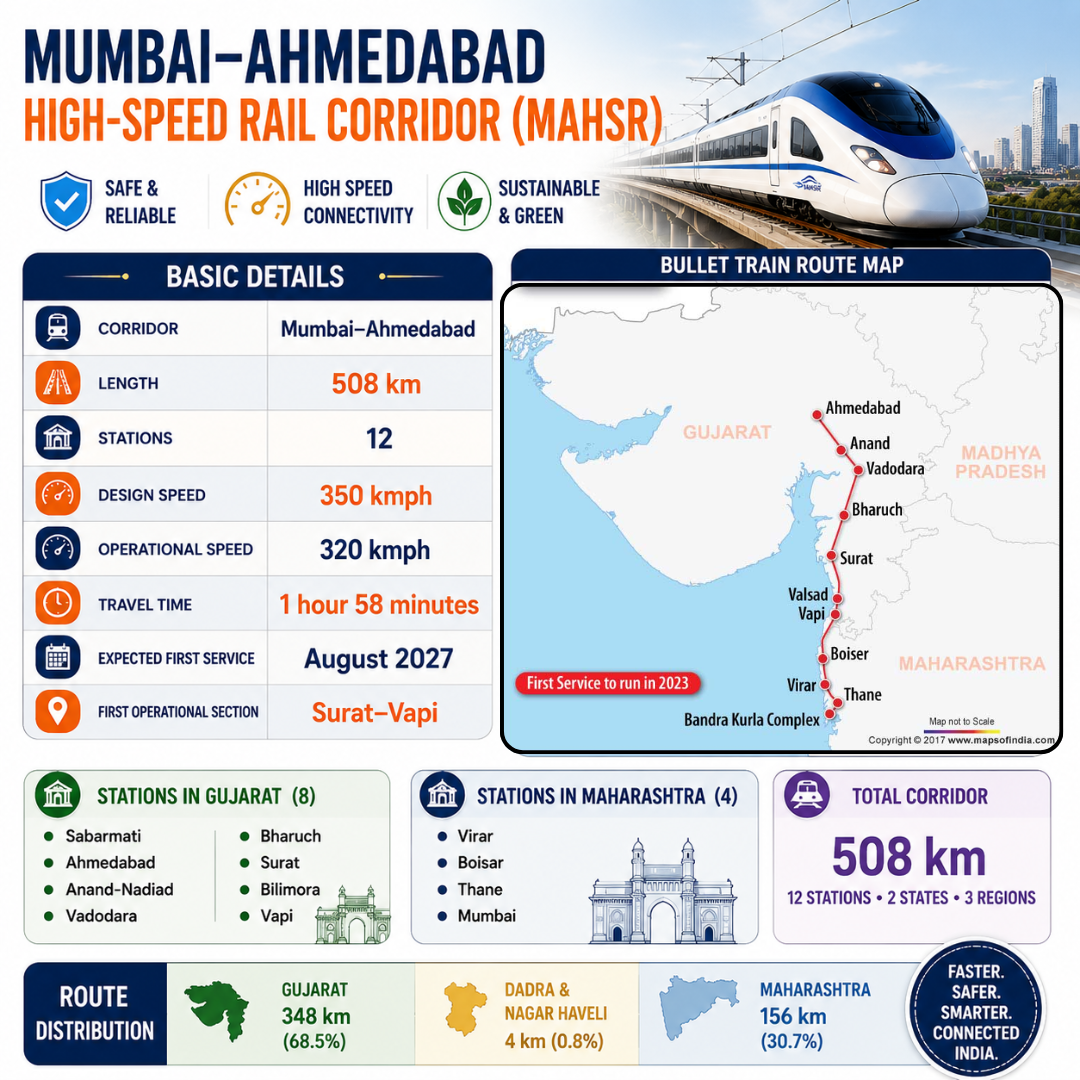
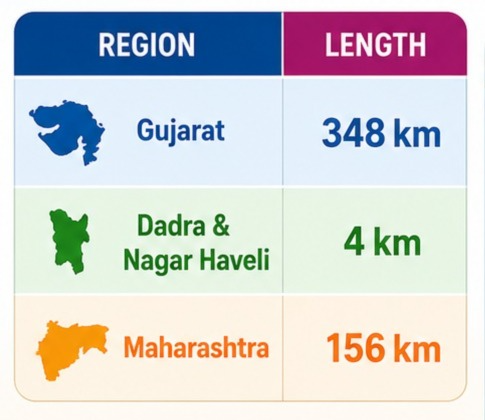
India is nearing the completion of its first Bullet Train Corridor – the Mumbai–Ahmedabad High-Speed Rail (MAHSR) project. Based on the experience gained from this project, the Government is preparing a standardised model for future high-speed rail corridors across the country, aiming to improve efficiency, reduce costs, and accelerate project execution.
India's First Bullet Train Corridor
-
India is developing its first High-Speed Rail Corridor between Mumbai and Ahmedabad.
-
The project marks India's entry into the era of world-class high-speed rail transportation.
-
It serves as a template for future Bullet Train projects across the country.
-
It introduces globally accepted engineering standards, safety systems, and operational practices.
Indigenous Manufacturing (Make in India)
India is promoting domestic manufacturing under:
-
Make in India
-
Aatmanirbhar Bharat
Major Developments
-
Integral Coach Factory (ICF) and BEML are developing indigenous 280 kmph train sets.
-
Indian companies are manufacturing:
-
High-speed rail components
-
Construction equipment
-
Slab-track systems
-
A new Aditya manufacturing complex in Bengaluru is being developed for B-28 coaches.
-
IITs are supporting research and technology development.
-
Japanese engineering practices are being adopted while strengthening indigenous capability.
Significance
-
Reduced dependence on imports
-
Development of domestic supply chains
-
Technology transfer
-
Growth of Indian railway manufacturing ecosystem
Technology Used:
1. Japanese Shinkansen Technology
-
The Mumbai–Ahmedabad High-Speed Rail project uses Japanese Shinkansen technology, renowned globally for its exceptional safety, reliability, punctuality, and high-speed operations.
2. Advanced Overhead Electrification (OHE)
-
Features 20,000+ OHE masts, a 2×25 kV traction power system, and Shinkansen-style cantilever designs to ensure uninterrupted, high-speed power supply.
3. Modern Traction & Power Infrastructure
-
The corridor includes 12 traction substations, 2 depot traction substations, and 16 distribution substations for efficient and reliable electricity distribution.
4. India's First J-Slab Ballastless Track
-
Introduces J-Slab ballastless track technology in India for the first time, offering greater stability, reduced maintenance, and smoother high-speed operations.
5. Dedicated Track Construction Bases
-
Specialised construction bases are being established for rail storage, slab storage, machinery handling, and construction logistics, enabling faster and more efficient project execution.
6. Rolling Stock Depots
-
Three state-of-the-art maintenance depots are being developed at Sabarmati, Surat, and Thane to support train maintenance, inspection, and operational readiness.
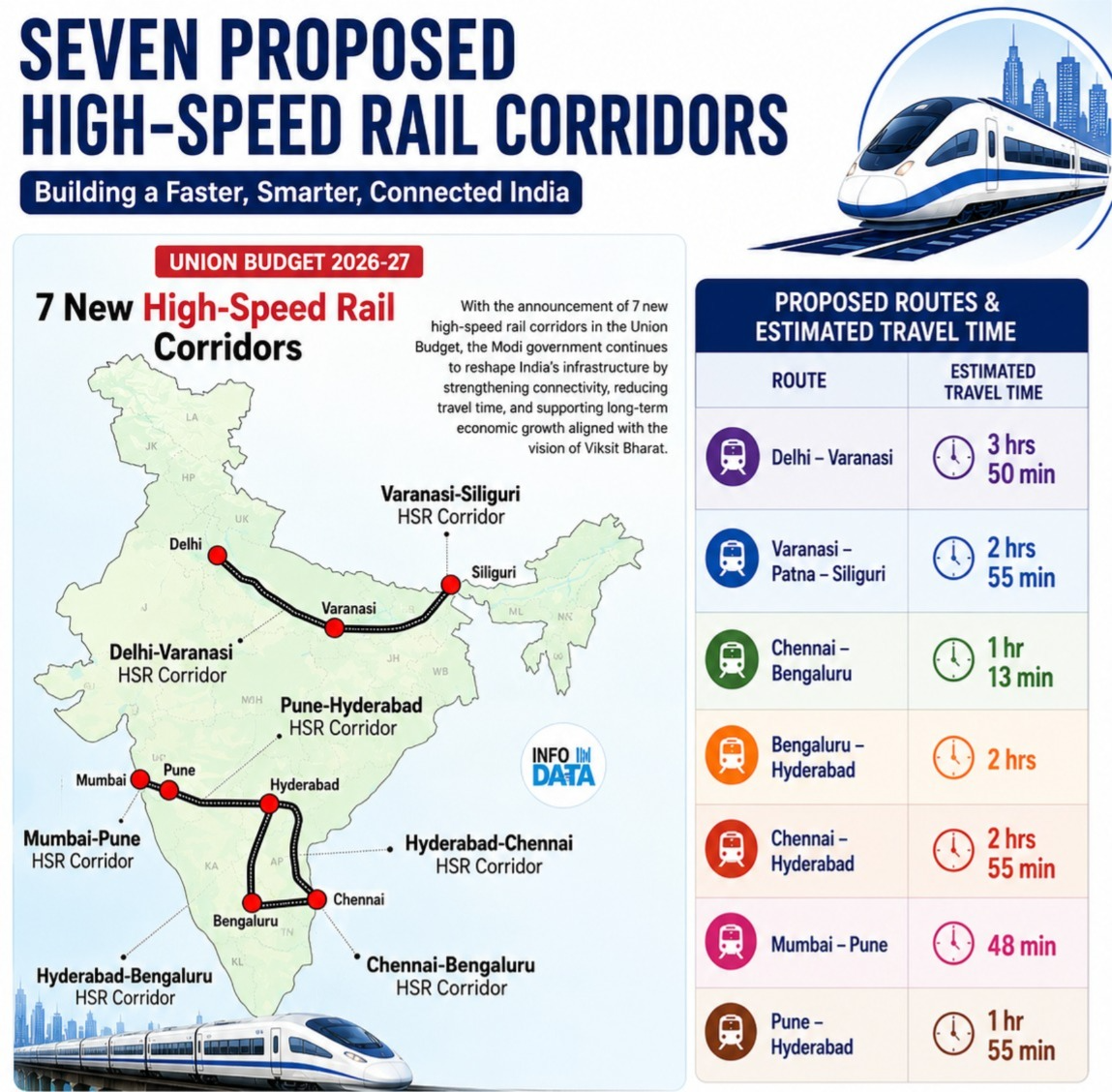
Seven Proposed High-Speed Rail Corridors
India has identified seven additional Bullet Train corridors covering nearly 4,000 km.
Estimated Investment: ₹16 lakh crore
Economic Significance
The High-Speed Rail programme will:
-
Strengthen regional connectivity
-
Reduce travel time dramatically
-
Promote industrial development
-
Create employment opportunities
-
Encourage technology transfer
-
Develop domestic manufacturing capabilities
-
Improve logistics efficiency
-
Increase investment in infrastructure
-
Boost tourism and business travel
-
Support long-term economic growth
Strategic Importance
The MAHSR project is expected to:
-
Establish India's Bullet Train ecosystem.
-
Develop indigenous technical expertise.
-
Create a scalable model for future corridors.
-
Standardise engineering practices nationwide.
-
Strengthen India's infrastructure competitiveness.
-
Improve passenger safety through advanced signalling and train control systems.
-
Enhance national integration by improving inter-city connectivity.
Way Forward
-
Complete the Mumbai–Ahmedabad corridor successfully as a benchmark project.
-
Expand indigenous manufacturing and reduce import dependence.
-
Adopt standardised engineering designs across future corridors.
-
Strengthen collaboration with research institutions and industry.
-
Develop sustainable financing models for future expansion.
-
Integrate high-speed rail with existing transport networks to maximise connectivity and economic benefits.
This PIB backgrounder emphasizes that the Mumbai–Ahmedabad Bullet Train project is not merely a single transport corridor but the foundation of India's future national high-speed rail network, providing the technological, industrial, and institutional framework for expanding bullet train connectivity across the country.
Prelims Question:
1. With reference to High-Speed Rail (HSR) systems, consider the following statements:
-
Ballastless tracks generally require lower maintenance than conventional ballasted tracks.
-
High-Speed Rail systems generally require dedicated tracks rather than mixed traffic operations.
-
India's first High-Speed Rail project is being implemented under the "Make in India" initiative with complete indigenous technology.
Which of the statements given above is/are correct?
A. 1 and 2 only
B. 2 and 3 only
C. 1 and 3 only
D. 1, 2 and 3
Answer: A
Explanation:
-
Statement 1 is correct. Ballastless tracks offer greater stability and lower maintenance.
-
Statement 2 is correct. High-speed rail generally requires dedicated corridors for safety and speed.
-
Statement 3 is incorrect. While Make in India promotes localisation and indigenous manufacturing, the project is based on Japanese Shinkansen technology, not complete indigenous technology.