
The article examines the sudden rise in Ethiopia-origin solar PV cell imports into India and concerns over possible trade circumvention involving Chinese manufacturers and preferential trade treatment.
Syllabus areas:
GS Paper II – International Relations
GS Paper III – Economy, Infrastructure & Energy, Environment
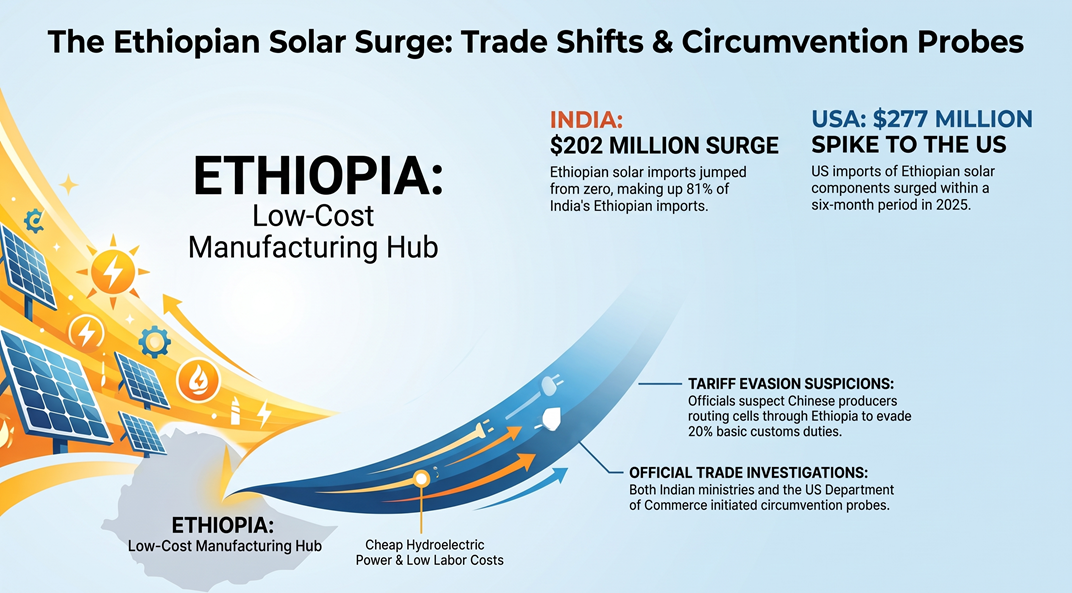
Solar PV cell imports from Ethiopia ballooning from zero to $202 million in 2025–26, 81% of India's total imports from Ethiopia.
Why this sudden and unusual surge?
Solar cells are semiconductor devices that convert sunlight directly into electricity through the photovoltaic effect. Usually made from silicon, they form the basic building blocks of solar panels and enable clean, renewable electricity generation with low operational emissions.
That is the concern of Govt of India. Hence the ministry of New and Renewable Energy MNRE has asked Finance and Commerce ministries to look into an exponential increase and suspecting Chinese manufacturers are dumping low-priced products in India.
This could be an account of recent additions in solar PV cell manufacturing capacities in Ethiopia and comparatively favourable duty treatment to solar cell export from Ethiopia to India vis-a-vis solar cells from China to India.
The ministry has sought intervention to see if trade rules are being circumvented via free trade agreement FTA or least developed country LDC benefits – including exemptions from basic customs duty on Solar PV cells.
In Feb 2025, India imposed basic customs duty of 20% on all imported solar cells and modules especially from China to protect the interests of India's $12 billion solar equipment industry.
India maintains an Approved List of Models and Manufacturers for clean energy under which only approved equipment is eligible for govt backed schemes.
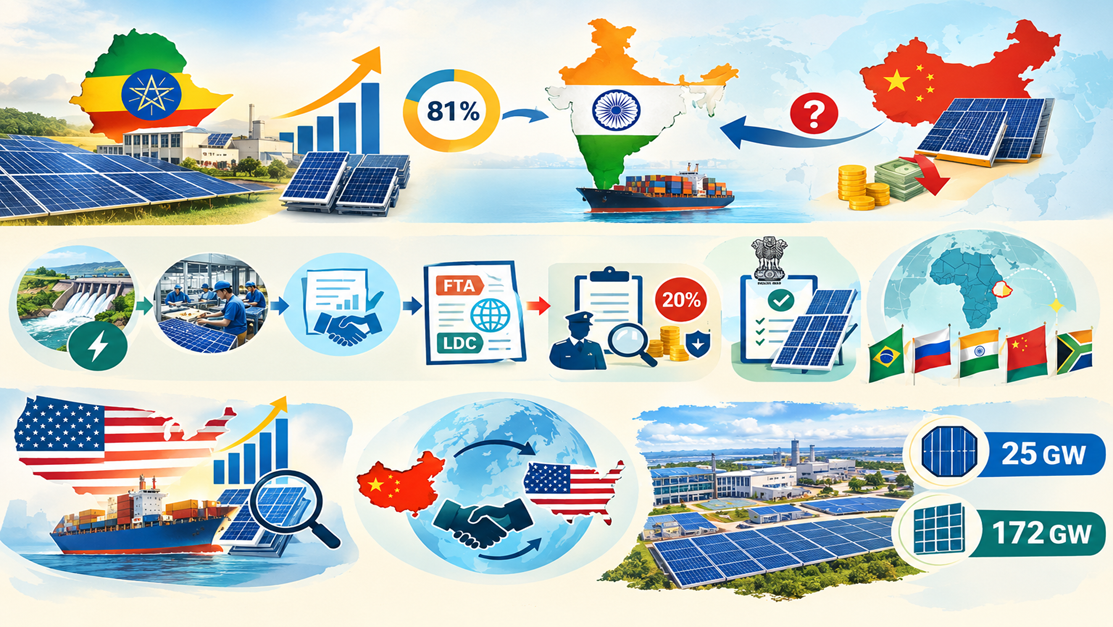
Ethiopia has emerged as a solar cell manufacturing hub due to cheap hydroelectric power and low labour cost.
The same scenario with USA also.
USA imports of Ethiopia origin Crystalline Silicon Photovoltaic (cSiPV) cells and modules rose to $277 million in the period of July–Dec 2025 from nearly nill before July 2025 prompting USA Department of Commerce to start circumvention probe in July 2026.
Ethiopia is also a BRICS member country.
Overall, China remained India's second largest trading partner after USA.
India has solar cell and module capacities of 25 Gigawatt and 172 Gigawatt respectively.
Why Ethiopia is Becoming a Solar Manufacturing Hub
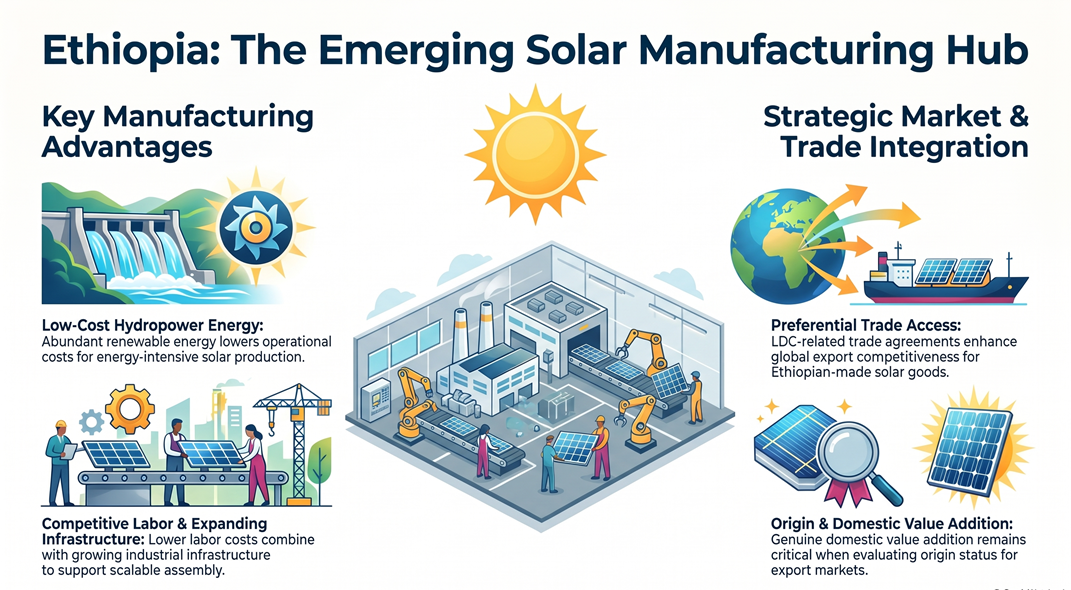
Ethiopia is attracting solar manufacturing investments due to its abundant and relatively low-cost hydropower, which can reduce energy costs for energy-intensive manufacturing. Its lower labour costs, expanding industrial infrastructure and access to international markets also enhance its attractiveness. Preferential trade arrangements, including LDC-related market access, can further improve export competitiveness. Ethiopia’s growing renewable-energy ambitions and expanding manufacturing base provide additional opportunities for solar-sector investment. These factors can make Ethiopia an attractive location for producing or assembling solar cells and modules, although the extent of genuine domestic value addition remains important when assessing the origin of exported products.
WTO and Trade-Remedy Framework
The World Trade Organization (WTO) provides rules under which countries can respond to imports that harm domestic industries while maintaining a rules-based trading system. Key trade-remedy instruments include anti-dumping measures, imposed when goods are exported below their normal value and cause material injury; countervailing measures, used against subsidised imports; and safeguard measures, applied when a sudden import surge causes or threatens serious injury to domestic producers.
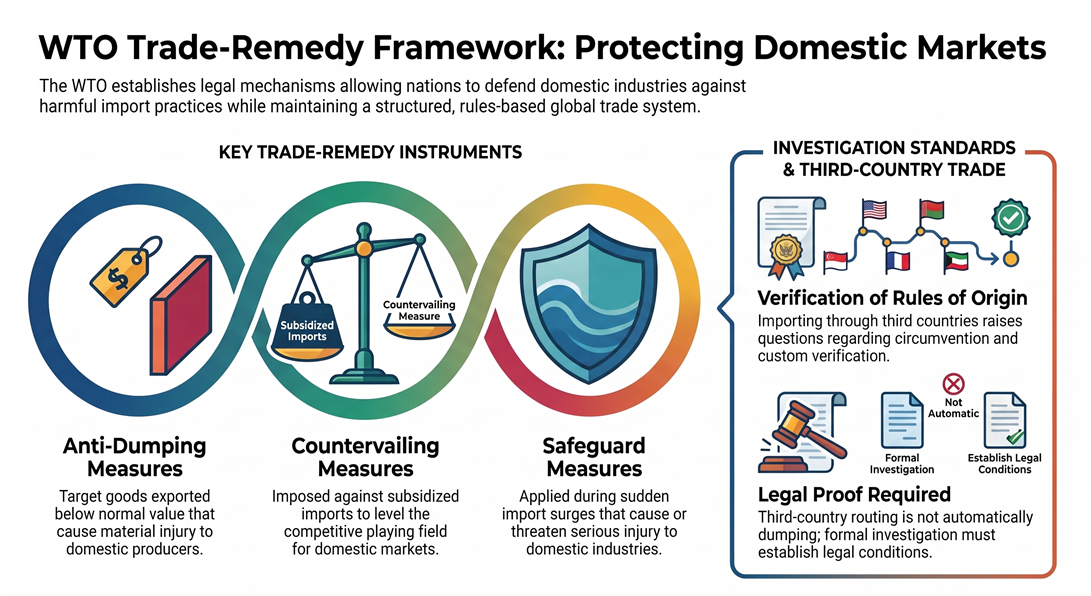
In India's solar-sector context, concerns about products entering through a third country can also raise questions about circumvention, rules of origin and customs verification. However, simply importing through another country does not automatically constitute dumping or circumvention; authorities must establish the relevant legal conditions through investigation.
Connection and Impact on India
The Ethiopia solar-cell issue directly affects India’s renewable-energy transition, domestic manufacturing and energy security. A sudden rise in low-priced imports could increase competition for Indian manufacturers and weaken the effectiveness of protective tariffs if trade rules are circumvented through third countries.
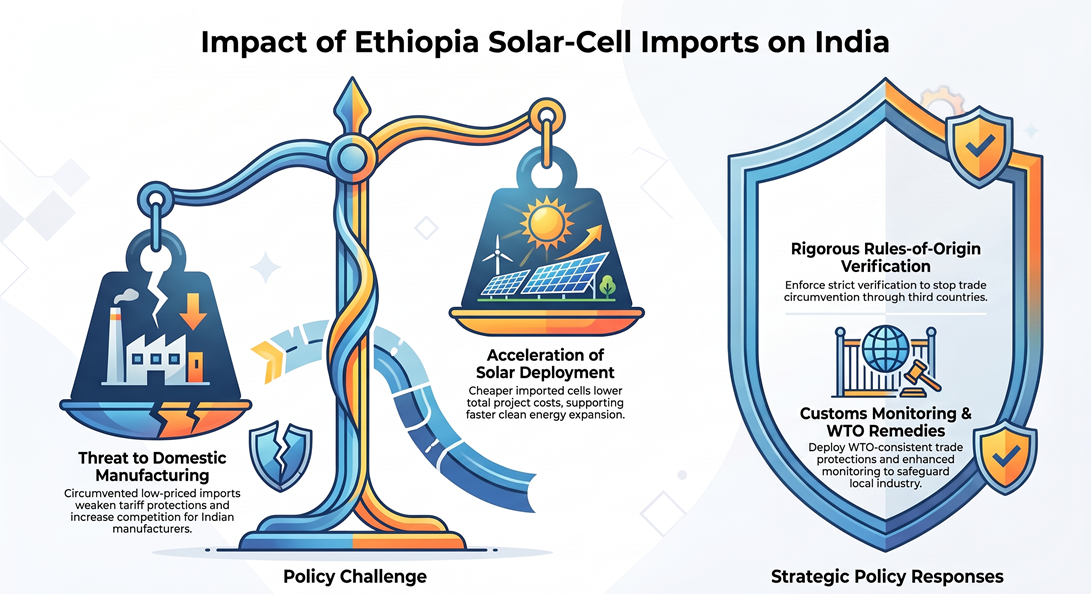
At the same time, cheaper solar cells may reduce the cost of renewable-energy projects and support faster solar expansion. India therefore faces a policy challenge of balancing affordable clean energy with domestic manufacturing and resilient supply chains. Stronger rules-of-origin verification, customs monitoring and WTO-consistent trade remedies can help protect domestic industry while maintaining India’s long-term clean-energy goals.