
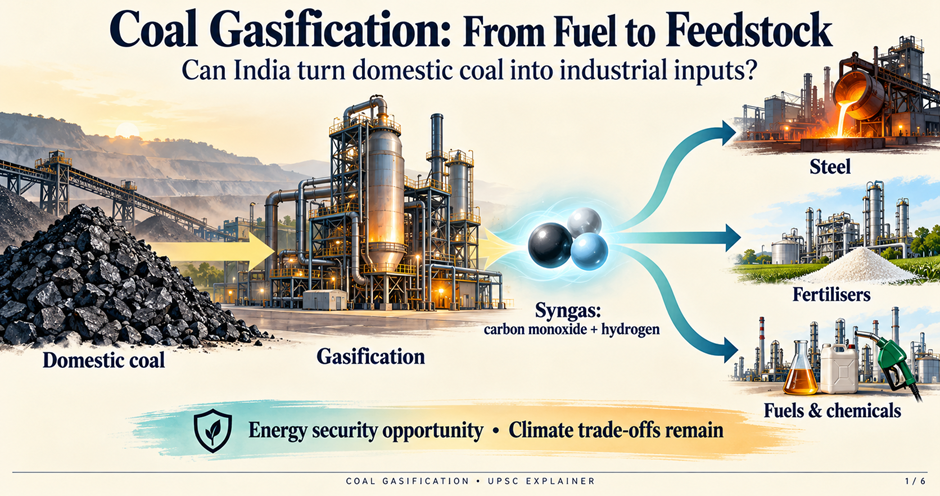
Explore how coal gasification can transform India’s domestic coal into syngas, fuels, chemicals and steel-making inputs. Examine its potential to strengthen energy security and reduce import dependence, alongside economic and environmental challenges.
UPSC linkage:
GS I - Geography
GS II - Government Policies & International Relations
GS III - Environment & Ecology, Science & Technology
Natural Gas in Steel Production
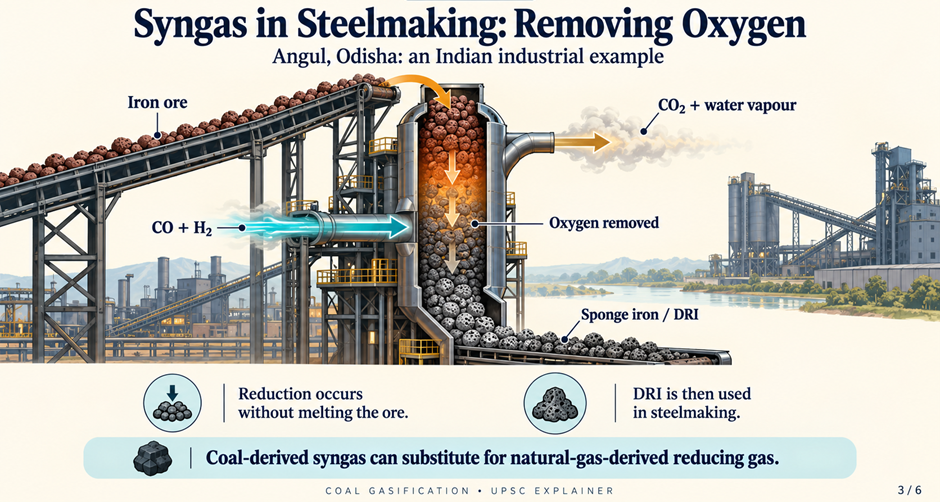
Natural gas is used in direct reduced iron (DRI) production, helping remove oxygen from iron ore through reducing gases such as hydrogen and carbon monoxide.
In 2006–07, gas shortages highlighted the steel sector’s vulnerability to supply constraints and import dependence. Power and fertiliser plants received higher priority in domestic gas allocation, limiting availability for steel producers.
Coal Gasification: An Alternative to Natural Gas
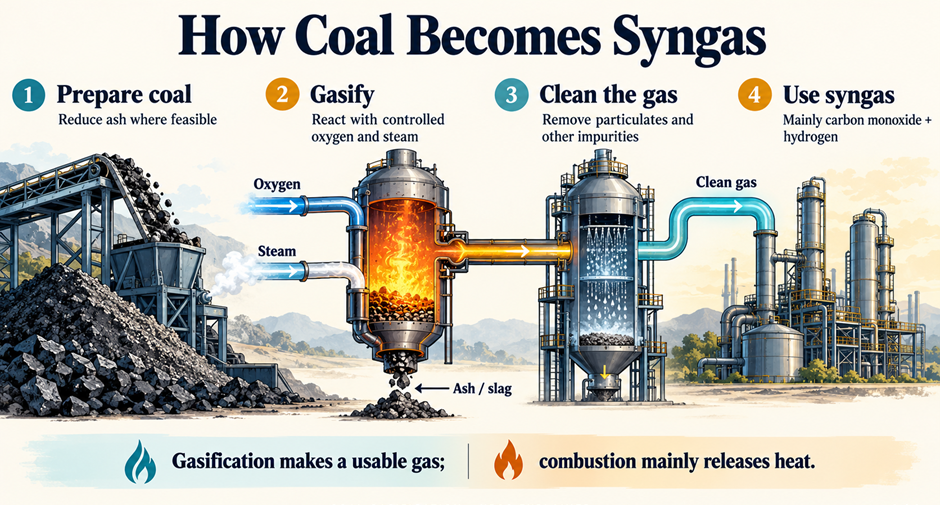
Coal gasification converts coal into synthesis gas (syngas), a mixture primarily comprising carbon monoxide and hydrogen. These gases can act as reducing agents to remove oxygen from iron ore, offering an alternative to natural gas in direct reduced iron production.
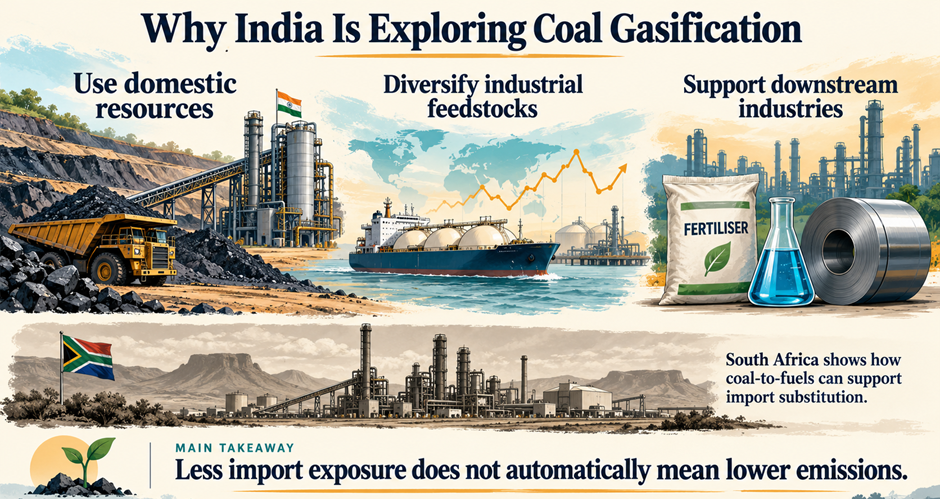
South Africa’s decades of experience with coal gasification demonstrated the technology’s potential for industrial use.
South Africa’s Coal-to-Fuel Strategy
During apartheid, international sanctions restricted South Africa’s access to crude oil. The country used its abundant coal reserves to develop coal gasification and reduce dependence on imported fuels and chemicals.
Coal was converted into syngas, which could then be processed into synthetic natural gas, petrol, diesel and industrial chemicals. This illustrates the role of coal-to-liquid and coal-to-chemical technologies in strengthening energy security and import substitution.
Coal Gasification in India: The Angul Example
A coal gasification plant commissioned in 2014 at Angul, Odisha, demonstrated the use of coal-derived syngas in steel production, providing an alternative to natural gas.
Key stages of the process:
-
Coal preparation: Coal is washed to reduce excessive ash.
-
Gasification: Prepared coal reacts with steam and oxygen under controlled conditions to produce raw gas.
-
Gas cleaning: The raw gas is cooled and cleaned to remove impurities, yielding syngas composed mainly of carbon monoxide and hydrogen.
Syngas in Iron Production and By-product Recovery
Carbon monoxide and hydrogen in syngas remove oxygen from iron ore, producing direct reduced iron (DRI), or sponge iron, without melting the ore.
Gasification and associated processing can also recover useful by-products such as tar, gasification oil, ammonia, sulphur and naphtha, supporting their use in other industries.
CO₂ Utilisation and Carbon Neutrality
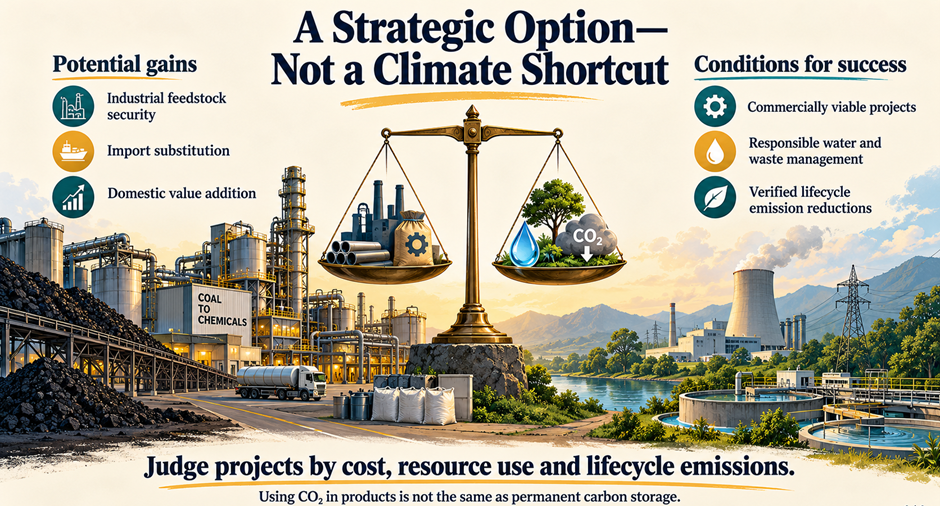
The process also generates carbon dioxide (CO₂), which can serve as a feedstock for chemicals such as methanol, when combined with hydrogen. However, CO₂ utilisation does not automatically make the process carbon-neutral; its climate benefit depends on energy sources, hydrogen production and eventual emissions.
Energy Security and Cost Competitiveness
Domestic coal-based syngas can reduce dependence on imported natural gas and exposure to international fuel-price fluctuations.
According to the plant’s reported estimates, syngas production costs $7–8 per MMBtu, compared with $12–16 per MMBtu for imported natural gas. These figures illustrate potential cost savings, though actual costs vary with fuel prices, coal quality and plant efficiency.
MMBtu means one million British thermal units, a unit used to compare energy content.
GAME CHANGER?
Import Dependence and Domestic Coal Resources
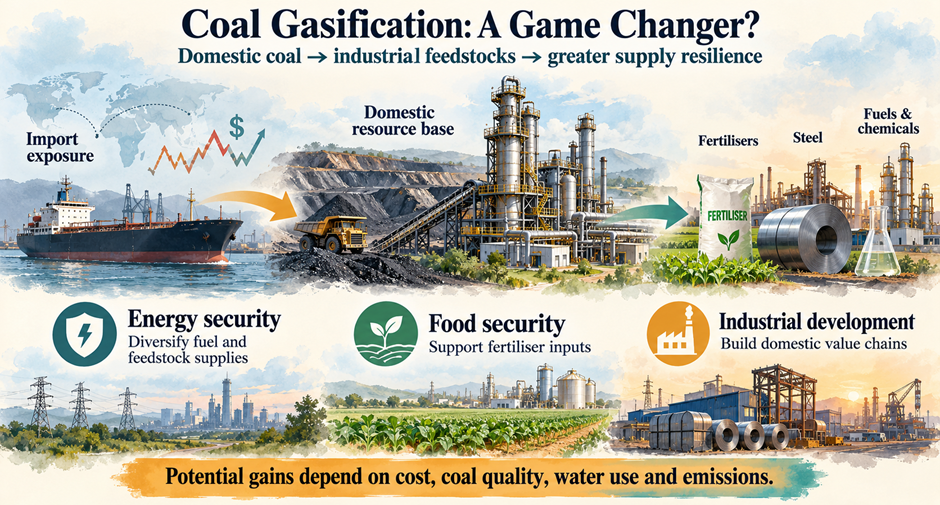
In a way, Jindal Steel’s coal gasification bet offers a blueprint for India. The country remains severely tethered to foreign shores for fuel and vital feedstocks, importing more than 80% of its crude oil. The reliance runs even deeper elsewhere: 100% of ammonia, 90% of methanol, half of natural gas, and a fifth of urea arrive from overseas.
Recent geopolitical turmoil across West Asia underlined that vulnerability, exposing domestic markets to sharp supply jolts and erratic price spikes. On the other hand, India has huge coal reserves—the fifth largest in the world. Government estimates put it at 400 billion tonnes and going by current annual consumption of a billion tonne, it would last 400 years!
The Strategic Case for Gasification
New Delhi’s aggressive push into coal gasification is meant to reduce the import dependency of critical imported feedstock, enhance energy and food security, efficiently use the domestic coal reserves and support the development of downstream industries.
Policy Support and Capacity Targets
The policy engine revved up in 2024, when the government launched an initial ₹8,500 crore incentive package designed to unlock 25 million tonnes per annum (MTPA) in gasification capacity. This May, it scaled up sharply with the national Coal Gasification Mission, unleashing another ₹37,500 crore in support to drive cumulative capacity toward 100 MTPA by 2030.
OLD WINE
Coal Supply: Earlier Constraints
Even as late as in 2016-17, 70% of India’s power generation was coal-based. The domestic coal production at 658 million tonnes was just enough to meet the demands of the power sector. The law prioritised supply of coal for power generation forcing other sectors such as steel and cement to import their coal needs.
Rising Domestic Production
Two shifts—surging domestic output and a historic green transition—have rewritten those dynamics. Aggressive auctioning of captive and commercial blocks sparked the mining revival. Since January 2020, 14 bidding rounds awarded 141 blocks to 123 private operators, locking in peak capacity of 366 million tonnes. As these pits fired up, output from captive and commercial mines cleared the 200-million-tonne benchmark for the first time in 2025-26, hitting 210 million tonnes—up from a meagre 29 million a decade back. That momentum lifted India’s total haul to 1,040 million tonnes.
The Changing Power Mix
At the same time, clean power exploded. Non-fossil sources accounted for barely 15% of capacity in 2015-16; today, they command over 54%. Growth remains relentless: additions touched 55.29 gigawatts (GW) in 2025-26, marching toward New Delhi’s 500GW target by 2030. Consequently, thermal power’s generation footprint shrank to 43%.
From Coal’s Energy to Its Chemical Value
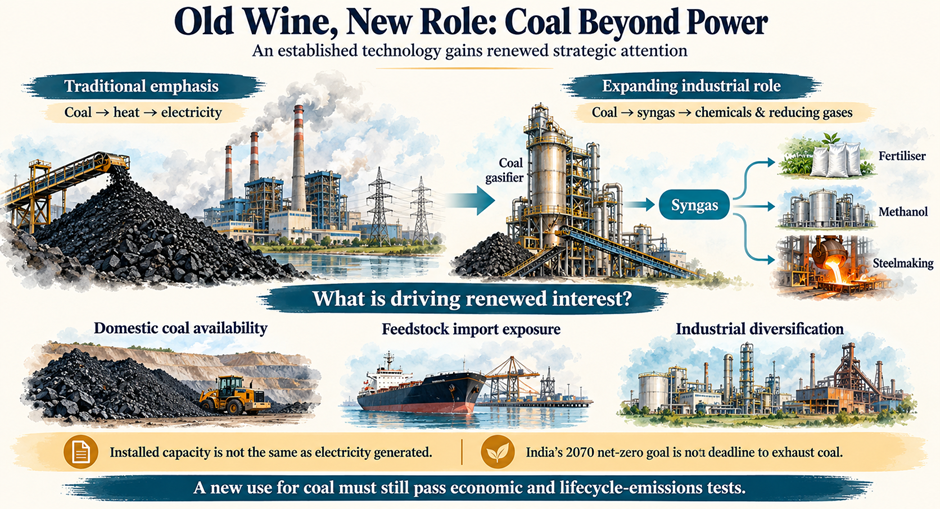
We have got just 44 years to use up our coal reserves that at current utilization pace can last us 400 years. Using coal gasification to consume coal, and in the process, reduce India’s import dependence is a win-win solution.
Also, domestic coal’s ash content means it has very little usage other than in the power sector.Earlier, we simply burned coal to use only its chemical energy. Now we have the opportunity to use its chemical values to produce valuable chemicals.
Geopolitical Shocks and Supply Security
Geopolitical upheaval drove the urgency home. The fallout from Ukraine, compounded by tremors across West Asia, exposed how acutely energy and food supplies hinge on global volatility.
China’s Coal Gasification Experience
China’s strategic playbook offers an instructive parallel. Boasting over 250 MTPA in gasification capacity, Beijing insulated itself from external shocks, churning out 70% of its methanol and 90% of its ammonia internally. When the US-Iran war disrupted markets, China stabilized local farm inputs, holding domestic fertilizer rates a third cheaper than international benchmarks. India, meanwhile, weathered a ballooning subsidy bill.
The Hydrogen Opportunity
Looking ahead, gasification opens a frontier into hydrogen. As India ramps up clean fuel mandates, syngas—carrying 58% hydrogen—presents an immediate bridge. With proper carbon capture, utilization and storage, India can produce blue hydrogen (one step lower than green hydrogen produced entirely from renewable sources) economically. Nonetheless, India’s coal gasification journey will not be without its set of challenges.
THE BOTTLENECKS
Capital Costs and Commercial Viability
These are high-stakes, capital-heavy ventures with long gestation timelines. As a rough rule of thumb, industry specialists peg capital outlay at about $500 million per million tonne per annum of gasification capacity. At current price points, the economics simply do not hold up on their own—making viability gap funding an absolute must.
Funding Support and Policy Incentives
The Indian government hopes its ₹37,500 crore incentive kitty will plug this commercial void. The question is whether that safety net goes far enough.
Other policy levers are kicking in alongside. The government has dangled a 50% revenue-share rebate on coal earmarked for gasification (in other words, they pay 50% less royalty), bestowed infrastructure status to unlock cheaper credit lines, and floated plans to shave customs levies on imported equipment.
Mains question:
GS Paper III | 15 Marks
“Coal gasification can strengthen India’s energy security and reduce import dependence, but significant economic and environmental challenges remain.” Discuss.