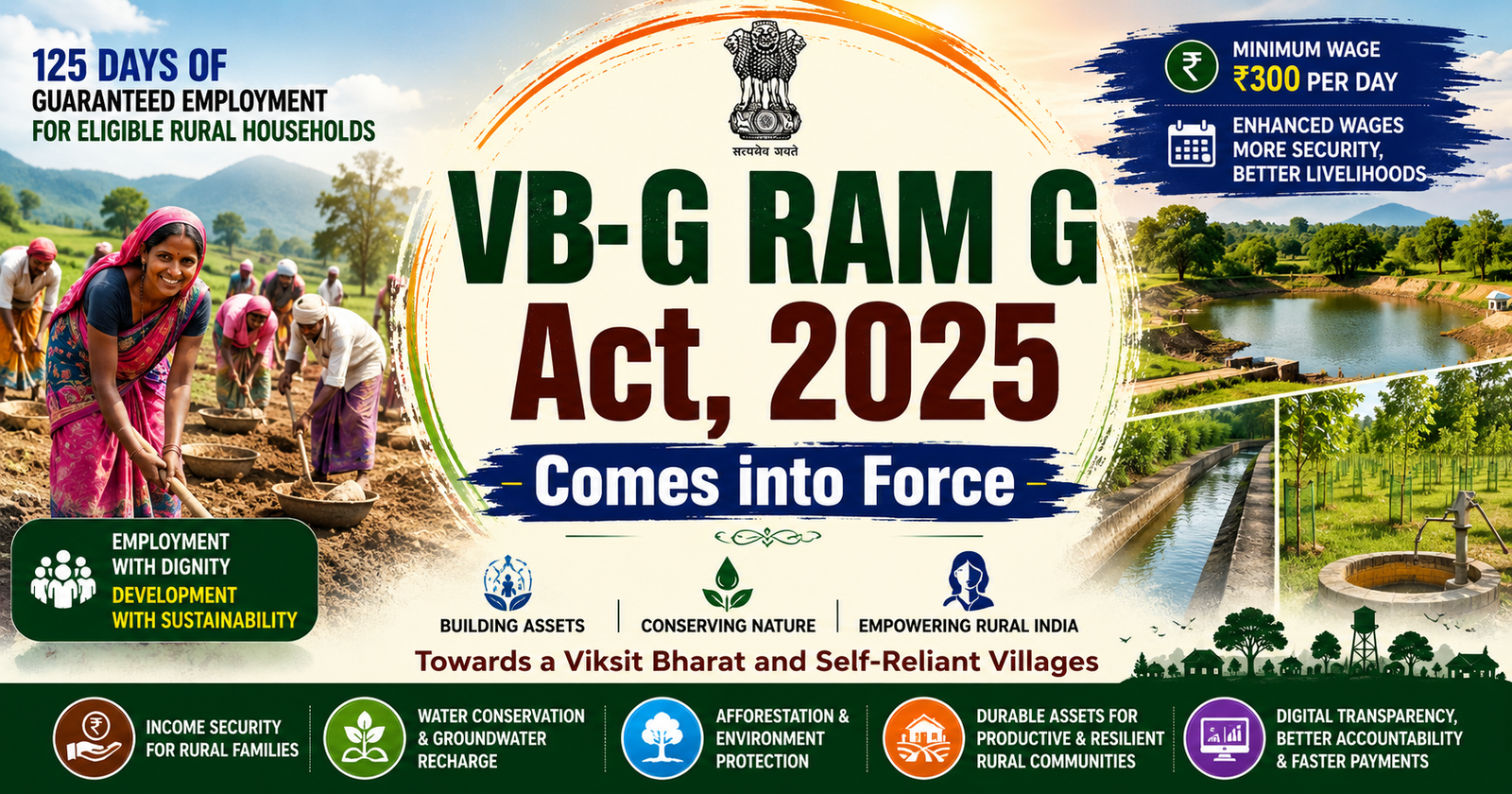
The VB-G RAM G Act, 2025 guarantees 125 days of rural employment, higher wages, digital transparency, and sustainable asset creation, driving inclusive and climate-resilient rural development.
Syllabus Areas:
GS II - Polity and Governance
The Government of India has operationalized the Viksit Bharat – Guarantee for Rozgar and Aajeevika Mission (Gramin) [VB-G RAM G] Act, 2025, marking a significant reform in rural employment policy. The Act aims to strengthen livelihood security, enhance transparency, create durable rural assets, and accelerate rural development.
The VB-G RAM G Act, 2025 has officially come into force across India from 2 July 2026. The Act replaces the earlier framework with expanded employment guarantees, higher wages, stronger focus on natural resource management, and greater emphasis on sustainable rural development.
What is this Act about?
The Act provides every eligible rural household a legal guarantee of 125 days of wage employment in a financial year. If a rural family seeks work under the scheme, the government is responsible for providing employment through approved public works.
However, the Act is not just about giving jobs. It aims to use employment to create productive rural assets that benefit villages in the long run.
The Act has four major objectives:
1. Livelihood Security
-
Guarantees 125 days of wage employment to eligible rural households.
-
Helps reduce seasonal unemployment and rural distress.
-
Ensures a stable source of income for poor families.
2. Creation of Durable Rural Assets
Instead of providing only temporary employment, workers are engaged in projects such as:
-
Water conservation
-
Irrigation facilities
-
Groundwater recharge
-
Watershed development
-
Afforestation
-
Revival of water bodies
These assets improve agriculture and benefit villages for many years. (These focus areas are illustrated in the infographic on page 2.)
3. Sustainable Rural Development
The works undertaken under the Act are intended to:
-
Increase agricultural productivity
-
Improve water availability
-
Strengthen climate resilience
-
Conserve natural resources
-
Promote sustainable livelihoods.
4. Better Governance
The Act emphasizes:
-
Transparent implementation
-
Digital monitoring through the VB-G RAM G software platform
-
Timely wage payments
-
Efficient execution of rural development works
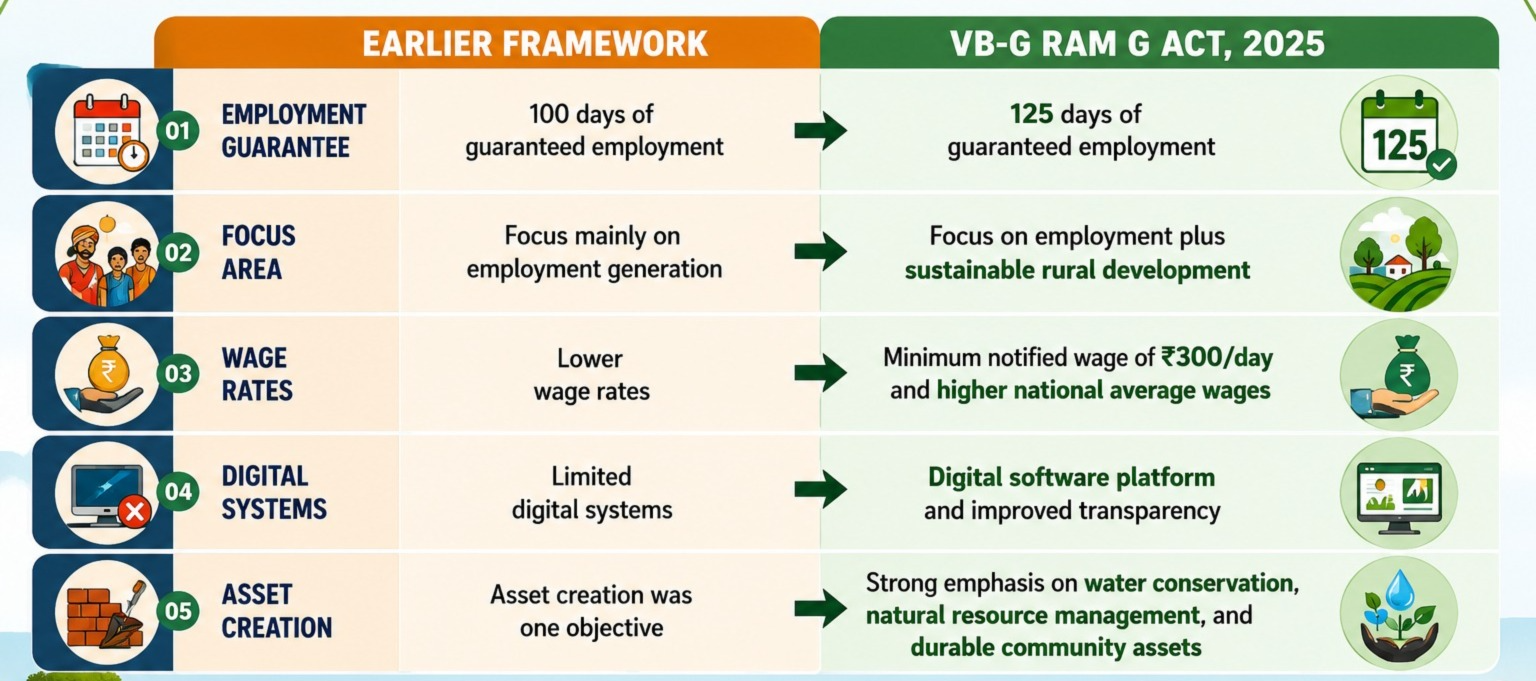
How is it different from the earlier rural employment programme?
Significance of the VB-G RAM G Act, 2025
The VB-G RAM G Act, 2025 marks a major shift in India's rural employment policy. Instead of focusing only on providing temporary wage employment, the Act aims to create sustainable livelihoods, productive rural assets, and long-term rural development.
1. Economic Significance
-
Enhances Rural Purchasing Power: Higher wages and increased employment days provide rural families with more disposable income, boosting their ability to spend on food, education, healthcare, and other essentials.
-
Ensures Income Security: The legal guarantee of 125 days of employment provides a reliable source of income, reducing uncertainty for rural households.
-
Boosts Rural Economy: Increased household income leads to higher demand for local goods and services, supporting small businesses and generating economic activity in villages.
-
Creates Productive Assets: Public works such as irrigation systems, ponds, roads, and watershed projects improve agricultural productivity and contribute to long-term economic growth.
2. Social Significance
-
Reduces Rural Distress: Guaranteed employment helps reduce seasonal unemployment, poverty, migration, and financial hardship in rural areas.
-
Promotes Women's Empowerment: The programme encourages greater participation of women in the workforce, enhancing financial independence and decision-making within households.
-
Improves Livelihood Opportunities: The Act creates regular employment opportunities while strengthening agriculture and allied rural activities.
-
Encourages Inclusive Development: The scheme benefits economically weaker rural households, ensuring that development reaches vulnerable and marginalized sections of society.
3. Environmental Significance
-
Conserves Water Resources: Supports construction of water harvesting structures, ponds, check dams, and other water conservation projects.
-
Recharges Groundwater: Activities such as percolation tanks and recharge pits help restore groundwater levels and improve water availability.
-
Promotes Afforestation: Tree plantation and restoration of degraded land improve biodiversity, increase green cover, and reduce soil erosion.
-
Strengthens Climate Resilience: Natural resource management projects help villages better withstand droughts, floods, and other climate-related challenges.
-
Supports Sustainable Agriculture: Improved irrigation, soil conservation, and water management enhance farm productivity while protecting natural resources.
4. Governance Significance
-
Ensures Transparent Implementation: Digital systems improve transparency by reducing leakages and enabling better monitoring of projects and funds.
-
Introduces Digital Monitoring: The VB-G RAM G Software Platform allows real-time tracking of works, beneficiaries, and fund utilization.
-
Strengthens Accountability: Clearly defined responsibilities and digital records improve accountability of implementing agencies.
-
Enables Faster Wage Payments: Technology-based payment systems facilitate timely transfer of wages directly to beneficiaries.
-
Focuses on Outcome-Based Development: The Act emphasizes measurable developmental outcomes by creating durable assets that generate long-term social, economic, and environmental benefits.
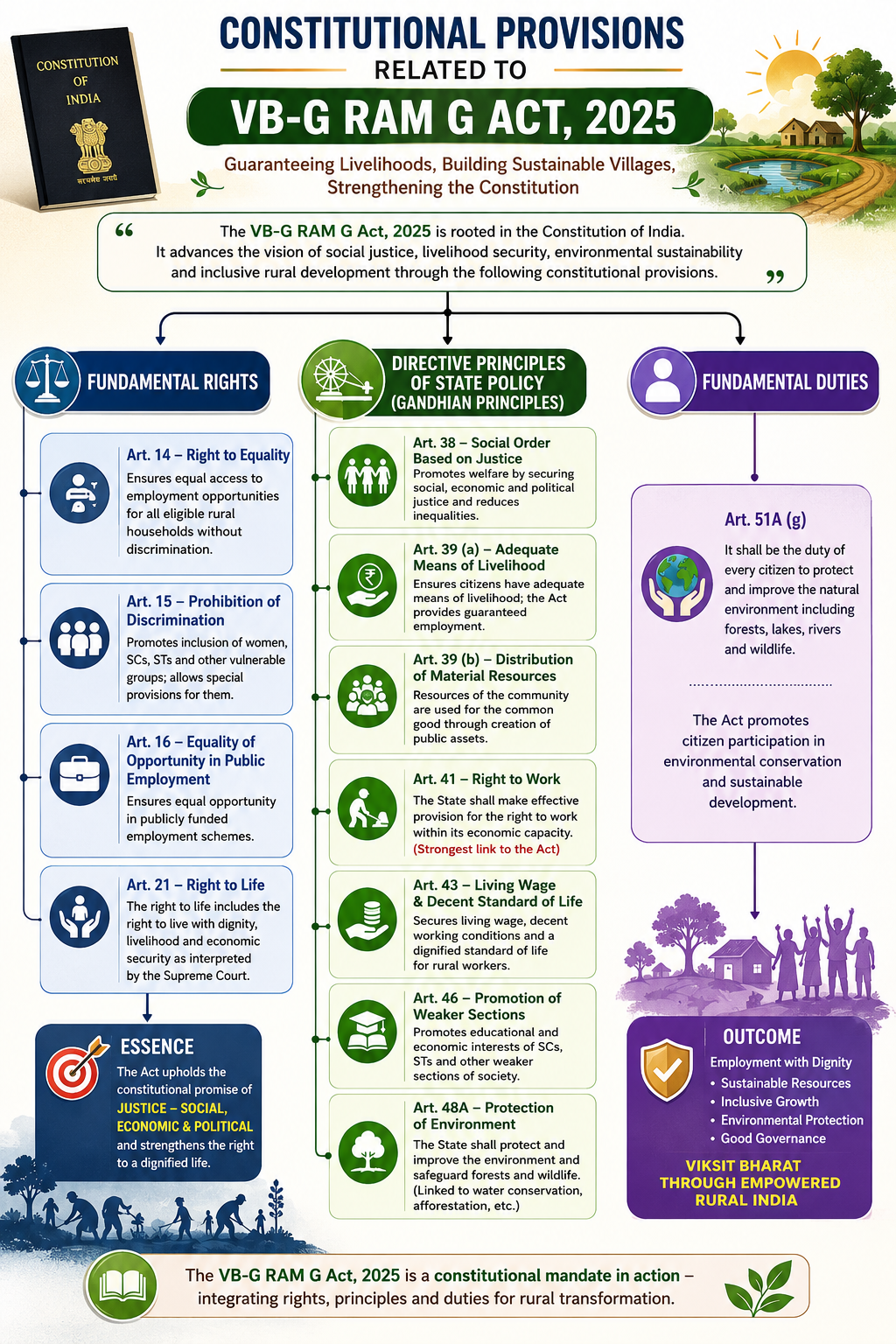
The VB-G RAM G Act, 2025 marks a major evolution in India's rural employment framework by combining enhanced wage security with sustainable rural development. By extending employment to 125 days, increasing wage rates, investing in natural resource management, and leveraging digital governance, the Act seeks to strengthen rural livelihoods while contributing to the broader vision of Viksit Bharat.
Prelims Questions:
1. With reference to the Viksit Bharat – Guarantee for Rozgar and Aajeevika Mission (Gramin) [VB-G RAM G] Act, 2025, consider the following statements:
-
It provides a statutory guarantee of 125 days of wage employment to every rural household in India.
-
The Act aims to create durable rural assets in addition to providing employment.
-
The Act emphasizes conservation of natural resources and women's empowerment.
Which of the statements given above are correct?
A. 1 and 2 only
B. 2 and 3 only
C. 1 and 3 only
D. 1, 2 and 3
Answer: B
Explanation:
-
Statement 1 is incorrect because the guarantee is available only to eligible rural households, not every rural household.
-
Statements 2 and 3 are correct.
2. Consider the following statements regarding the VB-G RAM G Act, 2025:
-
The Act integrates employment generation with natural resource management.
-
It reflects the constitutional vision embodied in Articles 21, 41 and 48A.
-
The Act seeks to improve agricultural productivity through creation of durable rural assets.
Which of the statements given above are correct?
A. 1 only
B. 1 and 2 only
C. 2 and 3 only
D. 1, 2 and 3
Answer: D
Explanation:
The Act combines guaranteed employment with environmental conservation, durable asset creation, and livelihood enhancement. These objectives align with the constitutional principles of the Right to Life (Article 21), Right to Work (Article 41, DPSP), and Protection of Environment (Article 48A, DPSP).
Mains Questions:
1. "Employment with dignity is more meaningful than temporary financial assistance." In the light of this statement, analyse how the VB-G RAM G Act, 2025 advances the constitutional vision of social justice and inclusive development. (250 Words) 15 Marks