National Anthem vs National Song: Understand their constitutional status, historical origins, legal significance, performance rules, and key differences essential for UPSC, competitive exams, and general awareness.
Syllabus Areas:
GS I - Modern Indian History
GS II - Polity and Governance
Read Why is it in News?
Background of Jana Gana Mana:
-
Jana Gana Mana was first written in Sanskritised (Tatsama) Bengali, also composed by Tagore.
-
It was first sung in Calcutta Session of Indian National Congress in 1911.
-
Ravindranath Tagore himself sang Vande Mataram in 1896 Session of Indian National Congress. It was the first political occasion when Vande Mataram was sung in chorus.
-
Former Supreme Court Judge Markandey Katju wrote that Jana Gana Mana was composed and sung as an act of psychophancy to George V, the only British King-Emperor to travel to India.
-
Jana Gana Mana was written in 1911 and published in Adi Brahmo Samaj journal "Tatwabodhini Patrika", with the title "Bharata Bhagyo Vidhata".
-
Jana Gana Mana was first sung by Sarala Devi Chowdhurani (Tagore's niece).
-
The duration of the Full Version of National Anthem is 52 seconds and for Shorter Version is 20 seconds.
Background of Vande Mataram:
-
The National Song Vande Mataram was composed in Sanskrit by Bankim Chandra Chatterjee, which he included in his 1881 novel "Anand Math".
-
The poem was composed into a song by Rabindranath Tagore.
-
It was translated into English by Aurobindo Ghosh.
No one can be compelled to sing the National Anthem since:
-
It will be violative of the Right to Freedom of Speech and Expression.
-
It will be violative of the Right to Freedom of Conscience, Practice and Propagation of Religion.
-
There is no legal provision obliging anyone to sing the National Anthem.
Constitutional Provisions and Acts:
-
Under Article 51A of the Indian Constitution, it is mentioned that it shall be the duty of every citizen of India to abide by the Constitution and respect its ideals and institutions, the National Flag and the National Anthem.
-
It is one of the Eleven Fundamental Duties enshrined in Part IV A of the Constitution.
-
These Fundamental Duties are non-justiciable in nature, but the Parliament is free to enforce them by suitable legislation.
-
Chief Justice Dipak Mishra, who had ruled in 2016 that the National Anthem must be played before every show at cinema theatres, was among the three judges who said in 2017 that the Centre should decide whether to modify that order without being influenced by what the court had said earlier.
-
The court indicated that it may modify its own order of November 2016 by replacing the word "shall" with "may".
-
The Section 3 of the Prevention of Insults to National Honour Act, 1971 states that whoever intentionally prevents the singing of the Jana Gana Mana or causes disturbances to any assembly engaged in such singing shall be punished with imprisonment.
-
The Act does not compel anyone to sing the National Anthem.
-
The National Anthem can be sung or played at any time; playing it during night does not violate any rule.
-
It is not necessary that everyone should sing the Anthem while it is played.
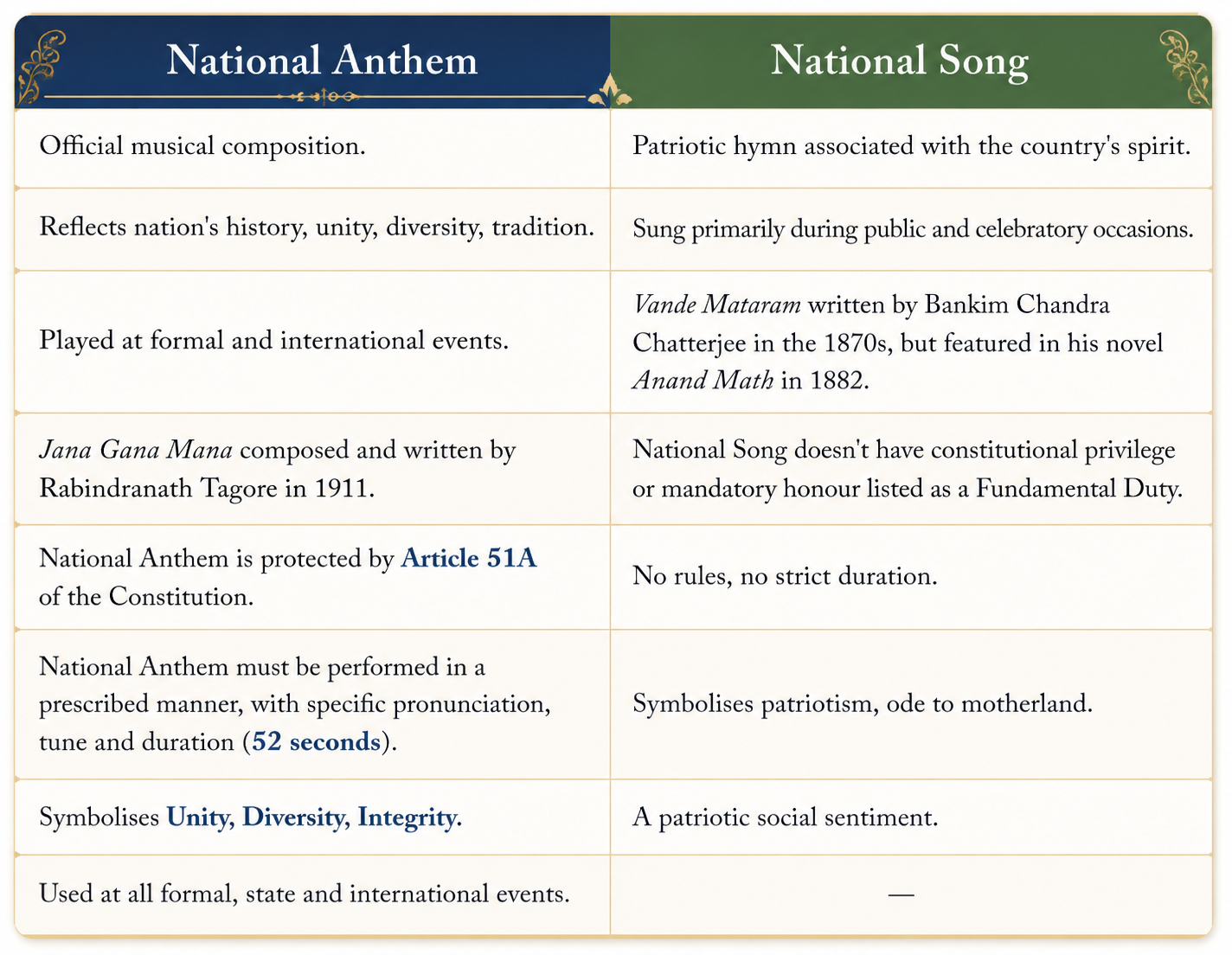
National Anthem and National Song?
A National Anthem has [Jana Gana Mana]:
-
A particular pronunciation, specific tune, and specified time.
-
A formal rendition of the National Anthem of India takes 52 seconds.
-
Found in Fundamental Duties of the Constitution.
-
Has some special privileges like Jana Gana Mana was adopted by the Constituent Assembly as the National Anthem.
-
Reflects the history and culture of the country.
-
Everybody has to pay their respects to it by giving a standing ovation whenever it is played.
-
Represents a particular country. A National Anthem is the official song for a country for any ceremony.
-
Singing the National Anthem can be made compulsory by the Act of Parliament.
-
As per Part IVA of the Indian Constitution, "We the People of India" are morally obliged to respect the National Anthem (3rd Fundamental Duty).
A National Song (Vande Mataram)
-
Vande Mataram was the National cry for freedom from British rule.
A National Song:
-
It is a song that many of the country's population might relate to very strongly.
-
May have variations in all those as it is not officially decided. Vande Mataram has three different versions with different tunes and speed.
-
It is not mandatory to sing.
-
Did not find place in Fundamental Duties.
-
Vande Mataram was written by Bankim Chandra Chatterjee.
-
Jana Gana Mana was written by Rabindranath Tagore.