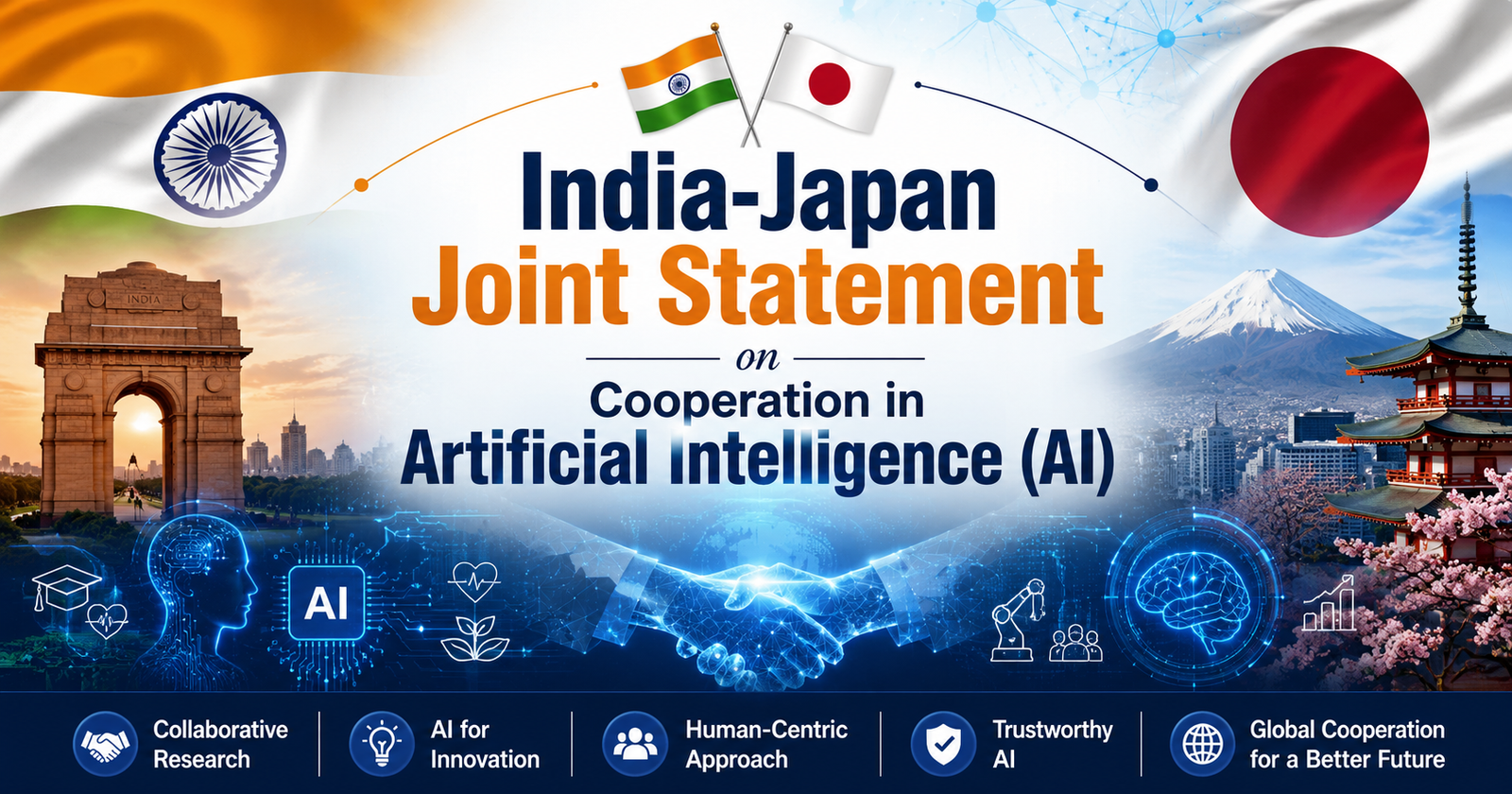
Explore the India–Japan Joint Statement on Artificial Intelligence, highlighting cooperation in AI governance, cybersecurity, research, semiconductors, innovation, talent development, and building safe, secure, trustworthy, and human-centric AI ecosystems
Syllabus Areas:
GS II - Governance
GS III - Science and Technology
India and Japan have signed a landmark Joint Statement on Cooperation in Artificial Intelligence (AI) during the 16th India-Japan Annual Summit. Recognising AI as one of the most transformative technologies of the 21st century, both countries agreed to deepen cooperation in research, innovation, governance, cybersecurity, infrastructure, and talent development.
The partnership aims to promote safe, secure, trustworthy, inclusive, and human-centric AI while strengthening economic growth, technological innovation, and Indo-Pacific resilience.
Why is this agreement important?
-
Artificial Intelligence is rapidly transforming almost every sector, including Healthcare, Agriculture, Manufacturing, Education, Defence, Governance, Financial Services
-
India and Japan believe that AI should benefit society while ensuring safety, transparency, accountability, and ethical use. Therefore, both countries have decided to work together in developing AI technologies and creating global standards for responsible AI.
Major Highlights of the Joint Statement
1. Safe and Responsible AI Development
-
Both countries agreed that AI should always be Safe, Secure, Trustworthy, Human-centric, Inclusive, Sustainable, Accountable
-
The objective is to ensure that AI supports innovation while protecting human rights and reducing risks.
2. Strengthening Global AI Governance
India and Japan will jointly work towards establishing international standards for AI governance.
They will cooperate through major global platforms such as:
-
G20
-
OECD
-
Global Partnership on AI (GPAI)
-
United Nations
The two countries also reaffirmed support for the Hiroshima AI Process, which promotes responsible development of advanced AI systems.
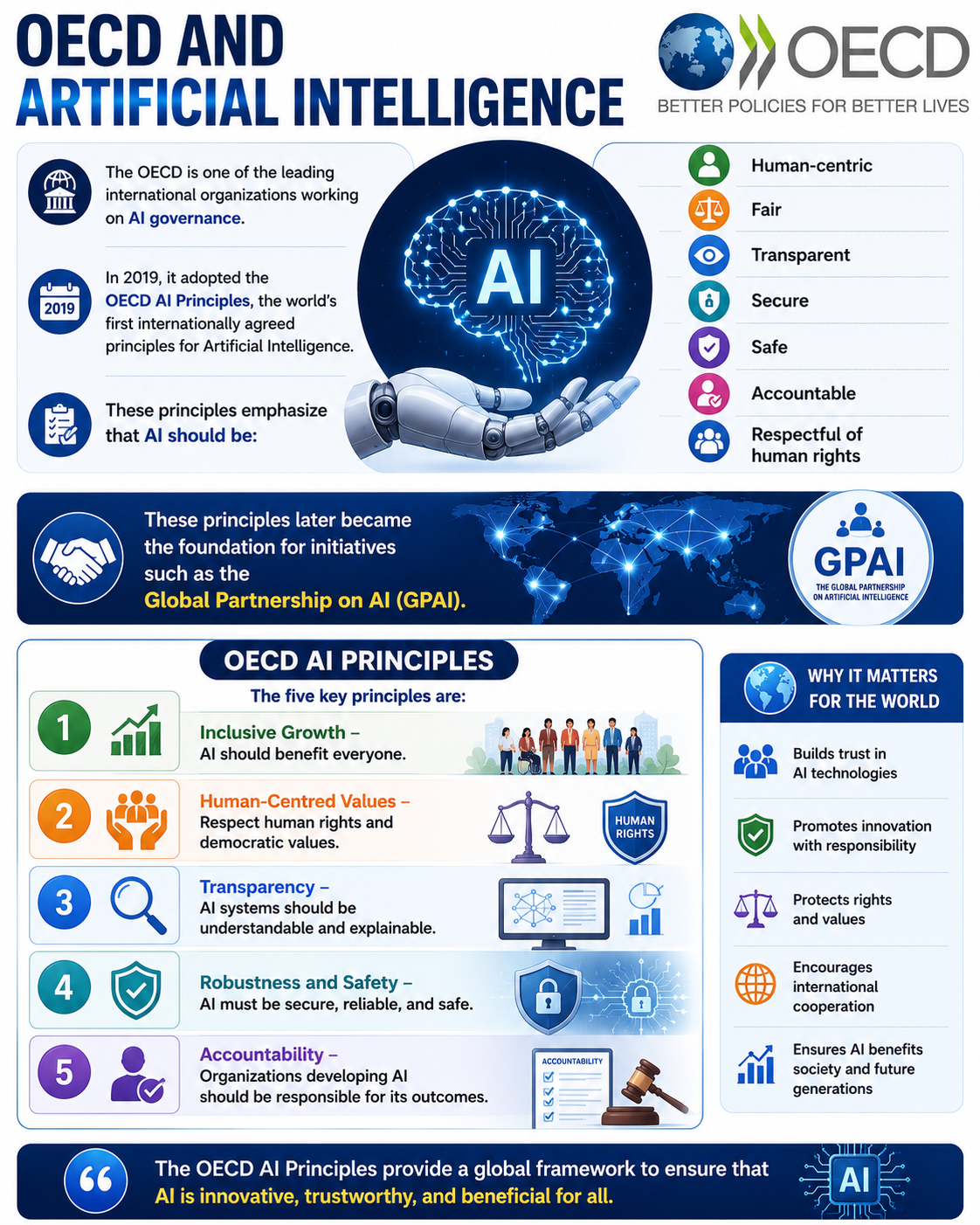
Organisation for Economic Co-operation and Development (OECD)
What is the OECD?
The Organisation for Economic Co-operation and Development (OECD) is an intergovernmental organization that works to promote economic growth, sustainable development, better public policies, and improved living standards across the world.
It provides a platform where governments work together to solve common economic, social, and environmental challenges.
History
-
Established: 30 September 1961
-
Headquarters: Paris, France
-
Origin: Succeeded the Organisation for European Economic Co-operation (OEEC), which was created in 1948 to administer the Marshall Plan after World War II.
What is GPAI?
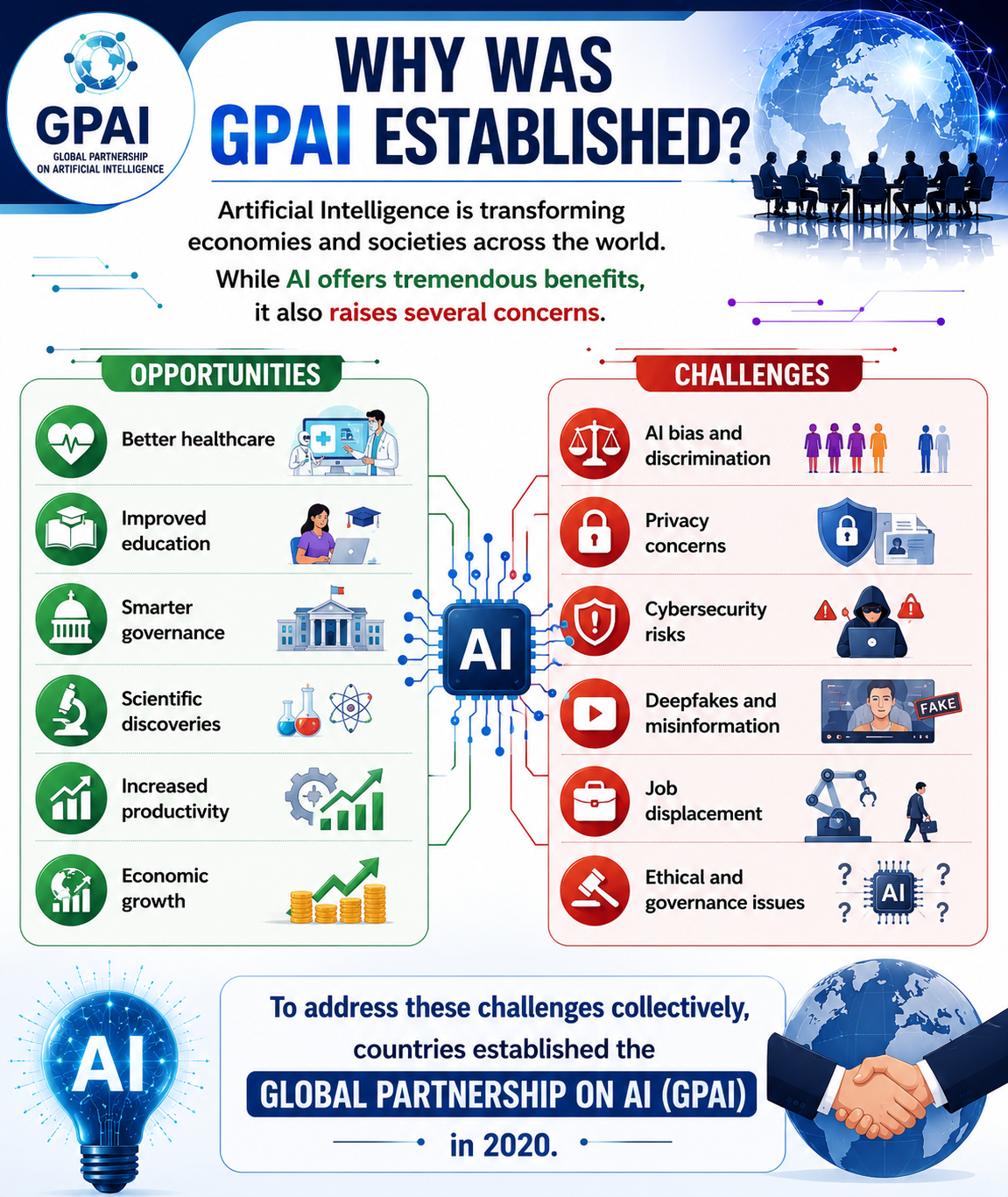
The Global Partnership on Artificial Intelligence (GPAI) is an international initiative launched in 2020 to promote the responsible development and use of Artificial Intelligence (AI) in line with human rights, democratic values, inclusion, and innovation.
It brings together governments and experts from academia, industry, and civil society to bridge the gap between AI research and public policy.
What is the Hiroshima AI Process?
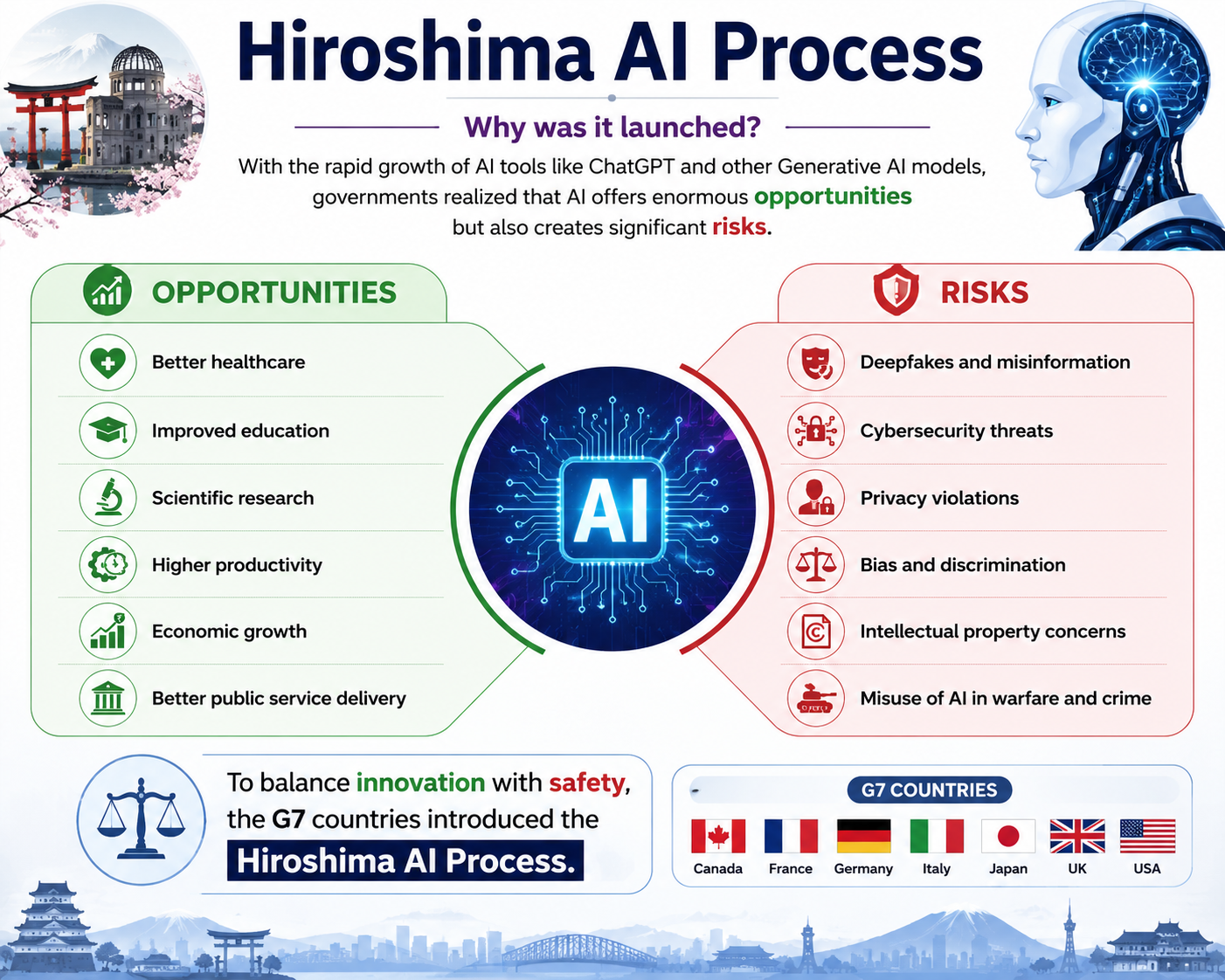
The Hiroshima AI Process (HAIP) is an international initiative launched by the G7 countries in 2023 to promote the safe, secure, and trustworthy development of Artificial Intelligence (AI), especially advanced AI systems such as Generative AI.
It was launched during the G7 Hiroshima Summit, held in Hiroshima, Japan, in May 2023, under Japan's G7 Presidency.
3. AI Safety and Cybersecurity
As AI systems become more powerful, cybersecurity becomes increasingly important.
Both countries agreed to cooperate in:
-
AI safety testing
-
AI model evaluation
-
Risk assessment
-
Protection of critical infrastructure
-
AI-enabled cybersecurity
-
Secure deployment of frontier AI models
Special emphasis has also been placed on protecting children from harmful AI applications.
4. Building AI Infrastructure
Developing AI requires powerful digital infrastructure.
India and Japan will jointly strengthen cooperation in:
-
Data Centres
-
High-performance computing (GPU infrastructure)
-
Semiconductors
-
Secure cloud infrastructure
-
AI supply chains
This will improve technological resilience and reduce dependence on limited global suppliers.
5. Promoting AI Research and Innovation
Both countries agreed to encourage collaboration among:
-
Governments
-
Universities
-
Research institutions
-
Start-ups
-
Private industries
Priority research areas include:
-
Large Language Models (LLMs)
-
Multilingual AI
-
Open-source AI
-
AI for scientific research
-
AI for public services
-
Green AI technologies
Several Memorandums of Understanding (MoUs) have also been signed between leading institutions from both countries.
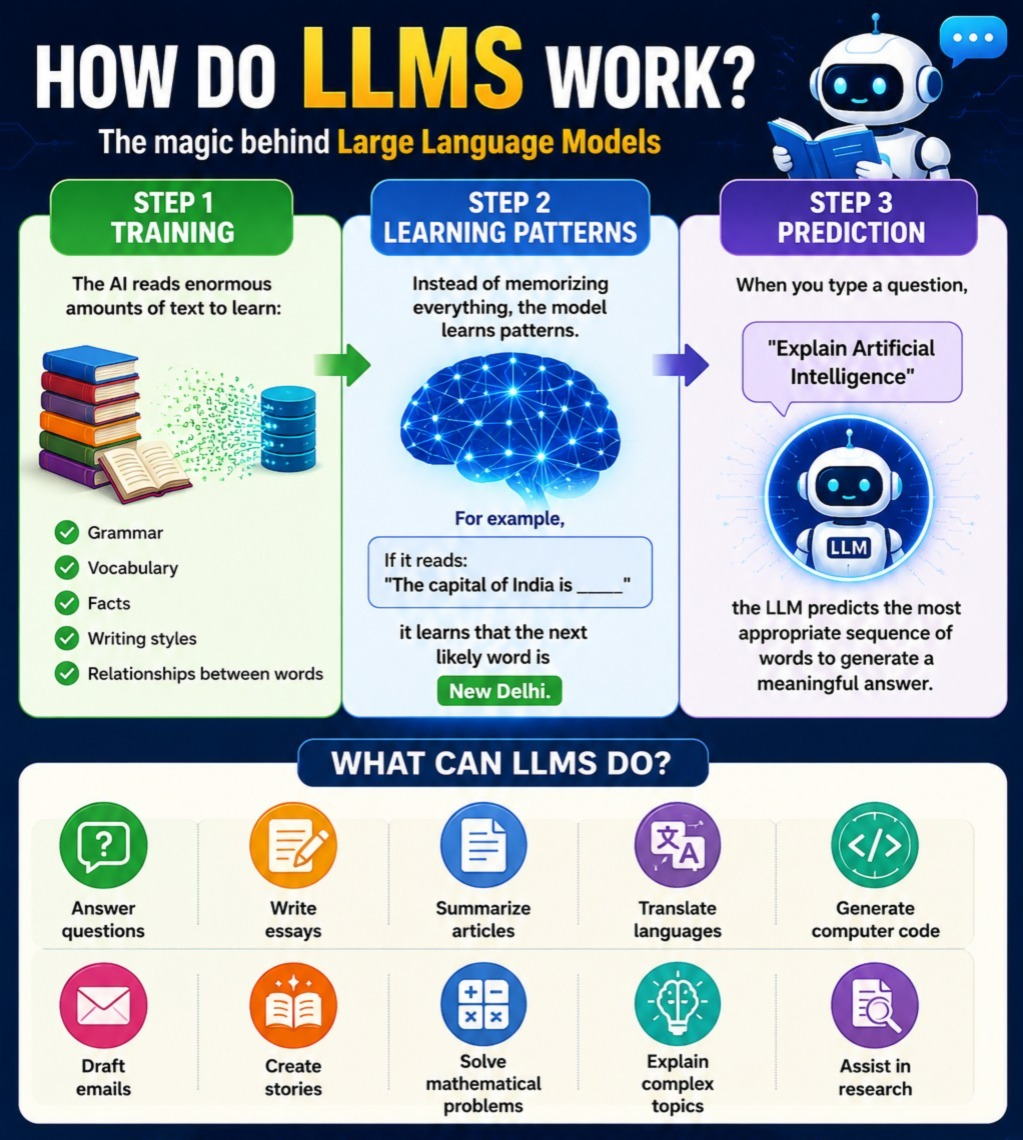
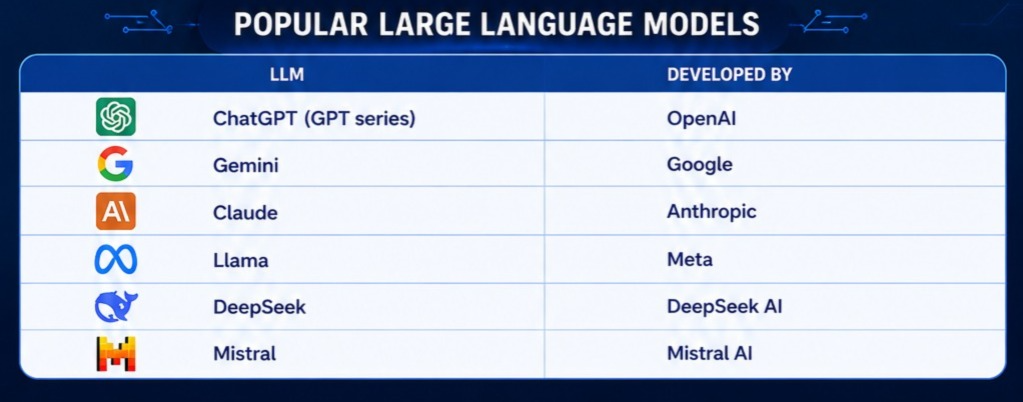
What are Large Language Models (LLMs)?
Large Language Models (LLMs) are advanced Artificial Intelligence (AI) systems that are trained on massive amounts of text data to understand, generate, summarize, translate, and answer questions in human language.
6. Developing Skilled AI Workforce
Recognising that skilled professionals are essential for AI leadership, India and Japan agreed to:
-
Promote joint research
-
Exchange AI researchers
-
Encourage internships
-
Facilitate talent mobility
-
Support AI skill development
A significant target is to facilitate the movement of 500 highly skilled Indian AI professionals to Japan by 2030.
7. AI for Inclusive Development
The partnership supports the vision of "AI for All."
The two countries will cooperate in:
-
Capacity building
-
Knowledge sharing
-
Technical assistance
-
AI adoption in developing countries
-
Public service delivery
-
Sustainable development
The objective is to ensure that AI benefits not only advanced economies but also the Global South.
Important Agreements Signed
Some of the notable AI-related agreements include:
-
IndiaAI Mission – Japan METI cooperation
-
IIT Bombay – National Institute of Informatics (Japan) collaboration on Large Language Models
-
BharatGen Technology Foundation partnership
-
Sarvam AI – Preferred Networks collaboration
-
AI research and development partnerships between universities and industries.
Why is this important for India?
The partnership will help India:
-
Strengthen AI research capabilities
-
Develop indigenous AI technologies
-
Build secure semiconductor and AI supply chains
-
Improve digital infrastructure
-
Enhance cybersecurity
-
Generate employment opportunities
-
Position India as a global AI innovation hub
The India-Japan AI Joint Statement marks a major step in strengthening bilateral cooperation in emerging technologies. By combining India's growing digital ecosystem and skilled workforce with Japan's technological expertise, the partnership seeks to build a secure, ethical, and inclusive AI ecosystem. Beyond bilateral cooperation, the agreement also reflects the shared vision of both countries to shape global AI governance and ensure that Artificial Intelligence contributes to sustainable and human-centric development worldwide.
Prelims Questions:
1. Which of the following statements with regard to Large Language Models (LLMs) used in machine learning is/are correct? [Prelims 2026]
-
LLMs assign probabilities to the next possible words and then pick the one with the highest probability.
-
LLMs process data through mathematical optimization to minimise prediction errors.
-
LLMs produce unbiased outputs.
Select the answer using the code given below:
(a) 1 only
(b) 1 and 2 only
(c) 2 and 3 only
(d) 1, 2 and 3
Answer: b
2. With reference to the OECD AI Principles, consider the following statements:
-
They were adopted in 2019 and are the world's first internationally agreed principles on Artificial Intelligence.
-
They emphasize transparency, accountability, and human-centred values in AI systems.
-
Compliance with the OECD AI Principles is legally binding on all member countries.
Which of the statements given above is/are correct?
(a) 1 and 2 only
(b) 2 and 3 only
(c) 1 and 3 only
(d) 1, 2 and 3
Answer: (a) 1 and 2 only
Explanation:
-
Statement 1 is correct: The OECD AI Principles were adopted in 2019.
-
Statement 2 is correct: Human-centred values, transparency, robustness, safety, and accountability are among the core principles.
-
Statement 3 is incorrect: The principles are not legally binding; they serve as internationally recognized policy guidelines.
These questions match the style and difficulty level typically seen in UPSC Civil Services Preliminary Examination.