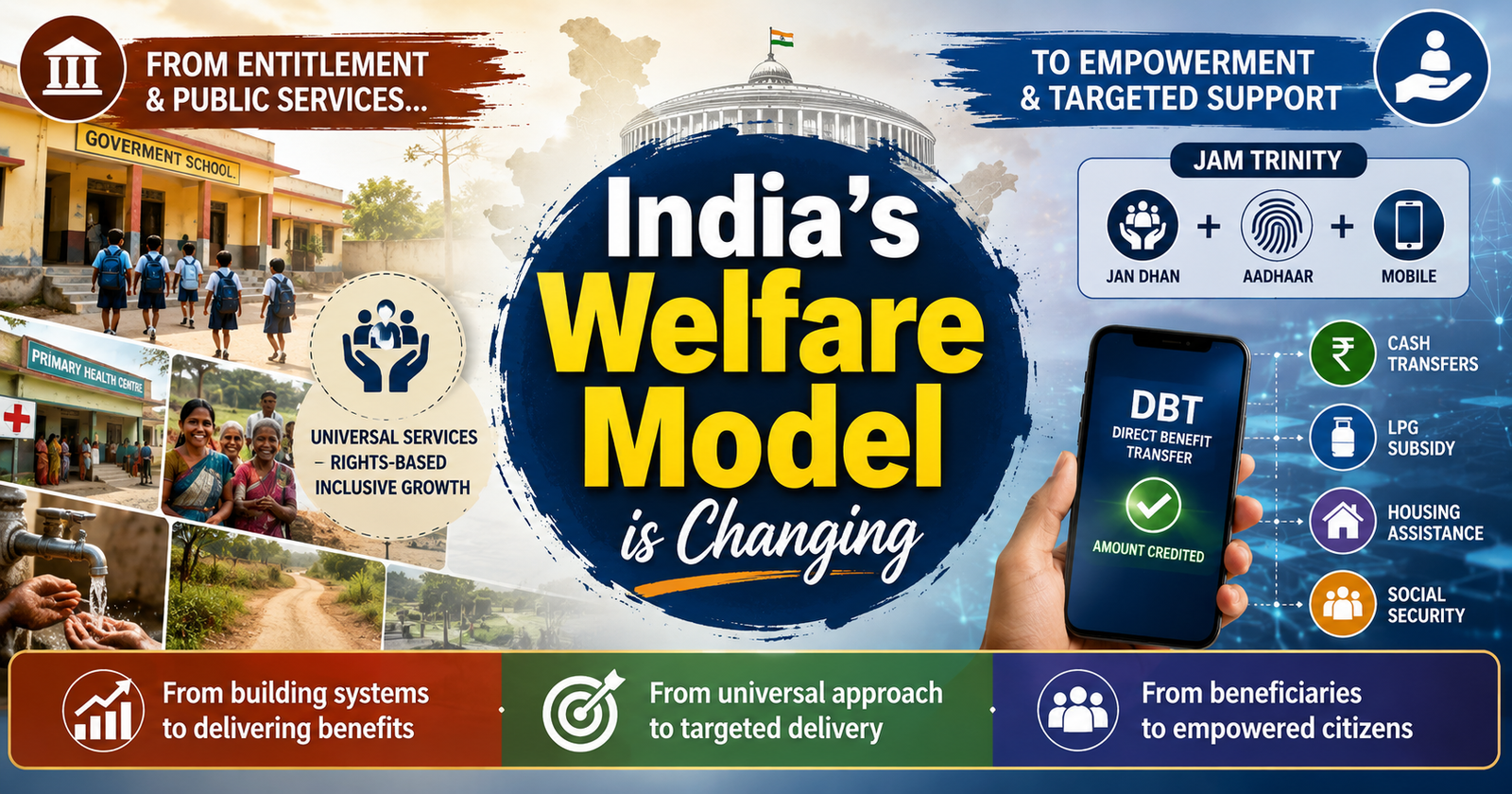
Explore how welfare model in India has evolved from rights-based governance to digital welfare, balancing efficiency through DBTs with concerns over health, education, and social development.
Syllabus Areas:
GS II - Governance
India's welfare system has undergone a major transformation over the past seven decades. Earlier, welfare policies emphasized rights-based development, universal public services, and accountability. Today, the focus has increasingly shifted towards digital governance, Direct Benefit Transfers (DBTs), and cash transfer schemes.
While technology has improved efficiency and reduced leakages, experts argue that excessive dependence on cash transfers and centralized schemes could weaken investments in health, education, nutrition, and other essential public services.
Evolution of India's Welfare Policy
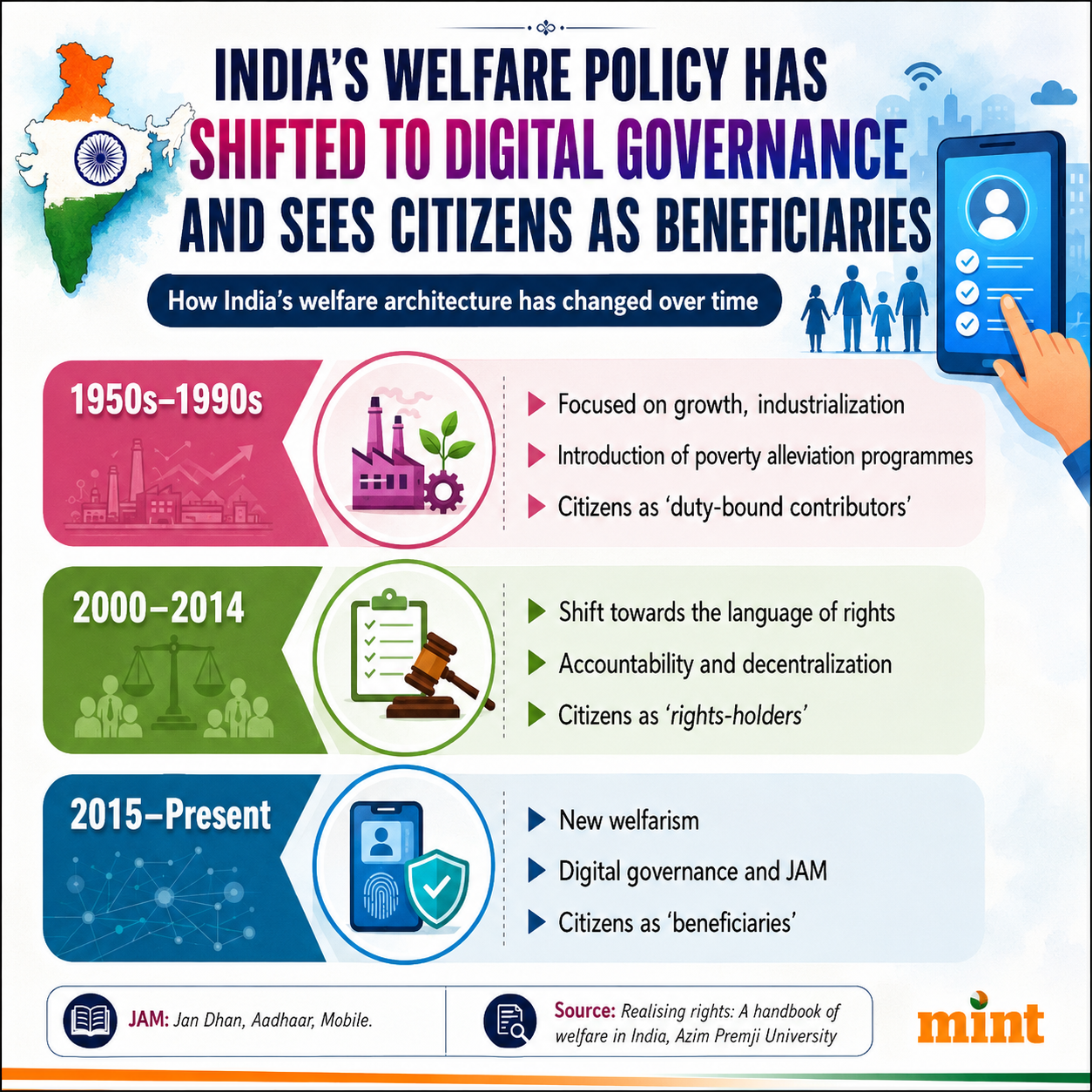
India's welfare policy has evolved through three major phases.
-
From the 1950s to the 1990s, welfare focused on economic growth, industrialization, and poverty alleviation, with the government expanding public institutions such as schools, hospitals, and community development programmes through state-led planning.
-
Between 2000 and 2014, India adopted a rights-based approach, introducing landmark legislations like the Right to Education (RTE), MGNREGA, Forest Rights Act, and National Food Security Act, which recognized citizens as rights holders and emphasized accountability and decentralization.
-
Since 2015, welfare has increasingly shifted to a digital governance model, driven by Direct Benefit Transfers (DBT) and the JAM (Jan Dhan–Aadhaar–Mobile) Trinity, enabling efficient benefit delivery while increasingly treating citizens as beneficiaries of targeted welfare schemes.
What is "New Welfarism"? (100–120 words)
-
New Welfarism refers to India's contemporary welfare approach, which emphasizes technology-driven, targeted delivery of benefits rather than expanding universal public services.
-
Instead of primarily investing in sectors such as health, education, and nutrition, governments increasingly rely on Direct Benefit Transfers (DBTs), cash transfers, LPG subsidies, housing assistance, and other direct financial support through centrally sponsored schemes.
-
Enabled by the JAM (Jan Dhan–Aadhaar–Mobile) Trinity, this model aims to ensure faster, transparent, and leak-proof distribution of welfare benefits.
-
While it improves administrative efficiency and reduces corruption, critics argue that excessive dependence on cash transfers may weaken long-term investments in public services, reduce social accountability, and shift welfare from a rights-based framework to a beneficiary-based approach.
Advantages of New Welfarism
1. Faster Delivery: Money reaches beneficiaries quickly.
2. Reduced Leakages: Aadhaar-linked DBTs have reduced duplicate beneficiaries.
3. Improved Transparency: Digital records make tracking easier.
4. Better Targeting: Welfare reaches intended beneficiaries more efficiently.
Concerns Raised by the Report
Despite efficiency gains, the report highlights several concerns.
1. Weakening Rights-Based Welfare
-
The focus is shifting away from legally guaranteed rights toward discretionary cash transfers.
-
This could reduce Social accountability, Citizen participation, Universal access to services
2. Reduced Investment in Human Development
-
The report argues that excessive cash transfers may reduce spending on Education, Healthcare, Nutrition, Public infrastructure
-
These sectors are crucial for long-term human development.
3. Centralization of Welfare
-
The Centre increasingly controls welfare through centrally sponsored schemes instead of transferring resources directly to states.
-
This reduces the flexibility of states to design welfare programmes suited to local needs.
Shift in Centre's Spending Pattern
-
Centrally Sponsored Schemes funding has increased rapidly. Allocation grew significantly after 2016.
-
State Plan Schemes funding has declined sharply.
-
It indicates that the Centre now relies more on centrally designed welfare programmes than on state-specific planning
States are Becoming the Main Social Spenders
The report finds that states now spend much more than the Centre on social sectors.
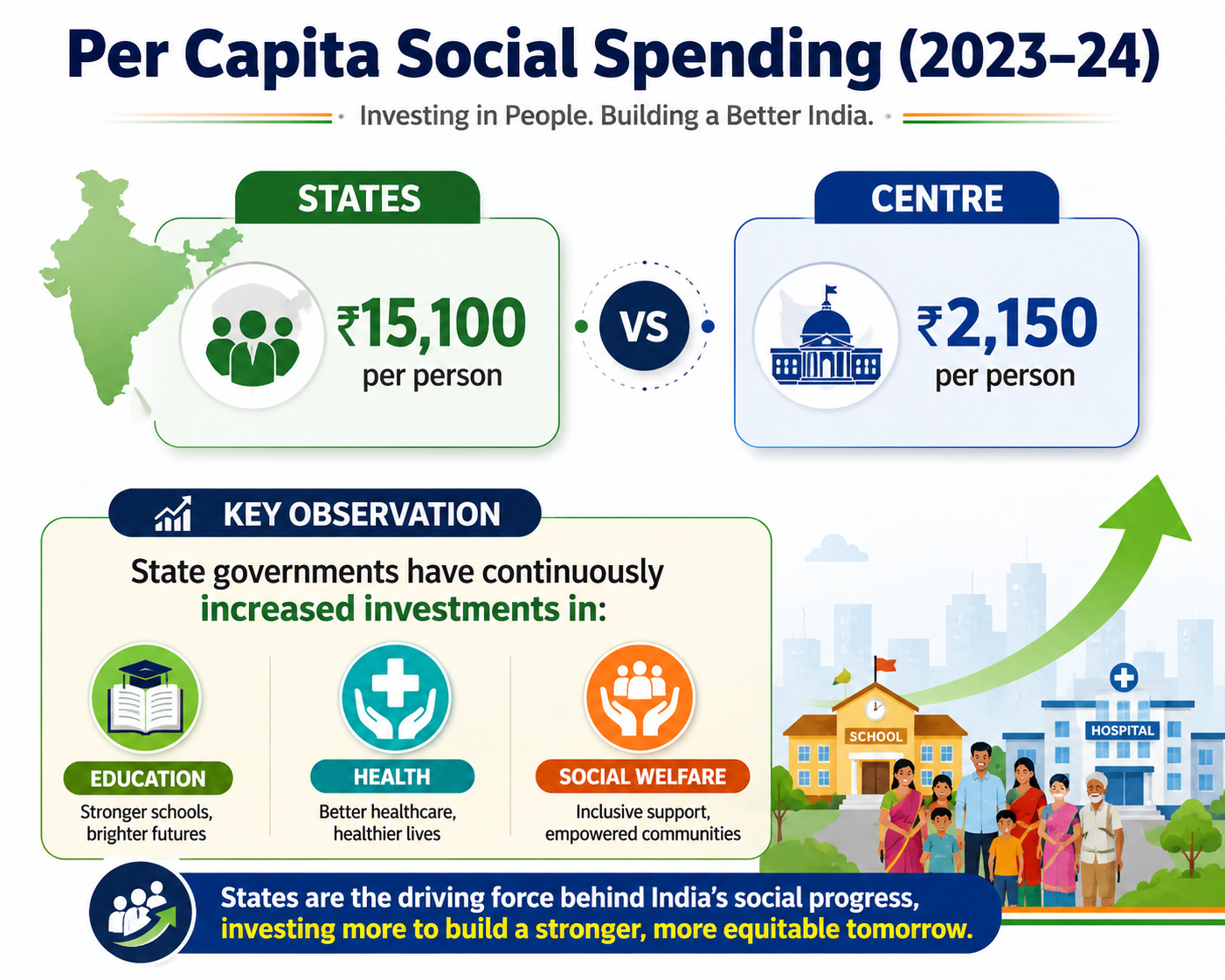
State governments have continuously increased investments in Education, Health, Social welfare despite receiving relatively fewer unconditional transfers from the Centre.
Cash Transfer Conundrum
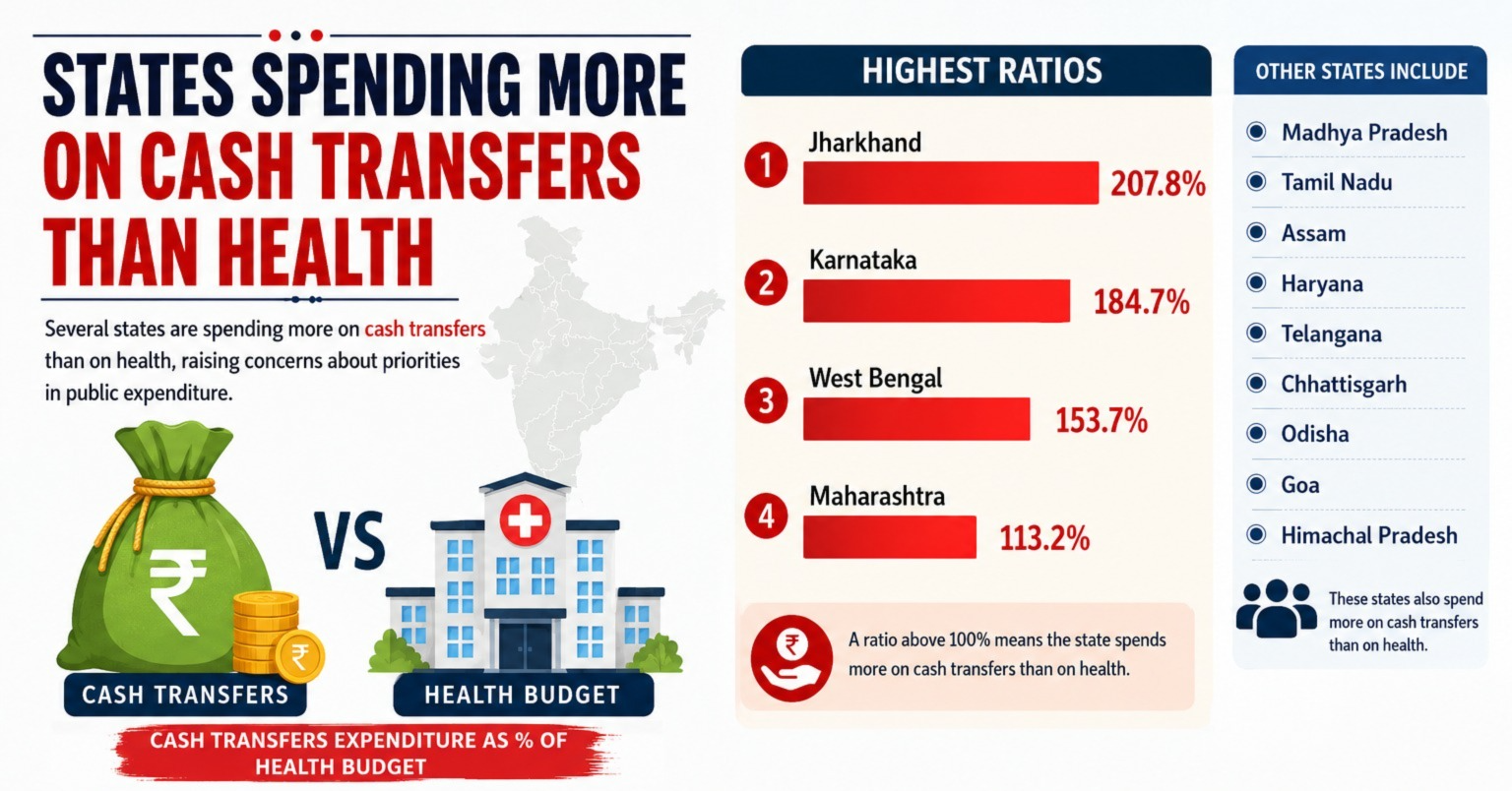
The report warns that unconditional cash transfers are expanding rapidly.
Findings
-
Cash transfer allocations increased nearly 20 times between 2015–16 and 2024–25.
-
Cash transfers now consume approximately 11% of total social sector spending.
-
Within state subsidies and transfers, the share of cash transfers increased from 3% (2018–19) to 20% (2025–26).
Why is This a Concern?
-
States have limited fiscal resources.
-
When large amounts are spent on cash transfers, there is less money available for Hospitals, Schools, Nutrition programmes, Public health, Infrastructure
-
The report argues this may crowd out long-term investments in human development.
India's Social Protection Spending Compared Globally
The article compares social protection spending (excluding health) as a percentage of GDP.
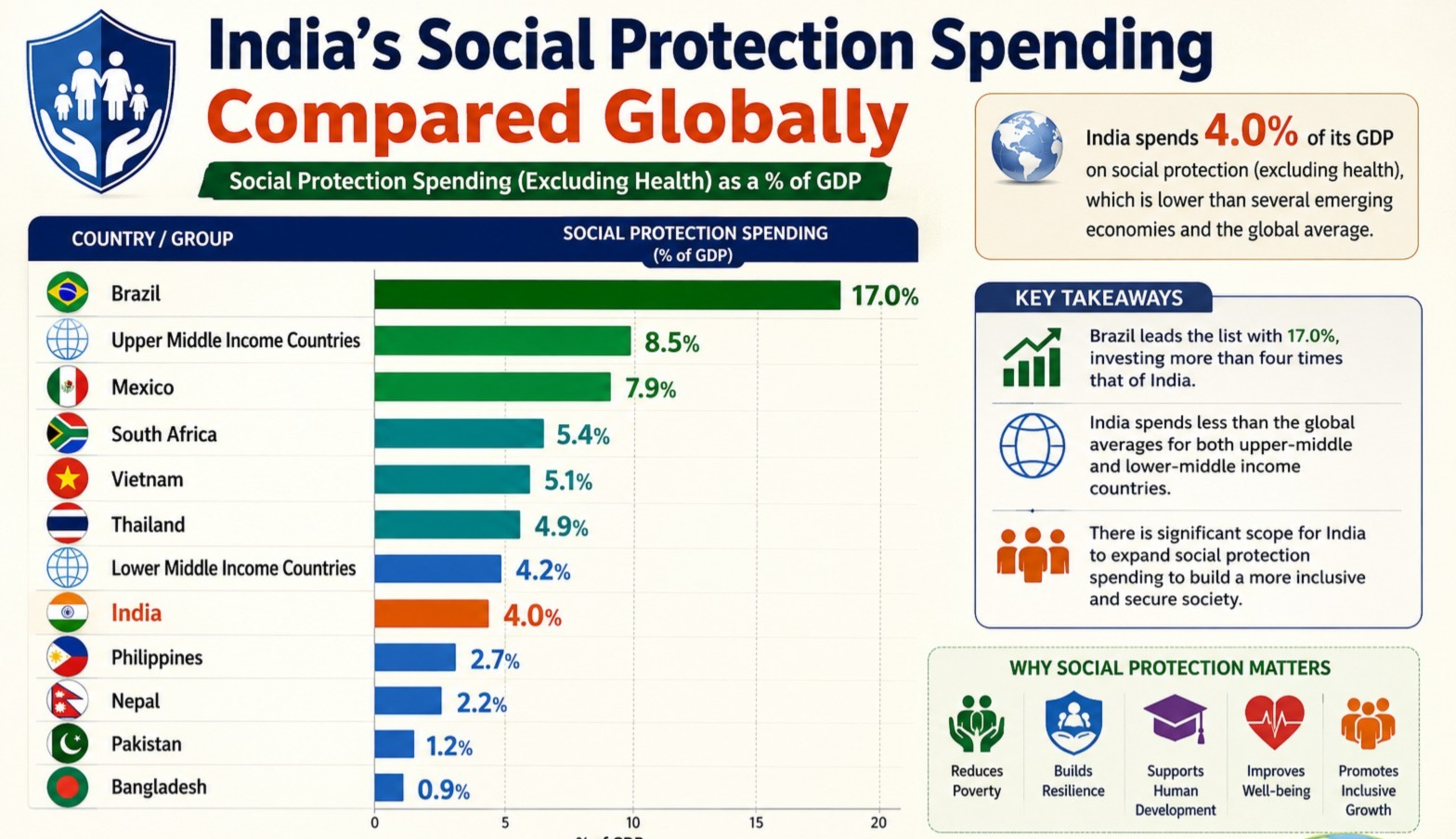
India's social protection spending remains lower than many comparable emerging economies.
Why Does India Spend Less?
The report cites several reasons:
-
Low tax-to-GDP ratio (around 17%)
-
Limited fiscal space
-
Growing expenditure commitments
-
Increasing reliance on targeted transfers instead of expanding universal public services
Major Takeaways
-
India's welfare model has shifted from rights-based welfare to digital cash transfer-based welfare.
-
JAM-enabled Direct Benefit Transfers have improved efficiency and reduced leakages.
-
The Centre increasingly favours centrally sponsored schemes over state-specific planning.
-
States have become the primary drivers of social sector expenditure.
-
Rapid growth of cash transfer schemes may reduce investments in health and education.
-
India's overall public spending on social protection remains relatively low compared with many emerging economies.
-
The long-term challenge is to balance efficient cash transfers with sustained investment in public services and human development.
India's welfare system has evolved from a development-oriented model to a rights-based approach and now to technology-driven digital welfare. While Direct Benefit Transfers (DBTs) and digital governance have improved efficiency and transparency, sustained investment in health, education, nutrition, and social infrastructure remains essential. A balanced welfare strategy that combines efficient cash transfers with strong public services is crucial for achieving inclusive growth, human development, and long-term social security.
Prelims Questions:
1. Which of the following legislations are associated with India's rights-based welfare approach?
-
Right to Education Act
-
Mahatma Gandhi National Rural Employment Guarantee Act
-
Forest Rights Act
-
National Food Security Act
Select the correct answer using the code below.
A. 1 and 2 only
B. 2, 3 and 4 only
C. 1, 2, 3 and 4
D. 1, 3 and 4 only
Answer: C
2. With reference to the JAM Trinity, consider the following statements:
-
It facilitates Direct Benefit Transfers (DBTs).
-
It aims to reduce leakages in welfare delivery.
-
It is based on Jan Dhan Accounts, Aadhaar and Mobile connectivity.
Which of the statements given above are correct?
A. 1 and 2 only
B. 2 and 3 only
C. 1 and 3 only
D. 1, 2 and 3
Answer: D
Mains Questions:
Q. "Cash transfers cannot be a substitute for sustained investments in health, education and nutrition." Discuss in the context of India's emerging 'New Welfarism' and fiscal federalism. 150 Words