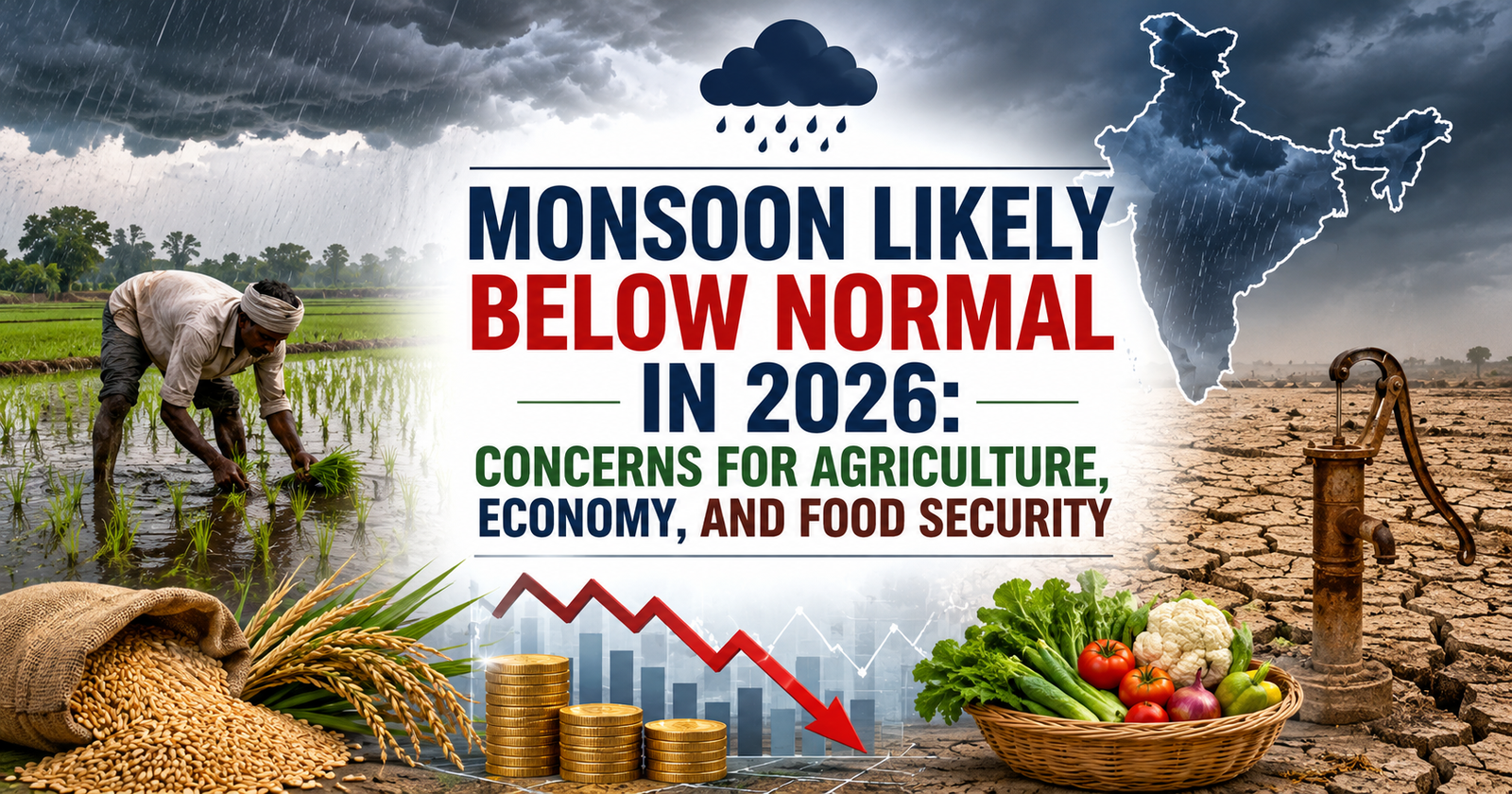
India may witness below-normal monsoon rainfall in 2026 due to possible El Niño conditions, raising concerns over agriculture, food production, water availability, inflation, and economic growth across multiple sectors.
Syllabus Areas:GS III - Economy and Environment |
India may experience below-normal southwest monsoon rainfall in 2026 due to the possible development of El Niño conditions in the Pacific Ocean. Weather agencies have also indicated that rainfall during June could remain weaker than normal, raising concerns over agriculture, water availability, and economic growth.
What is the Southwest Monsoon?
The southwest monsoon is the primary rainy season in India, generally occurring from June to September. It contributes nearly 70–75% of India’s annual rainfall and supports agriculture, drinking water supplies, hydropower generation, and groundwater recharge.
Since a large portion of India’s farming remains dependent on rainfall, monsoon performance directly affects livelihoods and food production.
What Does “Below Normal Monsoon” Mean?
The India Meteorological Department (IMD) classifies monsoon rainfall based on long period averages.
-
Normal rainfall: 96–104% of Long Period Average (LPA)
-
Below normal rainfall: Less than 96% of LPA
-
Deficient rainfall can create moisture stress and reduce agricultural output.
A below-normal monsoon does not mean drought everywhere, but it indicates that rainfall distribution may become uneven across regions.
Role of El Niño in Weakening Monsoon
El Niño refers to the warming of sea surface temperatures in the central and eastern Pacific Ocean. This warming affects atmospheric circulation patterns globally.
During El Niño years:
-
Moisture-bearing monsoon winds often weaken.
-
Rainfall distribution becomes irregular.
-
Heatwaves become more frequent and intense.
-
Agricultural productivity may decline in rainfed regions.
Historically, many weak monsoon years in India have shown links with strong El Niño events.
Impact on Agriculture Sector
1. Reduced Crop Productivity
Agriculture remains heavily dependent on monsoon rainfall. Below-normal rainfall may reduce soil moisture, delay sowing, and affect crop growth.
Crops most vulnerable include:
-
Rice
-
Pulses
-
Oilseeds
-
Cotton
-
Sugarcane
Lower agricultural output can reduce farm incomes and increase rural distress.
2. Delay in Kharif Sowing
Farmers generally begin sowing during June with the arrival of monsoon rains. Weak rainfall may delay planting schedules and shorten crop duration.
Delayed sowing can eventually affect harvesting cycles and market supply.
3. Pressure on Irrigation Systems
Reduced rainfall increases dependence on groundwater and irrigation reservoirs. Regions with weak irrigation infrastructure become more vulnerable during poor monsoon years.
Economic Implications of Weak Monsoon
1. Food Inflation Risks
Lower agricultural production may reduce supply of essential commodities. This can increase prices of vegetables, pulses, cereals, and edible oils.
Food inflation particularly affects lower-income households because a larger share of income is spent on food.
2. Impact on GDP Growth
Agriculture contributes significantly to employment and rural demand. Weak agricultural growth can reduce consumption demand and affect manufacturing and service sectors.
3. Higher Fiscal Pressure
Governments may need additional spending on:
-
Crop compensation schemes
-
Food subsidies
-
Rural employment programs
-
Water management projects
Water Security Concerns
A poor monsoon may affect:
-
Reservoir storage levels
-
Drinking water availability
-
Groundwater recharge
-
Hydropower generation
-
Urban water supply systems
States dependent on rain-fed water systems may experience greater stress.
Climate Change and Increasing Variability
Scientists increasingly link irregular rainfall patterns with climate change. Rising temperatures are making rainfall more extreme, with long dry periods followed by intense rainfall events.
This creates uncertainty for agriculture planning and disaster management.
Government Preparedness Measures
To reduce monsoon-related risks, governments generally focus on:
-
Reservoir management strategies
-
Crop insurance support
-
Promotion of drought-resistant crops
-
Expansion of irrigation infrastructure
-
Early weather warning systems
-
Micro-irrigation and water conservation programs
Way Forward
India needs to strengthen climate-resilient agriculture through better irrigation systems, improved forecasting technology, crop diversification, and efficient water management.
Reducing dependence on rainfall-sensitive agriculture will become increasingly important as climate variability rises.