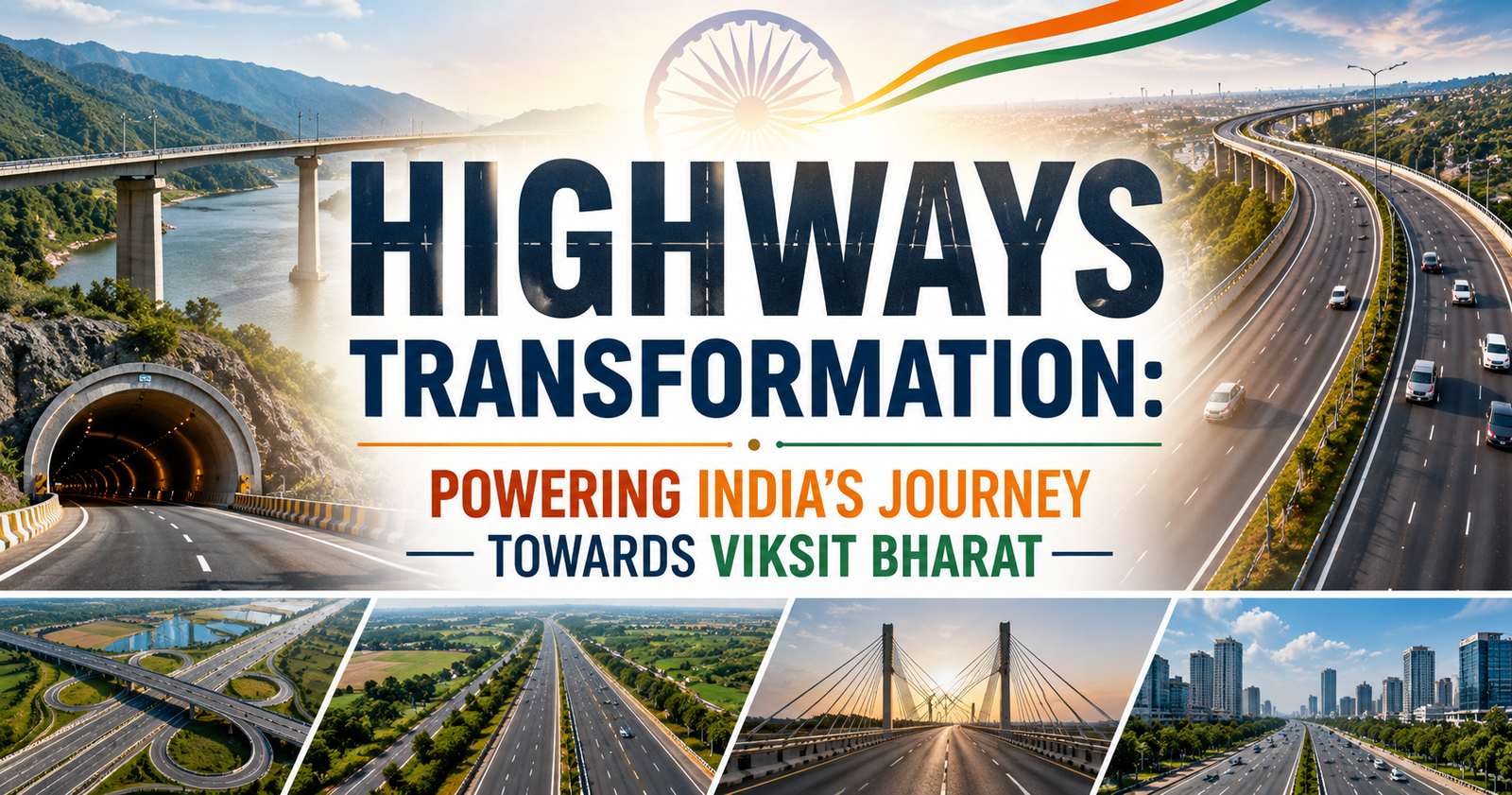
India s highway network has expanded rapidly through Bharatmala, expressways, and record construction speed, boosting connectivity, logistics efficiency, economic growth, and Viksit Bharat.
Syllabus Areas:
GS III - Economy (Infrastructure)
Over the past decade, India's road infrastructure has undergone a remarkable transformation. Roads and highways are not merely transportation assets; they are the backbone of economic growth, trade, industrial development, and regional integration. Recognizing this, the Government of India has placed infrastructure development at the center of its growth strategy.
The Ministry of Road Transport and Highways (MoRTH) has led an unprecedented expansion of the country's highway network, focusing on faster connectivity, reduced logistics costs, improved road safety, and seamless movement of people and goods. This transformation is helping build the foundation for a modern and developed India under the vision of Viksit Bharat.
Also Read about:
Bharatmala Pariyojana: The Backbone of Highway Development
-
One of the most ambitious initiatives in India's infrastructure journey is the Bharatmala Pariyojana.
-
Launched in 2017, the programme was designed to create an integrated highway network that improves both freight and passenger movement across the country.
-
Unlike traditional road projects that focused mainly on connectivity between cities, Bharatmala adopts a corridor-based approach.
-
It includes the development of economic corridors, feeder routes, border roads, coastal roads, port connectivity projects, and expressways.
-
The objective is to reduce travel time, lower logistics costs, and improve connectivity in strategically important and economically significant regions.
-
With a planned highway development target of 34,800 kilometres and an estimated investment of ₹5.35 lakh crore, the programme has already delivered substantial results.
-
By March 2026, over 22,500 kilometres of highways had been constructed under the initiative, strengthening national integration and creating new opportunities for regional economic growth.
Expansion of India's National Highway Network
-
The most visible outcome of the government's infrastructure push is the rapid expansion of the National Highway network.
-
In 2014, India's National Highway network stood at approximately 91,287 kilometres. By FY 2025-26, it had expanded to more than 146,500 kilometres, representing an increase of nearly 61 percent.
-
This growth has significantly improved connectivity between states and regions. Remote areas that were previously isolated now have better access to markets, healthcare facilities, educational institutions, and employment opportunities. The expanded network has also enhanced the movement of goods, contributing to a more integrated national economy.
Record-Breaking Pace of Highway Construction
-
India has not only expanded its highway network but has also dramatically increased the speed at which highways are built.
-
The average pace of National Highway construction has risen from around 11.6 kilometres per day in 2013-14 to nearly 34 kilometres per day in 2025.
-
This achievement reflects improvements in project execution, policy support, approval mechanisms, technological adoption, and institutional capacity.
-
The faster construction rate has enabled the timely completion of critical infrastructure projects while reducing delays that traditionally affected large-scale public works.
-
Improved highways have also contributed to lowering logistics costs, making Indian industries more competitive.
Landmark Expressways Transforming Connectivity
1. Delhi–Mumbai Expressway
-
The Delhi–Mumbai Expressway is among the most ambitious highway projects ever undertaken in India. Spanning approximately 1,386 kilometres and involving an investment of nearly ₹1 lakh crore, it will become the country's longest access-controlled expressway.
-
The corridor connects six major states—Delhi, Haryana, Rajasthan, Madhya Pradesh, Gujarat, and Maharashtra—linking some of India's most important economic centres.
-
Once fully operational, the expressway is expected to significantly reduce travel time, improve freight movement, attract investments, and generate employment opportunities along its route.
-
The project also incorporates modern infrastructure features such as logistics parks, connectivity to ports and airports, and numerous roadside amenities that will improve the overall travel experience.
2. Delhi–Meerut Expressway
-
The Delhi–Meerut Expressway has transformed regional connectivity within the National Capital Region (NCR).
-
Developed at a cost of over ₹8,300 crore, the 82-kilometre corridor has drastically reduced travel time between Delhi and Meerut.
-
Beyond improving commuter convenience, the expressway has supported economic growth in western Uttar Pradesh by facilitating trade, reducing congestion, and encouraging urban development.
3. Dwarka Expressway
-
The Dwarka Expressway represents a significant step forward in urban transportation infrastructure.
-
Connecting Delhi and Gurugram, the 29-kilometre corridor has improved mobility in one of India's fastest-growing urban regions.
-
Built with advanced engineering features, including multi-level interchanges and modern traffic management systems, the expressway is helping ease traffic congestion while supporting the growing transportation needs of the NCR.
4. Bengaluru–Mysuru Expressway
-
In southern India, the Bengaluru–Mysuru Expressway has emerged as a model of modern highway infrastructure.
-
The 118-kilometre corridor has reduced travel time between the two cities from nearly three hours to approximately 75 minutes.
-
The project has enhanced passenger convenience, improved road safety, strengthened tourism, and facilitated the transportation of agricultural and industrial products.
-
It has also contributed to greater economic integration across Karnataka and neighbouring states.
5. Delhi–Dehradun Economic Corridor
-
The Delhi–Dehradun Economic Corridor showcases how infrastructure development can be combined with environmental sustainability.
-
The 213-kilometre six-lane corridor has reduced travel time between Delhi and Dehradun from more than six hours to around two and a half hours.
-
A unique feature of this project is its focus on ecological preservation. The corridor passes through environmentally sensitive zones and includes one of Asia's longest elevated wildlife corridors, along with special engineering solutions designed to protect wildlife habitats and forest ecosystems.
-
The project demonstrates that modern infrastructure development can coexist with environmental conservation when planned effectively.
Economic and Social Impact
-
The expansion of highways and expressways has produced benefits that extend far beyond transportation.
-
Improved road connectivity has reduced logistics costs, making industries more competitive and supporting India's manufacturing sector.
-
Better transportation networks have also encouraged investment, generated employment, boosted tourism, and improved access to essential services.
-
For citizens, the benefits are equally significant. Reduced travel time, safer roads, improved connectivity, and enhanced accessibility have contributed to a better quality of life.
-
Rural and remote regions, in particular, have gained stronger links with economic growth centres.
India's highway transformation over the past twelve years reflects a broader commitment to infrastructure-led development. Through initiatives such as Bharatmala Pariyojana, rapid highway expansion, record construction speeds, and the development of world-class expressways, the country has created a stronger foundation for economic growth and national integration.
As India moves towards the goal of becoming a developed nation, a modern, resilient, and efficient highway network will continue to play a critical role in driving prosperity, connectivity, and inclusive development. The transformation of the road sector stands as one of the most significant achievements in India's journey towards Viksit Bharat.