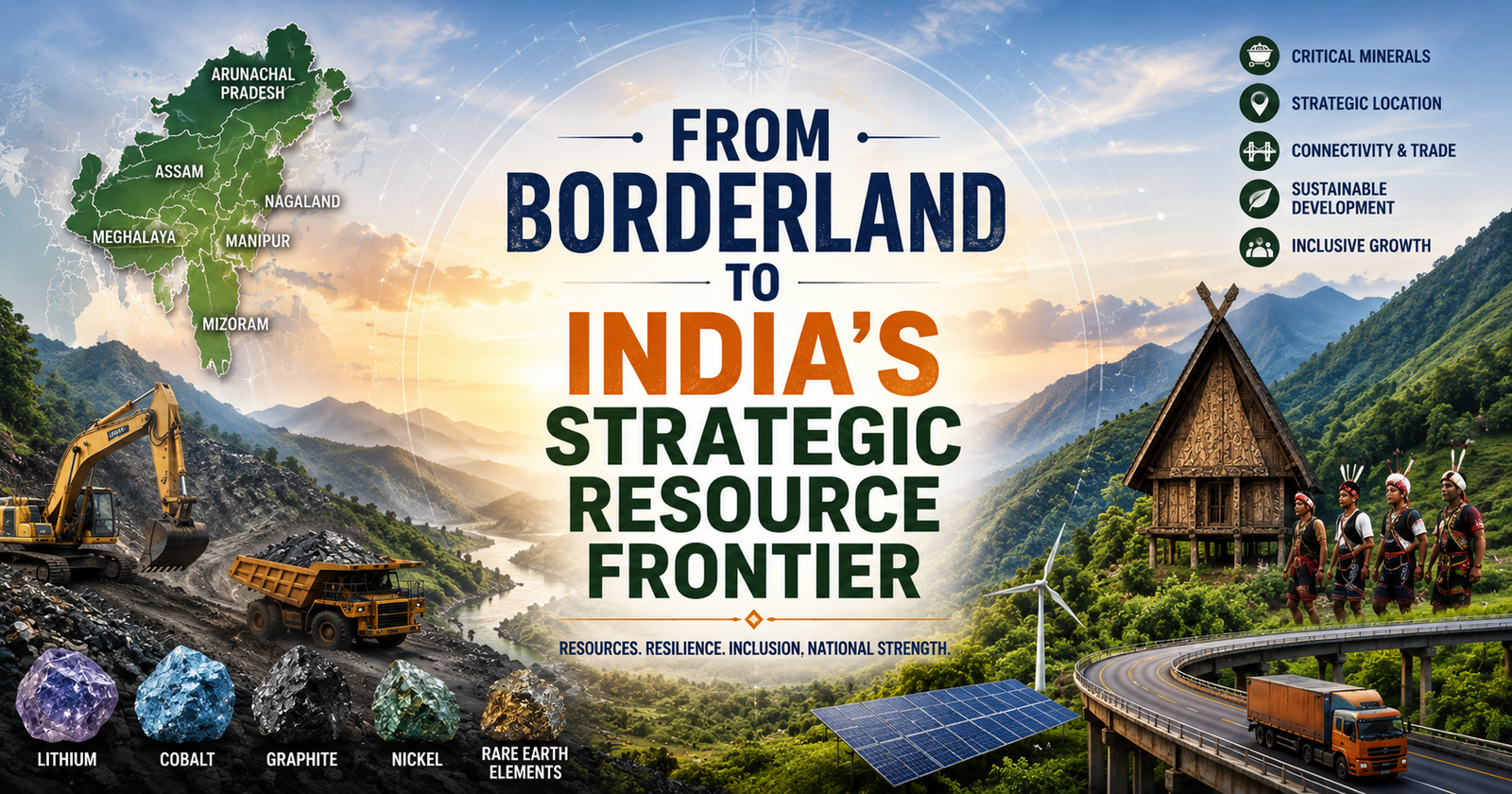
India’s Northeast is emerging as a strategic resource frontier due to critical mineral potential, geopolitical importance and connectivity, raising important questions about sustainability, inclusion, land rights and regional development.
Syllabus Areas:GS III - Economy, Internal Security |
The recent focus of the Ministry of Mines on northeastern states as repositories of critical minerals has brought renewed attention to the region’s strategic significance. States such as Arunachal Pradesh, Manipur, Meghalaya and others are increasingly being viewed not only through the lens of border security but also as vital resource frontiers for India’s economic and technological future.
What are Critical Minerals?
Critical minerals are minerals that are economically important and essential for strategic sectors but face supply risks due to import dependence, geographical concentration, or geopolitical vulnerabilities.
-
Some major critical minerals include Lithium, Cobalt, Graphite, Nickel, Rare Earth Elements (REEs), Vanadium, Copper, Silicon and Gallium
-
These minerals form the backbone of modern industrial economies and future technologies.
Why are Critical Minerals Important?
1. Energy Transition and Green Technologies
-
Essential for electric vehicle (EV) batteries
-
Used in renewable energy systems such as solar panels and wind turbines
-
Support global decarbonisation goals
2. Advanced Manufacturing
-
Important for semiconductors and electronics manufacturing
-
Required in aerospace and high-tech industries
3. Strategic and Defence Applications
-
Used in missile systems, communication equipment and defence technologies
-
Critical for national security preparedness
4. Supply Chain Security
-
Excessive import dependence creates vulnerabilities
-
Securing mineral supply chains reduces geopolitical risks
5. Economic Growth and Industrial Development
-
Enables growth of sunrise sectors
-
Supports domestic manufacturing under initiatives such as Make in India
Shift in National Thinking: From Borderland to Resource Frontier
Historically, Northeast India has largely been viewed through:
Border Security → Insurgency → Territorial Management → Connectivity
Today, this perspective is gradually changing toward:
Resource Security → Critical Minerals → Strategic Corridors → Supply Chain Resilience
-
This shift indicates that the Northeast is increasingly being integrated into India’s broader strategic and economic imagination.
-
The language of “frontier” itself is changing—from a space to secure and connect toward a space to develop, extract resources from and strategically integrate.
Why Northeast India Matters?
1. Rich Geological Potential: The region possesses significant deposits of:
-
Graphite
-
Nickel
-
Rare Earth Elements
-
Cobalt
-
Lithium-bearing resources
2. Strategic Location: The Northeast shares borders with multiple countries and acts as India’s gateway to Southeast Asia, increasing its geopolitical importance.
3. Connectivity and Trade Corridors: Projects under regional connectivity initiatives can transform the region into an economic corridor linking India with neighboring markets.
4. Economic Development Opportunities
Resource-based industries can generate:
-
Employment
-
Infrastructure development
-
Industrial investments
-
Regional growth
5. Strategic Resource Security: Developing domestic mineral resources reduces import dependence and strengthens long-term economic resilience.
Challenges in Resource Extraction and Protection of Local Realities
Despite opportunities, extraction activities raise significant concerns.
1. Land Rights and Customary Ownership
-
Many northeastern communities follow customary land systems
-
Ownership structures are community-based rather than individual-centric
-
Resource projects may create conflicts over ownership and compensation
2. Historical and Political Sensitivities
-
The region has experienced long histories of conflict and political contestation
-
Development projects without consultation may deepen mistrust
3. Ecological Vulnerability
-
Northeast India is one of the world’s biodiversity hotspots
-
Mining activities may threaten forests, rivers and fragile ecosystems
4. Displacement and Social Consequences
Large-scale extraction projects may lead to:
-
Displacement of local populations
-
Livelihood disruption
-
Cultural erosion
5. Representation and Participation Deficit
Communities often demand:
-
Greater participation in decision-making
-
Transparent governance mechanisms
-
Fair sharing of economic benefits
6. Security and Governance Challenges
Resource-rich regions sometimes witness tensions if extraction outpaces governance capacity.
Way Forward
-
Adopt Inclusive Resource Governance: Development should prioritize local participation and consent mechanisms.
-
Strengthen Environmental Safeguards
-
Conduct robust environmental impact assessments
-
Promote sustainable mining practices
-
Ensure biodiversity protection
-
Protect Customary Land Rights: Resource policies should respect existing land ownership systems and traditional institutions.
-
Build Local Economic Ecosystems: Resource extraction must create:
-
Local employment
-
Skill development
-
Value-addition industries
-
Regional entrepreneurship
-
Improve Institutional Capacity: Strengthening local governance institutions can help manage social and environmental consequences.
-
Balance Security with Development: Strategic objectives should be integrated with social justice and regional aspirations.
The growing focus on Northeast India as a critical mineral frontier marks a significant shift in India’s strategic thinking. However, minerals beneath the ground cannot be separated from the people, histories and institutions above it. Sustainable development in the Northeast will depend not merely on extracting resources but on creating an inclusive model where economic growth, environmental protection and community participation move together. The true success of this transition will lie in transforming the region from a resource frontier into a partnership frontier.
Prelims Question:1. Consider the following pairs:
How many of the above pairs are correctly matched? A. Only one Answer: C Explanation: |