Supreme Court clarifies Scheduled Caste status and religious conversion, highlighting constitutional provisions, loss of benefits, reconversion criteria, and the ongoing debate on Dalit Christians and Muslims in India.
Syllabus Areas:GS II - Polity and Governance |
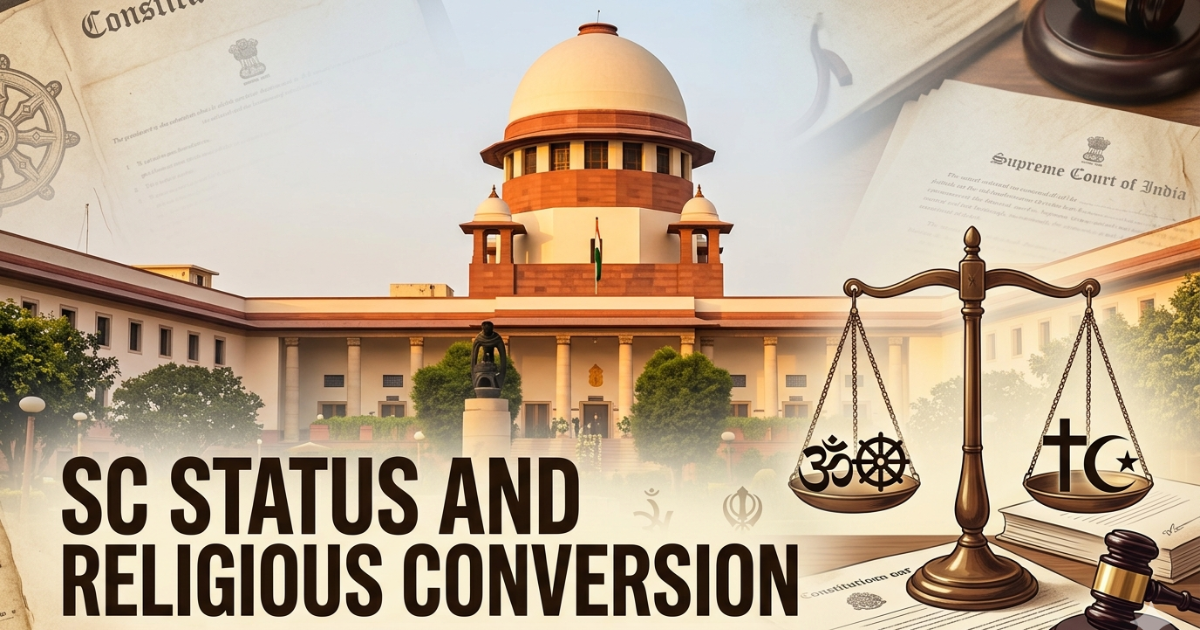
The Supreme Court, in its March 24, 2026 judgment, ruled that a person who converts to Christianity or any religion outside Hinduism, Sikhism, or Buddhism cannot claim Scheduled Caste (SC) status. The ruling reaffirms the legal framework under the Constitution (Scheduled Castes) Order, 1950 and has reignited debate on caste, religion, and social justice in India.
Background:
The Constitution (Scheduled Castes) Order, 1950 lays down the criteria for identifying Scheduled Castes. Initially applicable only to Hindus, it was later amended to include Sikhs (1956) and Buddhists (1990).
A key clause states that:
-
Only those professing Hinduism, Sikhism, or Buddhism can be recognised as SCs.
-
This provision was designed to address caste-based discrimination rooted in these religious social structures.
The Court reaffirmed that this framework remains legally binding and constitutionally valid.
Key Highlights of the Supreme Court Judgment
1. Religion-Based Restriction is Absolute
The Court held that the restriction imposed by the 1950 Order is absolute and leaves no room for exceptions.
-
Any individual professing a religion outside the specified three is ineligible for SC status.
-
The judgment emphasized that courts cannot dilute this constitutional mandate.
This interpretation strengthens the rigidity of the existing legal framework governing affirmative action.
2. Conversion Leads to Immediate Loss of SC Status
A crucial clarification of the judgment is that:
-
Conversion results in automatic and immediate loss of SC identity.
-
This applies regardless of:
-
Birth in an SC community
-
Historical caste background
The Court reiterated that SC status is not merely about origin but is linked to the current religious identity of the individual.
3. Loss of Associated Benefits and Protections
The judgment clarified that loss of SC status also results in the termination of all associated benefits, including:
-
Reservation in education and employment
-
Welfare schemes
-
Legal protections under laws like the SC/ST (Prevention of Atrocities) Act, 1989
Thus, the implications are not symbolic but material and far-reaching.
4. Meaning of “Professing a Religion”
The Court interpreted the term “profess” to mean:
-
Open declaration and active practice of a religion
This means that:
-
Mere birth identity is irrelevant if a person actively practices another religion.
-
The factual religious identity of the individual becomes decisive.
5. Documentary Evidence vs Ground Reality
The Court made an important observation:
-
Caste certificates alone cannot determine SC status
-
Actual religious practice and identity take precedence
This prevents misuse of reservation benefits based solely on documentation without reflecting social reality.
Reconversion and Regaining SC Status
The Court laid down strict conditions for regaining SC status after reconversion:
-
Proof of original SC origin
-
Clear and bona fide reconversion to a permitted religion
-
Acceptance by the original caste/community
Additionally:
-
The individual must demonstrate complete renunciation of the converted religion
-
Must adopt traditional customs and practices
Importantly, the burden of proof lies entirely on the claimant, and must be supported by strong, credible evidence.
Larger Constitutional Debate: Dalit Christians and Muslims
Pending Issue
The question of granting SC status to Dalit Christians and Muslims is still unresolved:
-
A petition filed in 2004 is pending before the Supreme Court
-
The issue revolves around whether caste-based discrimination persists even after conversion
Arguments Involved
Petitioners argue:
-
Caste discrimination continues even within Christianity and Islam
-
Denying SC status violates equality principles
Government’s stance:
-
SC status is tied to specific religious contexts
-
Christianity and Islam do not traditionally recognise caste hierarchy
Recent Developments
-
A Commission headed by former CJI K.G. Balakrishnan is examining this issue
-
Its findings may influence future constitutional interpretation
Distinct Position of Scheduled Tribes (STs)
The Court highlighted a critical distinction:
-
No religion-based restriction exists for ST status
-
Determination depends on:
-
Cultural identity
-
Tribal practices
-
Community acceptance
Thus:
-
Conversion alone does not automatically disqualify ST status
-
Each case must be evaluated on factual and cultural grounds
This creates a clear legal divergence between SCs and STs.
Critical Analysis: Constitutional Rigidity vs Social Reality
This judgment brings out a fundamental tension:
Legal Perspective
-
SC status is strictly defined by constitutional provisions
-
Religion acts as a determinant factor
Social Perspective
-
Caste-based discrimination often persists beyond religion
-
Converts may continue to face similar socio-economic disadvantages
Policy Dilemma
-
Should affirmative action be based on historical discrimination or current religious identity?
-
This remains a key unresolved question in Indian constitutional law
The Supreme Court’s ruling reinforces the existing constitutional position on SC status and religious identity, ensuring legal clarity. However, it also intensifies the broader debate on social justice, religious freedom, and equality.
The final resolution of this issue will likely depend on:
-
The pending Supreme Court decision on Dalit converts
-
Recommendations of the Balakrishnan Commission
This remains a critical and evolving area in India’s constitutional and social justice discourse.
Prelims Questions:1. With reference to the SC/ST (Prevention of Atrocities) Act, 1989, consider the following:
Which of the statements is/are correct? Answer: (b) 2. Which of the following statements correctly distinguishes Scheduled Castes (SCs) from Scheduled Tribes (STs)? (a) Both SC and ST status depend on religion Answer: (b) |
Mains Questions:1. “The linkage between Scheduled Caste status and religion reflects constitutional intent but raises questions of social justice.” Examine. 250 Words 2. “Affirmative action in India should be based on socio-economic backwardness rather than religion.” Discuss in the context of SC status. 250 Words 3. “Identity, discrimination, and justice: Can law fully capture social realities?” Discuss with reference to caste and conversion. 150 Words |