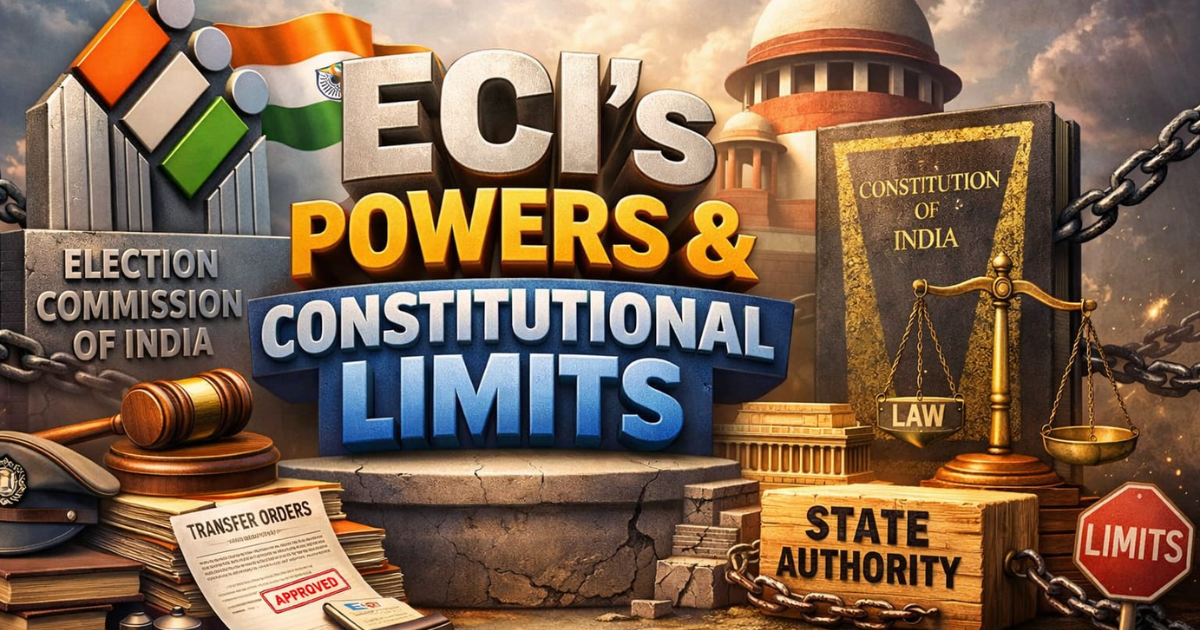
Explains the controversy over Election Commission’s transfer powers, limits of Article 324, Supreme Court interpretation, and its impact on federalism, rule of law, and free and fair elections in India.
Syllabus Areas:GS II - Polity and Governance |
The issue has come into focus because the Election Commission of India recently transferred several senior officials, including Chief Secretaries and Directors General of Police, in States where elections are about to be held. These transfers were done suddenly and without consulting the State governments. This has triggered a serious debate on whether the Commission has such sweeping powers under Article 324, or whether it has crossed constitutional limits.
What exactly is the role of the Election Commission?
The Constitution gives the Election Commission the responsibility to ensure that elections in India are conducted in a free and fair manner. This is not a small responsibility—it is central to democracy itself. Because of this, Article 324 gives the Commission broad powers to supervise and control elections.
What exactly did the Election Commission do?
In the present case, the Commission transferred top-level officers in election-bound States, especially in West Bengal. These officers include the highest administrative and police authorities in the State.
What made this controversial is:
-
The transfers were done overnight
-
The State government was not consulted
-
The administration was reportedly disrupted
The Commission justified this by saying that such steps are necessary to ensure neutral and fair elections.
What does the Constitution actually say?
Article 324 gives the Election Commission the power of “superintendence, direction and control” over elections. On the surface, this sounds very wide.
The Supreme Court of India, especially in the landmark case of Mohinder Singh Gill vs Chief Election Commissioner (1978), clarified that:
-
Article 324 is indeed a plenary power (very wide in scope)
-
It acts as a reserve power, meaning the Commission can act when there is no specific law covering a situation
But the Court also placed clear limits:
-
If there is already a law made by Parliament or State Legislature, the Commission must follow that law
-
The Commission must act fairly, reasonably, and within the rule of law
This is where the current controversy becomes important.
Where does the conflict arise?
The transfer of officers in India is not an undefined area. It is clearly governed by laws like:
-
The All India Services Act
-
Service rules under State and Union governments
These laws give the power of transfer primarily to governments, not to the Election Commission.
What about the Commission’s practical needs?
The Commission does not have its own administrative machinery. It depends on State officials to conduct elections.
The Constitution recognizes this under Article 324(6), which says that States must provide staff to the Election Commission when required.
But there is a crucial distinction:
-
Providing staff is one thing
-
Transferring or removing top officers is another
The article argues that the Commission may be stretching this provision beyond its intended scope.
Why is this seen as problematic?
There are three major concerns:
1. Federalism at stake: Public services fall under the State’s domain. If the Commission can unilaterally transfer top officers, it weakens State authority.
2. Lack of transparency
There is no clear procedure explaining:
-
How these officers were judged as biased
-
What evidence was used
This creates a perception of arbitrariness.
3. Risk of unchecked power: Even powerful constitutional bodies are not above the law. The Supreme Court has clearly stated that no authority in India has absolute power.
The deeper constitutional principle
At its core, this issue is not just about transfers. It is about balance.
India’s Constitution tries to balance:
-
Free and fair elections
-
Rule of law
-
Federal structure
If any one institution becomes too powerful, that balance is disturbed.
Constitutional ProvisionsInstead of listing them mechanically, let’s understand them logically:
|