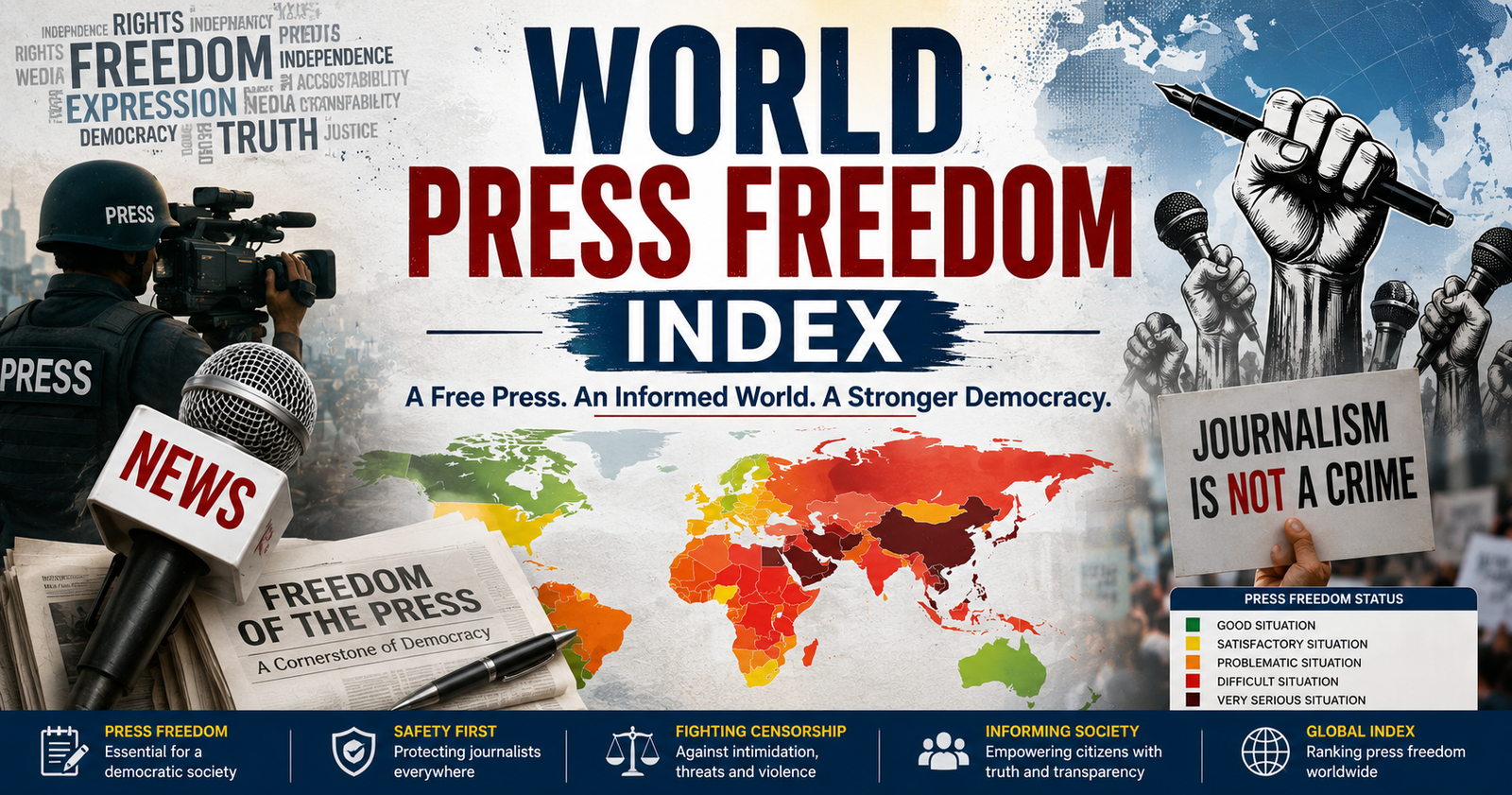
Explore the World Press Freedom Index, its significance, indicators, India’s position, challenges faced by media, journalist safety concerns and the importance of press freedom in a democratic society.
Syllabus Areas:GS II - IR and Governance |
Freedom of the press is one of the most essential foundations of a democratic society. A free and independent media informs citizens, questions those in power, exposes corruption, highlights public issues and strengthens accountability in governance. In any democracy, citizens can make informed political and social decisions only when information flows freely without fear, censorship or excessive control.
In recent years, press freedom has become a major topic of global discussion due to increasing concerns over attacks on journalists, political pressure on media institutions, misinformation on digital platforms and restrictions on free expression. The rapid growth of social media has transformed the way information is shared, but it has also created challenges related to fake news, online harassment and manipulation of public opinion.
What is the World Press Freedom Index?
The World Press Freedom Index is an annual ranking published by Reporters Without Borders (RSF), an international non-governmental organization based in Paris, France. The index measures the level of freedom available to journalists and media organizations in countries around the world.
The purpose of the index is to examine whether journalists can:
-
Report independently
-
Express opinions freely
-
Investigate sensitive issues without fear
-
Work safely without political or physical threats
The index does not evaluate the quality of journalism or the political ideology of media organizations. Instead, it studies the overall environment in which journalism operates.
The rankings are prepared using:
-
Expert surveys
-
Research analysis
-
Data regarding attacks on journalists
-
Information related to legal, political and economic pressures on media
Countries are ranked according to the degree of freedom and safety available for journalistic work.
About Reporters Without Borders (RSF)
Reporters Without Borders, also known as Reporters Sans Frontières (RSF), is an international organization dedicated to defending press freedom and protecting journalists.
The organization works in different parts of the world to:
-
Monitor censorship
-
Raise awareness regarding attacks on media freedom
-
Support journalists facing threats
-
Promote independent journalism
RSF publishes reports and research regarding global media conditions and highlights violations of press freedom.
Indicators Used in the Index
The World Press Freedom Index evaluates countries using several indicators that together determine the condition of media freedom.
1. Political Context
-
This indicator studies the level of political pressure or influence on media institutions. It examines whether governments tolerate criticism and whether journalists can report on political issues freely.
-
Countries where media faces direct political interference generally receive lower rankings.
2. Legal Framework
The legal environment significantly affects press freedom. The index examines laws related to:
-
Defamation
-
Sedition
-
National security
-
Media regulation
-
Protection of journalistic sources
If laws are excessively used against journalists, media freedom may weaken.
3. Economic Environment
Media organizations require financial independence to function freely. This indicator studies:
-
Corporate ownership
-
Dependence on advertisements
-
Financial pressure from political or business groups
Concentration of media ownership can affect editorial independence.
4. Sociocultural Environment
Social conditions also influence journalism. Journalists may face pressure from:
-
Religious groups
-
Ideological organizations
-
Social hostility
-
Online abuse
In polarized societies, critical reporting may lead to threats and harassment.
Safety of Journalists
This is one of the most important indicators in the index.
It examines:
-
Physical attacks on journalists
-
Arrests and detentions
-
Threats and intimidation
-
Violence during protests or conflicts
-
Digital surveillance
The safety of journalists directly affects the ability of media institutions to function independently.
Importance of Press Freedom in a Democracy
1. Ensuring Accountability
-
A free media exposes corruption, misuse of power and administrative failures. Investigative journalism often brings public attention to scams, policy failures and human rights violations.
-
Without independent journalism, governments and institutions may escape accountability.
2. Informing Citizens
Citizens require accurate information to:
-
Participate in elections
-
Understand public policies
-
Debate national issues
-
Hold leaders accountable
A democratic society cannot function effectively if information is controlled or manipulated.
3. Protecting Freedom of Expression
-
Freedom of the press is closely connected with freedom of speech and expression.
-
In India, Article 19(1)(a) of the Constitution guarantees freedom of speech and expression. Although freedom of the press is not explicitly mentioned, courts have interpreted it as part of this fundamental right.
-
Press freedom therefore strengthens constitutional democracy.
4. Promoting Transparency
-
Media plays a major role in promoting transparency in governance. Public awareness regarding welfare schemes, policy implementation and administrative decisions often depends on media reporting.
-
An informed society is better equipped to demand good governance.
5. Supporting Social Awareness
Media also contributes to awareness regarding:
-
Health
-
Education
-
Environment
-
Gender equality
-
Human rights
Journalism helps highlight the concerns of marginalized communities and promotes social debate.
India and the World Press Freedom Index
India’s ranking in the World Press Freedom Index has often attracted international and domestic attention. The index has raised concerns regarding:
-
Safety of journalists
-
Political pressure
-
Online harassment
-
Internet shutdowns
-
Media ownership concentration
At the same time, India possesses one of the world’s largest and most diverse media ecosystems. The country has:
-
Thousands of newspapers
-
Regional language journalism
-
Television news channels
-
Expanding digital media platforms
India’s democratic structure allows a wide range of opinions and political debates. However, concerns continue regarding the working environment for journalists and the increasing polarization within public discourse.
The issue therefore involves balancing:
-
Freedom of expression
-
Responsible journalism
-
National security
-
Public order
Challenges Faced by Media in India
1. Threats and Violence Against Journalists
-
Journalists reporting on sensitive subjects such as corruption, crime, illegal activities or political conflicts sometimes face threats and intimidation.
-
Attacks on journalists create fear and may discourage independent reporting.
2. Spread of Fake News and Misinformation
-
The rise of social media has increased the spread of:
-
Fake news
-
Rumours
-
Manipulated videos
-
Propaganda
-
Misinformation affects public trust and creates confusion in society.
-
This has become one of the biggest challenges for modern journalism.
3. Corporate and Political Influence
-
Media organizations often depend on advertisements and corporate funding. Excessive concentration of ownership may influence editorial independence.
-
Political and economic pressures can affect objective reporting.
4. Internet Restrictions and Digital Concerns
-
Internet shutdowns and digital restrictions during law-and-order situations have become a topic of debate.
-
Critics argue that such restrictions affect:
-
Access to information
-
Digital journalism
-
Freedom of communication
-
Governments, however, often justify these measures on security grounds.
5. Online Harassment
-
Many journalists face abuse and threats on social media platforms. Women journalists in particular often face severe online harassment.
-
Digital hostility has become a serious concern in the media environment.
Government’s Perspective
The government maintains that India has a vibrant and active media ecosystem where multiple viewpoints are expressed freely. Authorities argue that regulations are necessary to:
-
Maintain public order
-
Prevent misinformation
-
Address hate speech
-
Protect national security
The government also emphasizes that freedom of expression is subject to reasonable restrictions under the Constitution.
The challenge lies in ensuring that regulation does not weaken democratic freedoms.
Measures Needed to Strengthen Press Freedom
India can strengthen press freedom through balanced institutional reforms.
-
Ensuring Safety of Journalists: Fast investigation of attacks and stronger legal protection for journalists are necessary.
-
Promoting Ethical Journalist: Media organizations must strengthen:
-
Fact-checking
-
Editorial standards
-
Responsible reporting
-
to improve credibility and public trust.
-
Combating Fake News: Digital literacy and awareness programs are essential to reduce misinformation. Technology platforms should improve verification systems and transparency.
-
Strengthening Media Independence: Reducing excessive political and corporate influence can improve editorial freedom.
-
Transparent Regulation: Media regulations should remain constitutional, transparent and accountable while protecting democratic rights.
The World Press Freedom Index highlights the close relationship between journalism, democracy and freedom of expression. A free and independent press is essential for transparency, accountability and informed public participation.
India, as the world’s largest democracy, has a vibrant and diverse media landscape. However, challenges such as misinformation, journalist safety, political pressure and digital restrictions continue to influence discussions on press freedom.
The future of democratic governance depends on maintaining a balanced environment where journalists can work freely and responsibly while ensuring national security and social stability. A strong democracy ultimately requires both freedom of the press and accountability within the media system.