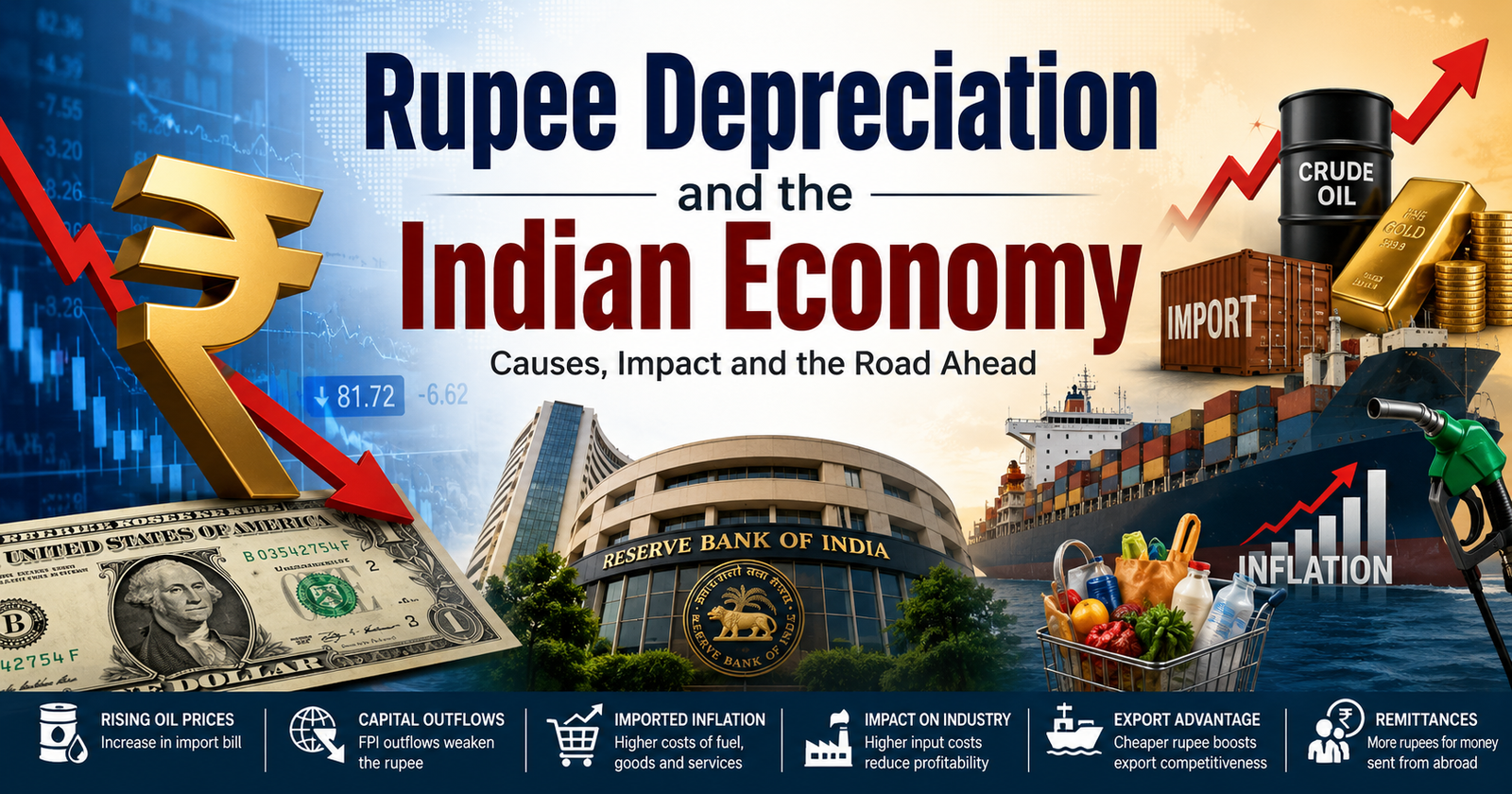
Explore the causes, impacts and policy responses related to Rupee depreciation in India, including inflation, exports, foreign investment, crude oil imports and economic stability in a changing global economy
Syllabus Areas:GS III - Economy |
The depreciation of the Indian Rupee against the US Dollar has become an important economic issue in recent years. Exchange rate movements significantly influence inflation, trade, investment, fiscal stability and the daily lives of citizens. Since India depends heavily on imports such as crude oil, electronics and industrial machinery, fluctuations in the value of the Rupee directly affect the economy.
Rupee depreciation refers to a decline in the value of the Indian currency relative to foreign currencies, especially the US Dollar. For example, if the exchange rate changes from ₹80 per Dollar to ₹85 per Dollar, the Rupee is said to have depreciated. This means more Rupees are required to purchase one Dollar.
The weakening of the Rupee is influenced by both domestic and global factors, and its effects are felt across various sectors of the economy.
Causes of Rupee Depreciation
1. Rising Crude Oil Prices
India imports nearly 85% of its crude oil requirements. Since oil imports are paid for in US Dollars, an increase in global crude oil prices raises the demand for Dollars. As demand for Dollars increases, the value of the Rupee declines.
Higher oil prices also increase transportation and production costs, contributing to inflation within the economy.
2. Strengthening of the US Dollar
The US Dollar has strengthened globally due to higher interest rates in the United States. When the US Federal Reserve raises interest rates:
-
Global investors shift investments towards US assets
-
Capital flows out of emerging economies like India
-
Demand for Dollars rises globally
This puts pressure on emerging market currencies, including the Indian Rupee.
3. Current Account Deficit (CAD)
The Current Account Deficit occurs when a country imports more goods and services than it exports. India imports large quantities of:
-
Crude oil
-
Gold
-
Electronics
-
Machinery
A high import bill increases the demand for foreign currency and weakens the Rupee.
4. Foreign Portfolio Investor (FPI) Outflows
Foreign investors play a major role in Indian financial markets. During periods of uncertainty, investors often withdraw money from emerging markets and move towards safer investments.
When FPIs sell Indian assets:
-
Rupees are converted into Dollars
-
Demand for Dollars increases
-
Rupee depreciates
Global instability and economic uncertainty frequently trigger such capital outflows.
Impact of Rupee Depreciation
Rupee depreciation has both negative and positive consequences for the Indian economy.
Negative Impacts
1. Imported Inflation
One of the most immediate effects of Rupee depreciation is imported inflation. Since imported goods become more expensive:
-
Fuel prices rise
-
Fertilizer costs increase
-
Prices of electronic goods go up
Higher fuel prices increase transportation costs, which eventually raise the prices of essential commodities. This directly affects household budgets and reduces purchasing power.
2. Pressure on Government Finances
A weaker Rupee increases the government’s subsidy burden on:
-
LPG
-
Fertilizers
-
Food imports
As expenditure rises, fiscal deficit pressures may increase. A higher fiscal deficit can affect long-term economic stability and increase borrowing requirements.
3. Industrial and Manufacturing Challenges
Several Indian industries depend on imported raw materials and intermediate goods. Sectors such as:
-
Electronics
-
Automobile manufacturing
-
Aviation
-
Pharmaceuticals
face higher production costs when the Rupee weakens.
This may reduce profitability and increase prices for consumers.
4. External Debt Burden
Indian companies and institutions that have borrowed in foreign currencies must repay loans in Dollars or other foreign currencies.
When the Rupee depreciates:
-
Repayment becomes more expensive in Rupee terms
-
Debt servicing costs increase
This creates pressure on corporate finances and can affect investment activity.
5. Impact on Students and Travellers
Rupee depreciation increases the cost of:
-
Foreign education
-
International travel
-
Overseas medical treatment
Families sending students abroad face higher tuition and living expenses due to the weaker Rupee.
Positive Impacts
1. Export Competitiveness
A weaker Rupee makes Indian goods cheaper in international markets. This benefits export-oriented sectors such as:
-
Information Technology
-
Textiles
-
Pharmaceuticals
-
Agricultural products
Higher exports can improve foreign exchange earnings and support economic growth.
2. Increase in Remittances
India is one of the world’s largest recipients of remittances from overseas workers. When the Rupee depreciates:
-
Families receiving foreign remittances get more Rupees for each Dollar sent
This benefits many households, especially in states dependent on overseas employment.
3. Tourism Benefits
A weaker Rupee makes India a cheaper destination for foreign tourists. This can help:
-
Tourism sector growth
-
Employment generation
-
Foreign exchange earnings
Role of the Reserve Bank of India (RBI)
India follows a managed floating exchange rate system where the market determines the value of the Rupee, but the RBI intervenes when excessive volatility occurs.
1. Forex Market Intervention
The RBI stabilizes the currency by selling Dollars from its foreign exchange reserves. This increases Dollar supply in the market and reduces pressure on the Rupee.
2. Monetary Policy Measures
Interest rate decisions influence:
-
Inflation
-
Capital inflows
-
Investor confidence
Higher interest rates can attract foreign investments and help support the currency.
Importance of Foreign Exchange Reserves
Foreign exchange reserves are crucial for economic stability. They help:
-
Finance imports
-
Stabilize currency markets
-
Improve investor confidence
-
Protect against external shocks
India’s strong forex reserves provide an important buffer during periods of global uncertainty.
Long-Term Structural Challenges
The recurring pressure on the Rupee reflects deeper structural issues in the Indian economy.
Major Challenges
-
Heavy dependence on crude oil imports
-
Persistent trade deficits
-
Dependence on foreign capital
-
Limited high-value manufacturing exports
Addressing these structural weaknesses is essential for long-term currency stability.
Measures Needed for Stability
1. Strengthening Domestic Manufacturing
Initiatives such as:
-
Make in India
-
Production Linked Incentive (PLI) schemes
should focus on reducing import dependence and improving industrial competitiveness.
2. Promoting Export Diversification
India must expand exports in:
-
Electronics
-
Green technologies
-
Advanced manufacturing
-
Semiconductor production
A diversified export base improves foreign exchange earnings.
3. Energy Security
Reducing dependence on imported crude oil is critical. Expansion of:
-
Renewable energy
-
Electric mobility
-
Green hydrogen
can improve long-term economic resilience.
Rupee depreciation is a complex economic issue influenced by global financial conditions, trade imbalances, oil prices and capital flows. While it creates inflationary pressures and increases import costs, it can also improve export competitiveness and foreign exchange earnings.
The long-term solution lies not in temporary market interventions alone, but in strengthening India’s economic fundamentals through manufacturing growth, export diversification, energy security and prudent fiscal management.
Ultimately, the stability of the Rupee depends on the strength, productivity and resilience of the Indian economy itself.