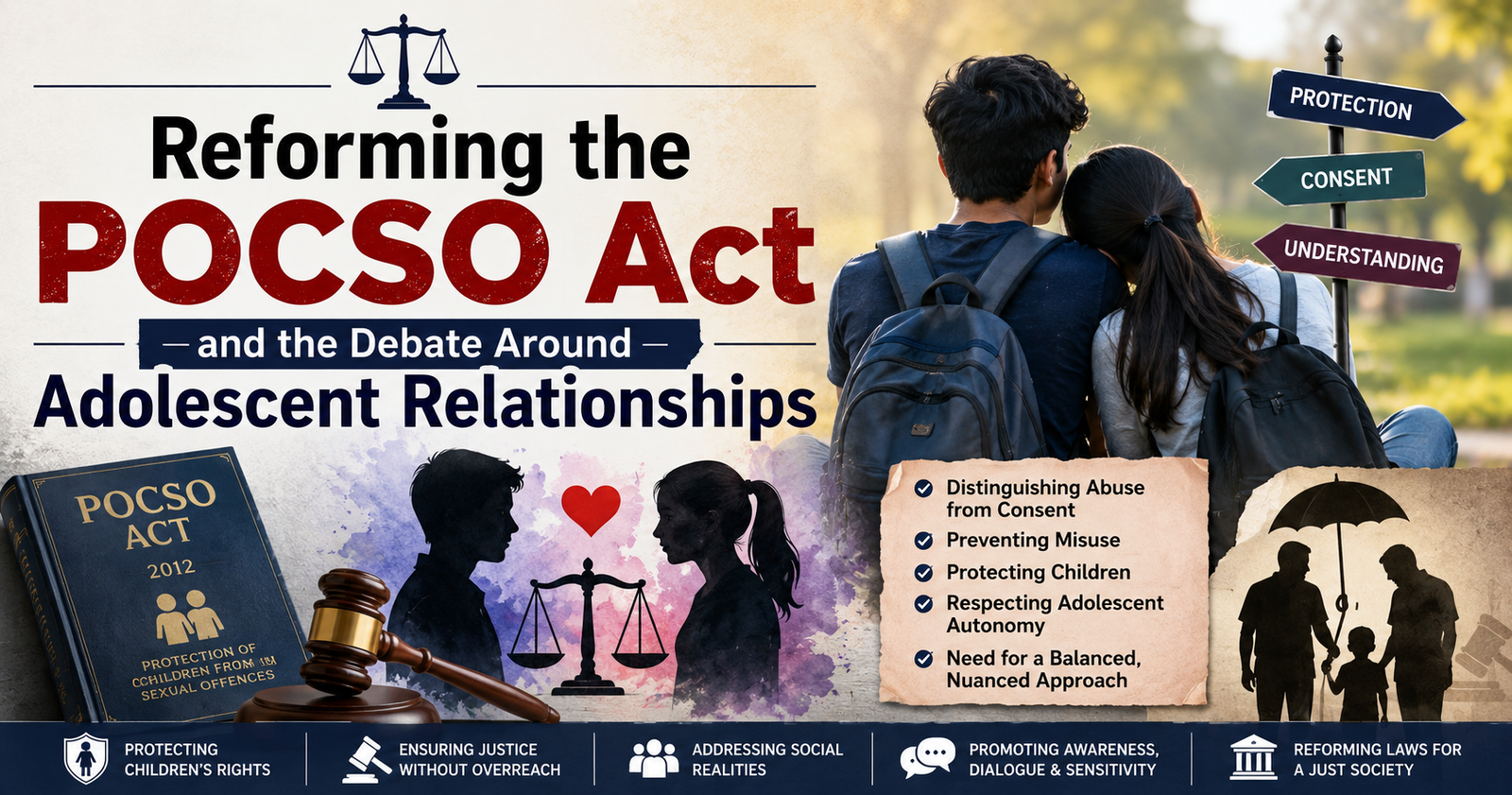
The article examines the debate around reforming the POCSO Act, balancing child protection with concerns over criminalising consensual adolescent relationships, judicial burden, and evolving social realities in India.
Syllabus Areas:GS II - Polity and Governance |
The Protection of Children from Sexual Offences (POCSO) Act was enacted in 2012 to provide strong legal protection to children against sexual abuse, harassment, exploitation, and pornography. The law was designed with the objective of safeguarding minors from sexual crimes and ensuring speedy justice through special courts.
However, over the years, an important debate has emerged regarding the application of the POCSO Act in cases involving consensual adolescent relationships. Courts, legal experts, child rights activists, and policymakers have increasingly observed that the law often treats consensual teenage relationships in the same manner as serious sexual abuse cases.
Understanding the POCSO Act
The POCSO Act defines any individual below the age of 18 as a child. Under the law:
-
Any sexual activity involving a person below 18 years is treated as an offence.
-
Consent of the minor is legally irrelevant.
-
Even if both individuals are adolescents and the relationship is consensual, the law may still classify it as a criminal offence.
The law was framed this way to ensure maximum protection for children from exploitation and coercion.
The Act includes:
-
Protection from sexual assault
-
Protection from aggravated sexual assault
-
Protection from sexual harassment
-
Protection from child pornography
-
Child-friendly judicial procedures
The legislation is considered one of India’s strongest child protection laws.
The Core Debate: Consensual Adolescent Relationships
The major issue raised in recent years is that the law does not clearly distinguish between:
-
Genuine sexual abuse and exploitation
-
Consensual romantic relationships between adolescents
As a result, many teenage relationships are entering the criminal justice system.
For example:
-
A 17-year-old girl and a 19-year-old boy in a consensual relationship may face criminal proceedings under POCSO.
-
In many cases, complaints are filed by parents who disapprove of the relationship.
-
The accused may face arrest, imprisonment, and social stigma even when no coercion or abuse exists.
Why This Issue is Becoming More Important
1. Rising Number of POCSO Cases Involving Consensual Relationships
Several court observations and legal studies indicate that a large proportion of POCSO cases now involve consensual adolescent relationships rather than violent sexual crimes.
This creates pressure on:
-
Police
-
Courts
-
Child welfare systems
As a result, resources meant for serious abuse cases may get diverted.
2. Adolescence is a Phase of Emotional and Social Development
Teenage years involve:
-
Emotional curiosity
-
Formation of personal identity
-
Attraction and relationships
-
Psychological development
Treating all such cases as criminal offences may ignore the realities of social and emotional development among teenagers.
3. Social and Family Factors Play a Major Role
In many instances, parents use POCSO provisions after discovering relationships they socially or culturally disapprove of.
This is particularly visible in:
-
Inter-caste relationships
-
Inter-religious relationships
-
Relationships involving economic or social inequalities
Thus, the law may sometimes become a tool for enforcing social control rather than protecting children from exploitation.
Concerns Associated with Criminalising Consensual Relationships
1. Psychological Trauma for Adolescents
When consensual teenage relationships become criminal cases:
-
Adolescents may face police interrogation.
-
They may experience social humiliation.
-
Educational opportunities may get disrupted.
-
Mental health issues may emerge.
Young individuals may carry long-term emotional trauma due to criminal proceedings.
2. Overburdening the Judicial System
Indian courts are already dealing with massive case backlogs.
When consensual adolescent relationship cases enter the system:
-
Judicial resources get stretched.
-
Serious abuse cases may face delays.
-
Investigation agencies become overburdened.
Several judges have observed that courts need a more nuanced approach.
3. Possibility of Misuse
The editorial points out that the strict nature of the law sometimes allows misuse.
In certain situations:
-
Families may use legal provisions to oppose relationships.
-
False allegations may arise after family disputes.
-
Social honour considerations may influence legal complaints.
This complicates the implementation of child protection laws.
Why Reforming the Law is Difficult
Despite these concerns, reforming POCSO is extremely sensitive because child protection remains a serious issue in India.
India continues to face:
-
Child sexual abuse
-
Human trafficking
-
Exploitation of minors
-
Online abuse and grooming
Any weakening of legal safeguards could potentially expose children to greater risks.
Therefore, policymakers must maintain a balance between:
-
Protecting children from exploitation
-
Avoiding criminalisation of consensual adolescent behaviour
This balance is the central challenge highlighted in the editorial.
Suggestions Emerging from Legal and Policy Discussions
The article discusses several approaches being debated in legal circles.
1. Introducing a “Close-in-Age” Exception
Some experts suggest introducing limited exceptions where:
-
Both individuals are adolescents or close in age.
-
The relationship is clearly consensual.
-
No coercion or exploitation exists.
Many countries already have such legal provisions.
This could prevent unnecessary criminalisation while still protecting minors from abuse.
2. Differentiating Between Exploitation and Consent
Courts may require clearer legal standards to distinguish:
-
Predatory behaviour
-
Genuine adolescent relationships
This would help ensure proportional justice.
3. Greater Judicial Discretion
Some legal experts argue that judges should have more flexibility in handling adolescent relationship cases instead of mandatory harsh treatment under all circumstances.
4. Strengthening Sex Education and Awareness
The editorial also indirectly highlights the need for:
-
Comprehensive sex education
-
Awareness regarding consent
-
Adolescent counselling
-
Mental health support
Legal punishment alone cannot address complex social realities.
Constitutional and Social Dimensions
The issue also raises important constitutional and ethical questions.
Right to Privacy and Personal Autonomy
The Supreme Court has increasingly recognized:
-
Individual dignity
-
Privacy
-
Personal choice
This creates debates regarding adolescent autonomy and state intervention.
Gender and Social Justice Dimensions
Many adolescent relationship cases disproportionately affect:
-
Young men from marginalized communities
-
Inter-caste couples
-
Economically weaker groups
Therefore, the issue also intersects with:
-
Social inequality
-
Patriarchal control
-
Honour-based social attitudes
Way Forward
The editorial suggests that India needs a balanced and sensitive approach.
The objective should be:
-
Strong protection against child sexual abuse
-
Prevention of exploitation
-
Avoidance of unnecessary criminalisation of consensual adolescent relationships
Reforms should focus on:
-
Legal clarity
-
Judicial sensitivity
-
Child psychology
-
Social realities
-
Gender justice
The POCSO Act remains an essential safeguard for protecting children from sexual crimes. However, changing social realities and increasing court observations have highlighted the need for a more nuanced legal framework regarding consensual adolescent relationships.
The challenge before policymakers is to ensure that child protection laws remain strong while also preventing the criminal justice system from unintentionally harming adolescents involved in consensual relationships. A balanced, sensitive, and rights-based approach will be crucial in addressing this complex issue effectively.