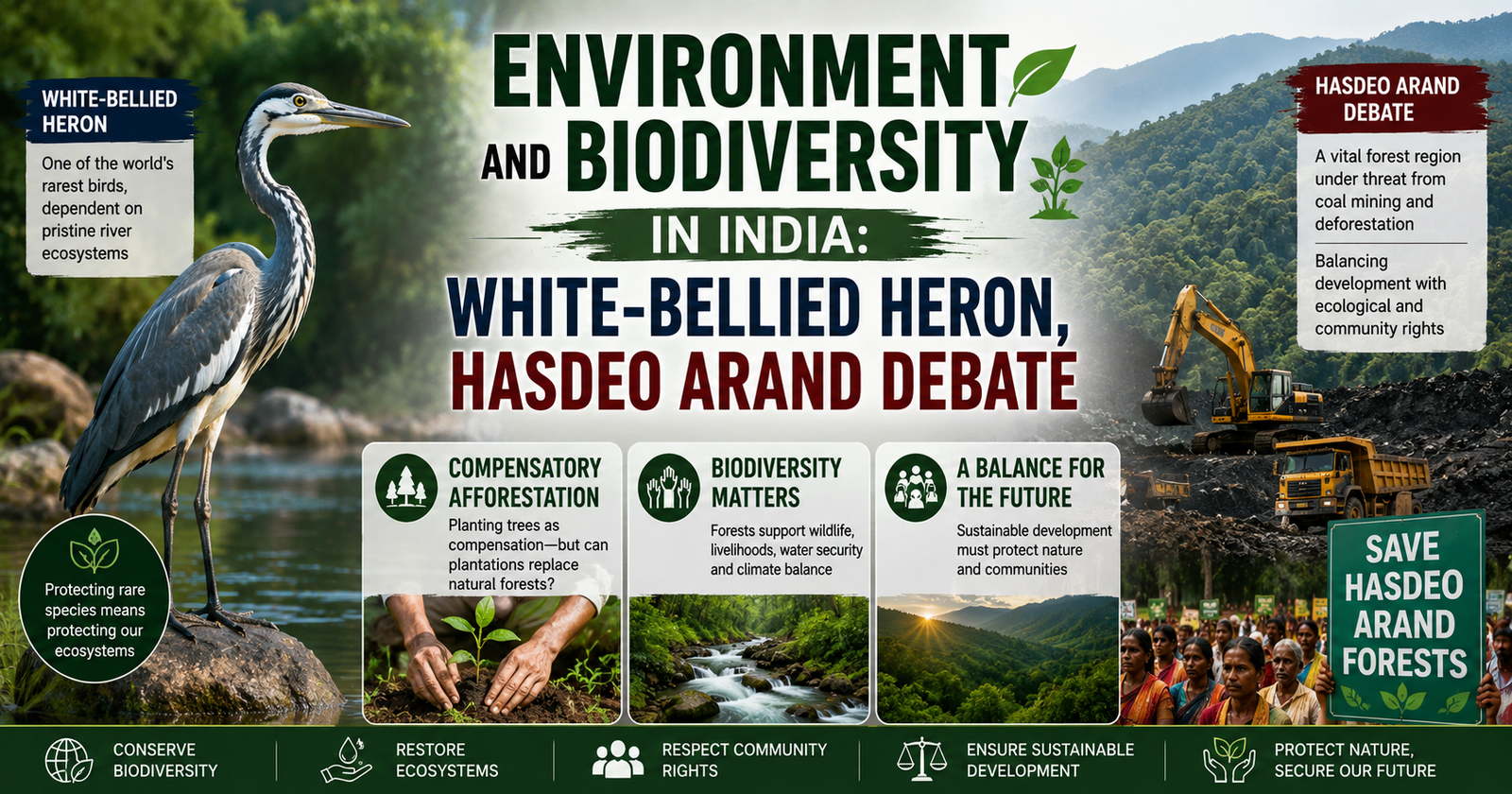
Explore the White-bellied Heron, compensatory afforestation debates and the Hasdeo Arand forest issue, highlighting biodiversity conservation, tribal rights, ecological balance and the challenge of balancing development with sustainability in India.
Syllabus Areas:GS III - Environment and Ecology |
India is one of the most biodiverse countries in the world. From the Himalayas to the Western Ghats, from dense forests to wetlands and river ecosystems, the country supports thousands of plant and animal species. Forests and biodiversity are not only important for wildlife but also for climate regulation, water security, tribal livelihoods and ecological balance.
However, rapid industrialization, mining projects, infrastructure expansion and urban growth have increased pressure on natural ecosystems. In recent years, three important environmental issues have gained attention — the conservation of the White-bellied Heron, debates surrounding compensatory afforestation and concerns related to the Hasdeo Arand forests in Chhattisgarh.
White-bellied Heron: Why is This Rare Bird Important?
The White-bellied Heron is considered one of the rarest birds in the world. It is mainly found in a few parts of India, Bhutan and Myanmar. In India, it is mostly sighted in Arunachal Pradesh near undisturbed river ecosystems and forest regions.
This bird is not just important because it is rare. It is important because it acts as an ecological indicator. The survival of the White-bellied Heron depends on healthy rivers, wetlands and dense forest ecosystems. If such species begin disappearing, it usually indicates that the ecosystem itself is under stress.
The bird prefers isolated riverbanks with minimal human disturbance. However, many of these habitats are now facing pressure due to:
-
Hydropower projects
-
Deforestation
-
River pollution
-
Human encroachment
-
Infrastructure expansion
For example, construction activities near river ecosystems may disturb nesting areas and reduce food availability. Since the population of this bird is already extremely small, even limited ecological disturbance can create serious threats to its survival.
Conservation experts therefore argue that protecting the White-bellied Heron is not only about saving one species. It is about protecting entire river ecosystems and forest habitats that support biodiversity.
The issue also highlights an important environmental lesson: when rare species disappear, it usually reflects larger ecological imbalance.
Compensatory Afforestation: Can New Plantations Replace Forests?
-
One of the most debated environmental issues in India today is compensatory afforestation.
-
When forests are cleared for Mining, Highways, Industries, Dams, Infrastructure projects
-
the law requires agencies to plant trees elsewhere to compensate for forest loss. This process is called compensatory afforestation.
-
At first glance, the idea appears simple and practical. If forests are cut in one place, trees should be planted in another place to maintain ecological balance. Funds collected for this purpose are managed through CAMPA (Compensatory Afforestation Fund Management and Planning Authority).
-
However, environmentalists and ecologists argue that the issue is far more complex.
-
A natural forest is not merely a group of trees. Forest ecosystems develop over hundreds of years and contain Biodiversity, Wildlife habitats, Soil organisms, Water systems, Natural food chains
-
When a dense natural forest is cleared, simply planting trees somewhere else may not recreate the same ecological conditions.
-
For example, a centuries-old forest may support Birds, Insects, Mammals, Medicinal plants, Tribal livelihoods
-
A newly planted artificial plantation may not support the same biodiversity.
-
Another major concern is monoculture plantation. In many afforestation programmes, a single tree species is planted over large areas because it is easier to manage. While this increases tree numbers statistically, it often reduces biodiversity and ecological resilience.
-
There are also concerns regarding the location of afforestation projects. In some cases, plantations are carried out on land traditionally used by tribal and forest-dependent communities. This may affect grazing rights, livelihood activities and traditional land use patterns.
-
As a result, critics argue that compensatory afforestation should focus on ecological restoration rather than merely achieving plantation targets.
Hasdeo Arand Forest: Development Versus Conservation
-
The Hasdeo Arand forests in Chhattisgarh have become one of India’s most discussed environmental conflict zones.
-
Hasdeo Arand is a large contiguous forest region known for:
-
Dense forests
-
Rich biodiversity
-
Elephant corridors
-
Tribal settlements
-
Large coal reserves
-
The controversy mainly revolves around coal mining projects proposed in the region.
-
Supporters of mining argue that coal remains important for:
-
Energy production
-
Industrial growth
-
Employment generation
-
Economic development
-
India’s growing energy demand has increased pressure to expand coal extraction in resource-rich regions such as Hasdeo Arand.
-
However, environmental groups and tribal communities strongly oppose large-scale mining activities in the forest region.
-
The primary concern is ecological destruction. The forests support wildlife habitats and act as an important elephant corridor. Large-scale deforestation may fragment habitats and increase human-animal conflict.
-
Forest loss also affects:
-
Water systems
-
Soil quality
-
Carbon absorption
-
Climate regulation
-
Another major issue is the impact on tribal communities living in the region. Many local communities depend on forests for:
-
Minor forest produce
-
Agriculture
-
Livelihoods
-
Cultural identity
-
Mining projects may lead to displacement and loss of traditional forest rights.
-
Therefore, the Hasdeo Arand issue is not only an environmental issue. It is also connected with Tribal rights, Social justice, Sustainable development
-
The controversy reflects a larger challenge faced by developing countries:
How can economic growth be achieved without causing irreversible ecological damage?
Larger Environmental Concerns in India
-
The issues related to biodiversity and forests are part of broader environmental challenges facing India today.
-
Rapid urbanization, industrial expansion and infrastructure development have increased pressure on:
-
Forest ecosystems
-
Wetlands
-
Wildlife habitats
-
River systems
-
Climate change has further intensified environmental vulnerabilities.
-
Environmental degradation can lead to:
-
Loss of biodiversity
-
Water scarcity
-
Floods and droughts
-
Human-wildlife conflict
-
Decline in ecological stability
-
This is why environmental governance is no longer seen as separate from economic planning. Sustainable development requires balancing ecological protection with developmental needs.
Need for a Balanced Approach
-
India requires a balanced environmental strategy that combines Economic growth, Biodiversity conservation, Tribal welfare, Sustainable resource use
-
Development projects are important for employment and infrastructure, but environmental protection is equally important for long-term ecological security.
-
Important steps include:
-
Scientific environmental assessments
-
Protection of ecologically sensitive regions
-
Community participation in conservation
-
Sustainable mining practices
-
Strengthening biodiversity conservation programmes
-
Environmental policies should focus not only on short-term economic gains but also on long-term ecological sustainability.
The White-bellied Heron, compensatory afforestation debates and the Hasdeo Arand forest issue together highlight the growing environmental challenges facing India. These issues show that biodiversity conservation is not merely about protecting wildlife; it is deeply connected with climate stability, water security, tribal livelihoods and sustainable development. The central challenge before India is finding a balance between development and ecological protection. Forests and biodiversity are not obstacles to growth; they are essential foundations for long-term environmental and economic stability. As environmental pressures continue to rise, India’s future development strategy must ensure that economic progress and ecological sustainability move together rather than in conflict.