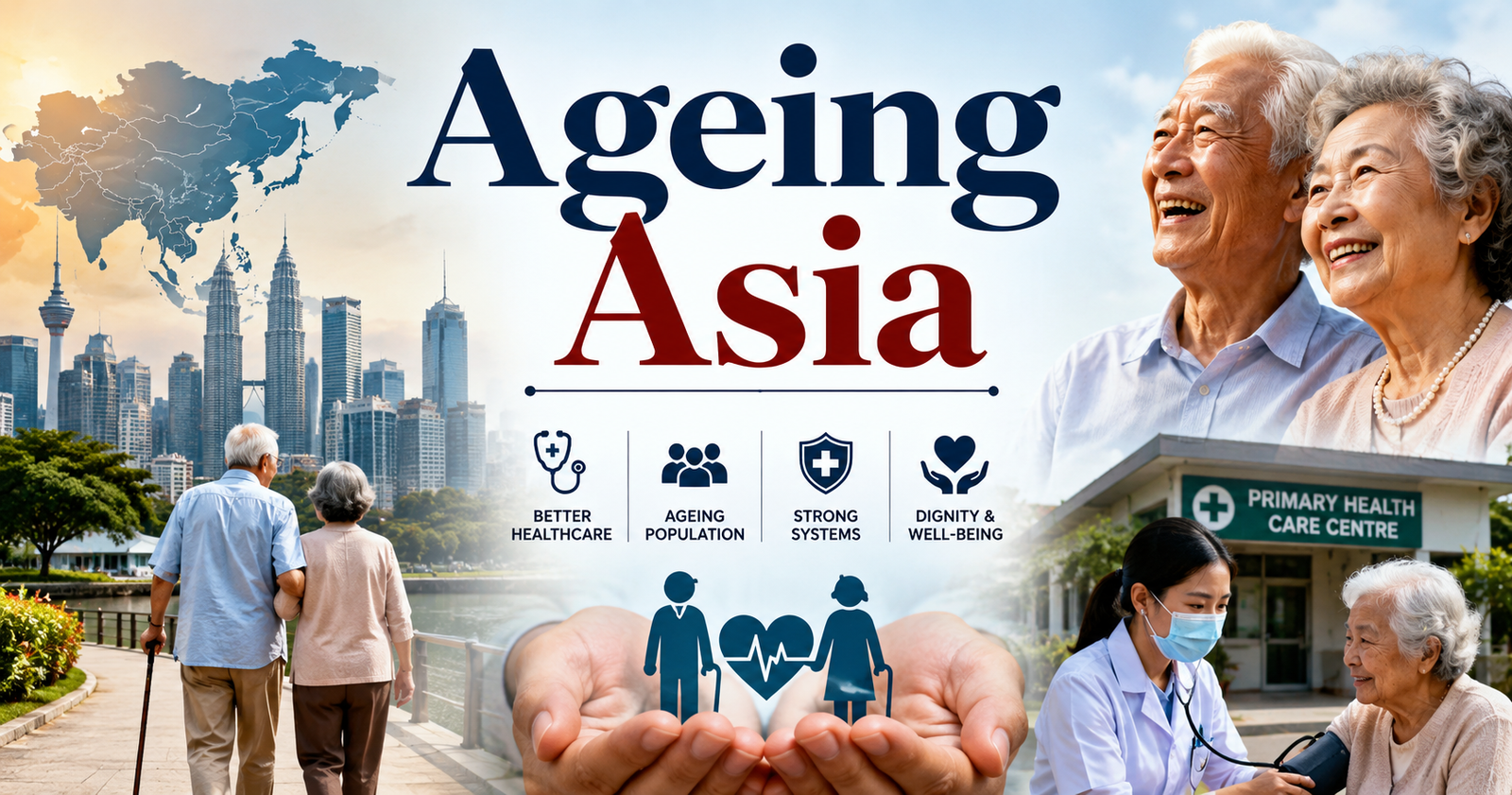
Explore the growing challenge of ageing populations across Asia, the pressure on healthcare systems, and why strong primary healthcare, elderly care, and preventive health policies are becoming increasingly important.
Syllabus Areas:GS II - Governance GS III - Economy |
Asia is currently witnessing one of the fastest demographic transitions in human history. Due to improvements in healthcare facilities, nutrition, sanitation, and medical technology, people are now living longer than before. At the same time, fertility rates are falling in many countries. As a result, the proportion of elderly people in the population is steadily increasing.
This issue is especially important because most Asian countries are still not fully prepared to handle the healthcare and social challenges associated with ageing populations. The editorial highlights that healthcare systems across Asia, including India, continue to depend heavily on hospitals and curative treatment models instead of investing adequately in preventive and primary healthcare systems.
Understanding the Concept of Population Ageing
Population ageing refers to a situation where the share of elderly people in the total population increases over time. Generally, people above the age of 60 are considered elderly for demographic studies.
This demographic change occurs mainly because:
-
People are living longer due to medical advancements and better living conditions.
-
Fertility rates are declining, meaning fewer children are being born.
-
Infant mortality rates have reduced significantly.
Several Asian countries are already facing this challenge very seriously.
Japan
Japan is one of the oldest societies in the world. A large proportion of its population is elderly, which has created pressure on healthcare systems, pension systems, and labour markets.
China
China is experiencing rapid ageing because of declining birth rates and the long-term effects of the former one-child policy. Its working-age population is shrinking, while elderly dependency is increasing.
South Korea and Singapore
These countries are facing extremely low fertility rates, which means their ageing problems may intensify further in the future.
India
India is still considered a relatively young country. However, the ageing transition has already begun. According to several demographic projections, India’s elderly population is expected to rise sharply in the coming decades. By 2050, India may have more than 300 million elderly citizens.
This means India must start preparing now rather than waiting for the problem to become severe.
Why Ageing Populations Create Serious Healthcare Challenges
As people grow older, their healthcare needs become more complex and continuous. Elderly populations generally require:
-
Long-term medical care
-
Regular health monitoring
-
Chronic disease management
-
Mental health support
-
Rehabilitation services
-
Palliative and geriatric care
Unlike younger populations, elderly individuals often suffer from multiple chronic diseases simultaneously.
For example:
-
Diabetes
-
Hypertension
-
Arthritis
-
Heart diseases
-
Dementia
-
Respiratory illnesses
These diseases require continuous treatment and monitoring rather than occasional emergency treatment.
As the elderly population increases, governments must spend more on:
-
Healthcare infrastructure
-
Insurance systems
-
Social security
-
Elderly welfare programs
If healthcare systems are not designed properly, this can create huge financial pressure on both governments and households.
The Major Problem: Hospital-Centric Healthcare Systems
1. Healthcare Becomes Extremely Expensive
Hospital treatment, surgeries, and specialist consultations are very costly. Elderly people often require repeated hospitalization due to chronic illnesses.
This increases:
-
Out-of-pocket expenditure for families
-
Financial burden on governments
-
Insurance costs
In countries where public healthcare systems are weak, families may fall into poverty due to medical expenses.
India already faces this problem because a large proportion of healthcare spending comes directly from citizens rather than the government.
2. Preventive Healthcare Gets Neglected
Most diseases affecting elderly people develop slowly over many years.
For example:
-
High blood pressure develops gradually.
-
Diabetes may remain undetected for years.
-
Heart diseases often show warning signs early.
If regular screening and preventive healthcare are available, these diseases can be identified early and managed effectively.
However, hospital-centric systems usually intervene only after the disease becomes severe. This increases both human suffering and treatment costs.
3. Rural and Poor Populations Remain Excluded
Advanced hospitals are usually located in urban areas. Rural populations often lack:
-
Doctors
-
Diagnostic facilities
-
Medicines
-
Basic healthcare infrastructure
Elderly people in villages may struggle even for simple medical consultations.
This creates serious inequality in healthcare access.
4. Hospitals Become Overcrowded
When primary healthcare systems are weak, even minor illnesses reach large hospitals.
As a result:
-
Tertiary hospitals become overcrowded.
-
Doctors become overburdened.
-
Waiting times increase.
-
Quality of care declines.
Hospitals should ideally focus on specialized and emergency care, while basic healthcare should be handled at the community level.
Importance of Strong Primary Healthcare Systems
Primary healthcare must become the foundation of future healthcare systems in Asia.
Primary healthcare refers to the first level of medical care available to citizens within communities.
It includes:
-
Basic medical consultations
-
Vaccination
-
Disease screening
-
Maternal and child care
-
Preventive healthcare
-
Health awareness
-
Nutrition guidance
-
Community outreach
The World Health Organization has repeatedly stated that strong primary healthcare systems are essential for universal health coverage.
Why Primary Healthcare is More Effective
1. Early Detection of Diseases
Primary healthcare systems help identify diseases at early stages before they become severe.
For example:
-
Blood pressure monitoring can prevent strokes.
-
Early diabetes diagnosis reduces complications.
-
Cancer screening improves survival rates.
Early intervention saves both lives and money.
2. Lower Healthcare Costs
Preventive healthcare is much cheaper than hospitalization.
Treating advanced diseases requires:
-
Expensive medicines
-
ICU care
-
Long hospital stays
-
Specialized surgeries
In contrast, preventive care and early diagnosis are relatively affordable.
3. Better Healthcare Access for Rural Areas
Primary healthcare centres can reach remote populations more effectively.
Village-level health workers and community clinics can provide:
-
Basic treatment
-
Health education
-
Routine monitoring
-
Elderly support services
This reduces regional inequalities in healthcare access.
4. Better Quality of Life for Elderly Citizens
Elderly individuals often need continuous support rather than emergency treatment alone.
Primary healthcare systems can provide:
-
Regular follow-ups
-
Medication management
-
Home-based care
-
Mental health support
This helps elderly citizens live healthier and more dignified lives.
Need for Family Physicians and Community Healthcare
The editorial also stresses the importance of family doctors and community healthcare networks.
Family physicians play a very important role because they:
-
Understand the long-term medical history of patients
-
Provide continuous care
-
Detect illnesses early
-
Reduce unnecessary tests and hospitalization
-
Build trust within communities
Many advanced healthcare systems across Europe and other developed regions rely heavily on family medicine models.
India’s healthcare system, however, has gradually become overly dependent on specialist-driven urban healthcare.
Growing Importance of Geriatric Care
Geriatric care refers to healthcare specifically designed for elderly populations.
Older individuals often face:
-
Reduced mobility
-
Memory-related disorders
-
Loneliness
-
Depression
-
Multiple chronic illnesses
India currently faces serious shortages in:
-
Geriatric specialists
-
Elderly care infrastructure
-
Caregivers
-
Rehabilitation facilities
As India’s elderly population grows, this sector will become increasingly important.
India’s Healthcare Challenge
India faces a dual healthcare burden:
-
Communicable diseases still exist.
-
Non-communicable diseases are rapidly increasing.
At the same time:
-
Public health expenditure remains relatively low.
-
Rural healthcare infrastructure is uneven.
-
Out-of-pocket expenditure remains high.
India has launched several important initiatives such as:
-
Ayushman Bharat
-
Health and Wellness Centres
-
National Programme for Health Care of the Elderly (NPHCE)
However, implementation challenges continue to limit their effectiveness.
Asia’s ageing challenge is not only a medical issue but also an economic and governance challenge. Countries that fail to strengthen preventive and primary healthcare systems today may face severe financial and social crises in the future.
For India, this is a critical moment. The country still has time to prepare before ageing becomes overwhelming. Building strong, affordable, and accessible primary healthcare systems will be essential to ensure healthy ageing, social stability, and sustainable development in the coming decades.